Alternatives to Youth Incarceration: Effective Models and Principles for Success
Many juvenile court jurisdictions operate one or more alternative-to-incarceration programs for youth at risk of being removed from their homes and placed in correctional institutions or other residential facilities. Research shows that, on average, home-based programs yield equal or better recidivism outcomes than incarceration, with far less disruption to young people’s healthy adolescent development, and at a fraction of the cost for taxpayers. However, few alternative-to-incarceration programs have been rigorously evaluated, leaving many programs without the evidence needed to prove their positive impact. Still fewer program models have had their methods and protocols documented carefully for other jurisdictions that might be interested in replicating their approaches.
The six models described here have demonstrated compelling evidence of effectiveness, and all have the backing of energetic organizations dedicated to supporting replication efforts.
- Credible messenger mentoring programs, in which community residents with lived experience in the justice system provide intensive support to youth, typically as part of a multifaceted alternative-to-incarceration intervention.
- Advocate/Mentor programs such as Youth Advocate Programs (YAP), especially when combined with advanced cognitive behavioral therapy.
- Family-focused, multidimensional therapy models, such as Multisystemic Therapy (MST) and Functional Family Therapy (FFT).
- Cognitive behavioral therapy along with mentors for youth and young adults at extreme risk, such as Roca, Inc.
- Diversionary restorative justice interventions targeting youth accused of more serious offenses who might otherwise be placed in facilities.
- Wraparound care for youth with serious emotional disturbances, such as Wraparound Milwaukee.
Credible Messenger Mentoring Programs
Overview: This model employs community residents with a history of involvement in the justice system to provide intensive support and assistance to youth and their families. This approach, typically one part of a comprehensive intervention, aims to help young people avoid reoffending while achieving goals important to their personal development and well-being. Two evaluation studies of programs in New York City that employ credible messengers found that the interventions substantially reduced reoffending rates. While a similar program in Washington, DC, has not been formally evaluated, its outcomes are favorable and have been a key element of the District’s success in dramatically reducing juvenile incarceration in recent years.
Core elements and variations on the model: The term “credible messengers” refers to individuals who live in the neighborhoods where the programs operate (often areas with concentrated poverty and high rates of crime); these individuals share many characteristics with participating youth, including a history of involvement in the justice system. Credible messengers often facilitate group activities aimed at teaching youth cognitive behavioral skills. They also spend considerable time individually with the young people and make themselves available 24/7 to help youth build motivation and achieve their personal goals, and to deal with any crises that may arise. In addition, credible messengers advocate for the young people in court and with school and probation personnel, and provide support and encouragement to the young people’s families.
Clinton Lacey, who developed the two New York City programs as deputy director of the NYC Department of Probation, and who then oversaw the development of the program in Washington, DC, explains that the credible messengers approach (also known as transformative mentoring) is best understood not as a program in itself, but rather as an invaluable extra ingredient – “the glue” – in a comprehensive intervention. In many programs, youth and their families work with the credible messenger to develop an individualized success plan which may include continuing probation or correctional supervision, educational support, employment opportunities and job readiness training, positive youth development programming, substance abuse and mental health treatment, and family counseling. While credible messenger programs share these common ingredients, they may differ in important respects.
- In New York City, the Advocate, Intervene, Mentor (AIM) program works with 13- to 18-year-old youth on probation who score as high risk for reoffense and would otherwise be placed in facilities subsequent to a new felony offense or repeated failures on probation. Once enrolled, a “family team” including the youth, family members, probation officer, and credible messenger develops an individual plan with goals and related action steps for the young person during the 6- to 9-month AIM program period.
- New York City’s Arches Transformative Mentoring program works with 16- to 24-year-olds on probation. Unlike the AIM program, where mentors’ work with youth is mostly one-to-one, Arches is primarily a group program in which participating youth and young adults attend group mentoring sessions facilitated by credible messengers, following a 48-session curriculum that relies on interactive journaling to develop important cognitive behavioral skills. Participants receive stipends to attend the sessions. In addition to helping facilitate the group journaling sessions, credible messengers also meet individually with participants to reinforce the group lessons and heighten young people’s motivation to avoid further offending and pursue positive goals. Typically, participants complete the program in 6 to 12 months.
- In Washington, DC, credible messenger mentors provide group and individual activities for youth committed to the District’s Department of Youth Rehabilitation Services (DYRS), including some youth who are permitted by DYRS to remain at home in a community commitment status (an alternative to incarceration). Unlike the New York City programs, the DYRS Credible Messenger Initiative assigns two mentors for every youth – one to the young person and another to the family – and the mentors also work with the siblings of program participants to prevent their involvement in delinquency. Also unlike the New York City programs, the credible messengers in Washington, DC, have offices and work alongside correctional agency staff, and they participate in the initial case planning process, family team meetings, and virtually all other meetings between youth and DYRS staff.
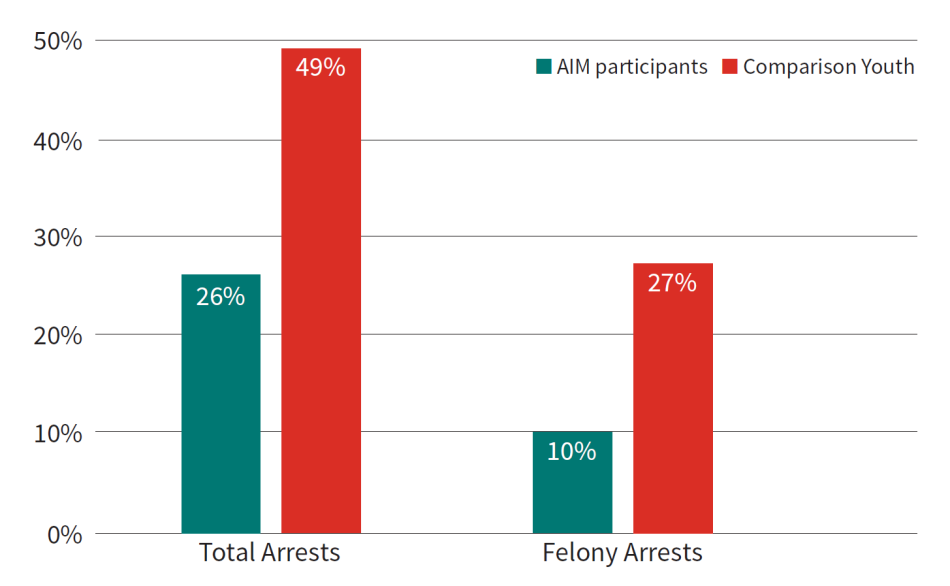
Evidence of effectiveness: An evaluation of New York City’s AIM program found that just 20% of the participants, all of whom would have been incarcerated if not placed into the AIM program, were incarcerated because of a new offense during the program period. In the year after enrolling in AIM, 77% of participants remained arrest-free and just 11% were arrested for a felony. The reoffending rates were far lower for AIM participants than for youth released from facilities before the inception of the AIM program. The evaluation also found that most AIM participants made significant progress on a range of youth well-being measures, and that success was highly correlated with the amount of time youth spent participating in program activities with their credible messenger mentors. An evaluation of New York’s Arches program found that, for the total program population (ages 16 to 24), participants were less than half as likely as a matched comparison group to be convicted of a new felony both 12 months and 24 months after beginning probation. The results were especially strong for younger participants. Compared with youth in a comparison group, Arches participants under age 18 were 68% less likely to be convicted of a new felony within 24 months.
In Washington, DC, the credible mentor program operated by DYRS for youth at home in community commitment status has not been rigorously evaluated. However, a qualitative study by scholars at the John Jay College of Criminal Justice found that, “without exception,” youth involved in the DC Credible Messenger program spoke positively about the impact of credible messenger mentors, reporting that mentors made a difference in their self-confidence, attitudes toward education, coping skills, relationships with their families, feelings about their communities, and attitudes about the future. Parents and other family members also found the credible messengers “extremely helpful.” DYRS data show that the addition of credible messengers improved the system’s outcomes. In the six years before credible messengers were introduced in 2015, the recidivism rate for youth committed to DYRS custody averaged 35.8%; since then (fiscal year 2016 through fiscal year 2021), the recidivism rate averaged 21.5%,even though the share of youth committed for felony offenses increased.
FIGURE 1. NYC’s AIM Program Reduced Recidivism
Results after 12 months
Comparison Youth” were placed in locked facilities prior to the launch of the AIM Program.
Status of and support for replication efforts: In March 2021, Clinton Lacey left DYRS to found a new organization, the Credible Messenger Mentoring Movement (CM3), dedicated to replicating the credible messenger model in jurisdictions throughout the U.S. As of early 2023, the CM3 is supporting credible messenger alternative-to-incarceration program replication efforts in Atlanta, GA; Chicago, IL; Houston, TX; New Orleans, LA; Birmingham, AL; Bridgeport, CT; Columbus, OH; Jackson, MS; Jersey City, NJ; Orlando, FL; and multiple sites in Washington State. CM3 is also supporting credible messenger programs within correctional facilities in Los Angeles County, South Carolina, and Oakland, Calif. A number of other jurisdictions – including Maine, Milwaukee, and San Diego – are also exploring credible messenger mentoring programs for youth in the justice system.
Mentor/Advocate Programs
Overview: Founded in 1975, Youth Advocate Programs, Inc. (YAP) is a Pennsylvania-based nonprofit organization that operates programs to prevent out-of-home placements for nearly 18,000 youth and young adults per year in more than 100 jurisdictions nationwide. Though YAP programs often work with other populations (those in the child welfare/foster care system, youth with disabilities, youth attending public schools in disinvested communities, and youth in other stages of the justice system), some YAP programs are designed as alternatives to incarceration for youth found delinquent in court. While few of those programs have been evaluated rigorously, the available evidence suggests that they are effective in helping youth remain safely in the community. A 2020 study found that a Chicago program combining YAP’s standard program with enhanced cognitive behavioral therapy substantially reduced reoffending rates and improved school attendance and behavior.
Core elements and variations on the model: At the beginning of the YAP process, program staff work together with the young person and their family to develop an individual plan that identifies goals the young person will seek to accomplish during the program period. YAP then assigns a community resident, recruited and trained by YAP to work intensively with each young person and their family, typically for 10 hours per week or more, to provide guidance and encouragement to support the family and help the young person avoid delinquency and achieve their case plan goals. The advocates make themselves available on a 24/7 basis to address any crises, and YAP makes available flexible funds to address any important needs or opportunities that may arise – anything from a new tire for the family car to new sports equipment or art supplies for an afterschool program. Finally, YAP offers subsidized employment opportunities that enable young people to gain work experience and earn extra money to meet basic needs.
In 2015, YAP began working on a new hybrid program in Chicago called
Choose to Change, which combines YAP’s standard model with a series of 16 trauma-informed cognitive behavioral therapy (CBT) sessions delivered by trained therapists employed by Children’s Home & Aid, a community-based social service organization. YAP advocates participate in the CBT sessions and then reinforce the lessons in their regular interactions with participants.
Evidence of effectiveness: In a 2014 study, scholars at the John Jay College of Criminal Justice examined YAP’s impact on over 3,500 adolescents referred from the justice system, of whom 30% had been adjudicated for felonies and 21% had been removed from their homes at least once prior to entering the YAP program. The study found that 86% of these youth were not arrested during their time in the program, and 7% were removed from their homes while participating in YAP. In four Alabama counties where YAP operated alternative-to-incarceration programs, 87% of the 220 youth completing the program from 2011 through 2013 remained arrest-free during the program; just 35% remained under court supervision at the end of the program (whereas 79% had been under court supervision upon entering YAP).
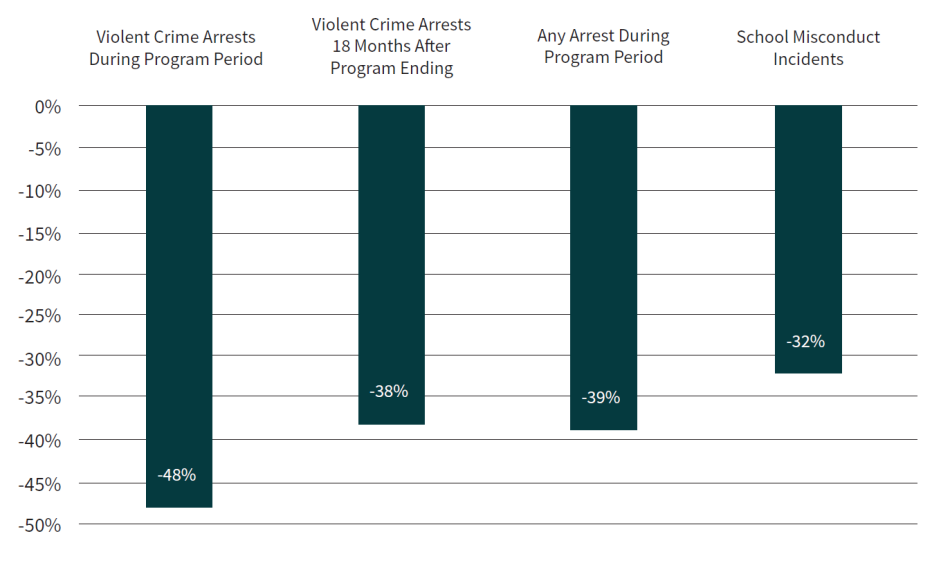
FIGURE 2. YAP Participants Reduced Recidivism, Improved School Outcomes Results
during program vs Control Group
Choose to Change participants receive usual YAP services combined with intensive cognitive behavioral therapy.
More recently, a study evaluated six new YAP alternative-to-incarceration programs serving youth with significant offending histories: roughly half of the youth had previously been adjudicated for a felony offense or faced new felony charges, and in most sites a majority of participants had experienced previous out-of-home placements. Most participants (83%) remained at home at the end of their participation in YAP, and less than 10 percent were adjudicated for a new offense while participating in the program. In addition, YAP increased the share of youth who were on track in school, and the share of youth working in paid jobs, internships, or community service rose by 50 percent.
Finally, a preliminary evaluation found that the Choose to Change program in Chicago reduced violent crime arrests by 48% during the program period, and most of this difference persisted in the 18 months after discharge from the program. The study, which involved random assignment (the gold standard for this type of research), also found that participants were one-third less likely than a control group to suffer any arrest two-and-a-half years after leaving the program. After beginning the program, participants attended more school days than control group youth did, and they were less likely to be cited for misconduct at school.
Status of and support for replication efforts: Nearly 40 years after its founding, YAP continues to vigorously promote its model and work to expand the program’s reach. This includes a continuing commitment to support local YAP programs that serve as alternatives to both pre-trial detention and long-term placement following adjudication. YAP programs that serve as alternatives to long-term custody now operate in over 100 sites nationwide.
Evidence-Based, Family-Focused, Multidimensional Therapy Models
Overview: In family-focused therapy models such as Multisystemic Therapy (MST) and Functional Family Therapy (FFT), as well as several other models that are less widely replicated, therapists work closely with the family and strive to identify and address the multitude of factors that propel the young person toward delinquent conduct. Both MST and FFT have been found to be highly effective in many evaluation studies, and both are used by dozens of jurisdictions across the nation as an alternative to placement in facilities for youth with significant offending histories.
Core elements and variations on the models: In MST, specially trained therapists typically meet with youth and their families at their homes, or in the community, and maintain frequent contact as they seek to identify problems in the family, peer group, school, and neighborhood that might be causing behavior problems. To address the identified problems, MST therapists work with the youth and family to develop and test individualized intervention strategies to promote the young person’s success. MST involves family members closely in all interventions and seeks to help build the family’s motivation and capacity to support the young person’s success. Treatment is usually completed in three to five months. By contrast, FFT is typically delivered in an office setting, supplemented by home visits, with the young person and at least one parent or guardian, usually in 12–16 sessions over three or four months. The therapy process involves five phases: engagement, motivation, relational assessment, behavior change, and finally, generalization to sustain progress and forge connections with helpful resources in the community.
Evidence of effectiveness: FFT has been evaluated in 75 research studies dating back to 1973, many of which show that it produced far lower recidivism than probation or other justice system interventions. MST has been the subject of 96 evaluation studies, including 19 studies measuring MST’s effectiveness for court-involved youth with serious offenses and 19 more for youth with serious conduct problems. The studies found that MST programs for youth with serious offenses reduced long-term rearrest rates by 42% on average, compared with probation, residential confinement, and other alternatives. Across outcomes studies of MST with all high-risk youth populations (including youth with mental health conditions, youth who were victims of neglect and abuse, and youth involved in sexual offenses), studies found that MST reduced out-of-home placements by 54%.
Some have challenged the research on MST and FFT by noting that, in many studies, the programs under study were supervised by the models’ developers rather than by state and local agencies or community providers in typical real-world conditions, and that many studies were conducted by the scholars associated with the model’s development and replication. However, several organizations have identified both FFT and MST as evidence-based interventions. For instance, FFT and MST (as well as a specialized version of MST focused on youth with problematic sexual behavior[s]) are among the only juvenile justice interventions to meet the exacting standards required to be named as a model program under the University of Colorado’s highly regarded Blueprints for Healthy Youth Development initiative.
Status of and support for replication efforts: Both FFT and MST have dedicated organizations working to support replication efforts throughout the US and around the world. FFT LLC employs several dozen trainers to support FFT replication efforts, and it reports that FFT programs currently operate in 45 states and 10 foreign countries, with 310 treatment teams serving 40,000 youth per year. MST Services employs more than three dozen trainers and other staff members, and it lists nearly 600 program sites worldwide operating in more than 35 states and 16 other nations. Both organizations offer training, support, quality assurance, and coaching for local entities seeking to develop new programs and to ensure that the therapies are replicated with fidelity to the original models.
Roca, Inc. – Cognitive Behavioral Therapy and Mentors for Youth and Young Adults at Extreme Risk
Overview: Unlike the other models highlighted here, Roca, Inc. (Roca) does not primarily serve youth referred from the justice system as part of the court process. Rather, Roca intervenes on its own initiative in the lives of youth living in violence-torn neighborhoods who are at extreme risk for future incarceration. Through a four-phase intervention that can last up to four years, Roca youth workers go into the community and engage participants, train them using Roca’s tailored cognitive behavioral therapy treatment model, and connect them with education, employment, and other relevant services. Available data and evaluation research show that, through this unique model, Roca is successfully engaging youth and young adults at the center of urban violence, many of them gang-involved, and substantially reducing their likelihood of arrest and incarceration.
Core elements of the model: Roca operates programs for young men in five Massachusetts locations and in Baltimore. The programs target 16- to 24-year-olds who have a history of arrest, incarceration, violent behavior, gang involvement, or disconnection from education and work and who, in Roca’s words, are “not ready, willing, or able to participate” in more traditional programs or services. Roca also operates programs for young mothers in several Massachusetts locations and in Hartford, CT. Roca operates its programs with a mix of public and private funding, and participation in the program is voluntary, not mandated. Participants are referred from a wide variety of partner organizations including police, probation, corrections, and other public agencies, or through Roca’s own street outreach.
The first of the four phases in the Roca model, “Building Trust,” involves what the organization calls “relentless outreach” by trained youth workers to engage the identified young people in their homes and communities – continually knocking on the young people’s doors, and those of their friends and families, until the youth agree to participate. The second phase, “Behavior Change,” focuses on teaching cognitive behavioral therapy skills using Rewire CBT, a curriculum specially designed by Roca and Massachusetts General Hospital, which can be taught individually, on an ad hoc basis, rather than in scheduled group lessons (as is done in most CBT programs). Roca youth workers also mentor participants and connect them to education, workforce readiness training, and subsidized work in Roca’s transitional employment program.
A final noteworthy element of Roca’s model is the unusual financing mechanism – “social impact bonds” – used to support Roca programs in Massachusetts. In this “Pay for Success” initiative, private investors have contributed money to support Roca’s program costs, and the state has agreed first to have criminal justice agencies refer high-risk participants to Roca and second to reimburse Roca and its investors based on the program’s success in reducing participants’ incarceration rates. Specifically, the state agreed to refer 1,300 youth to Roca for the period from 2014 to 2023, and to pay Roca up to $32 million based on the savings achieved by reducing the time participants spend in correctional facilities, which cost $55,000 per individual per year.
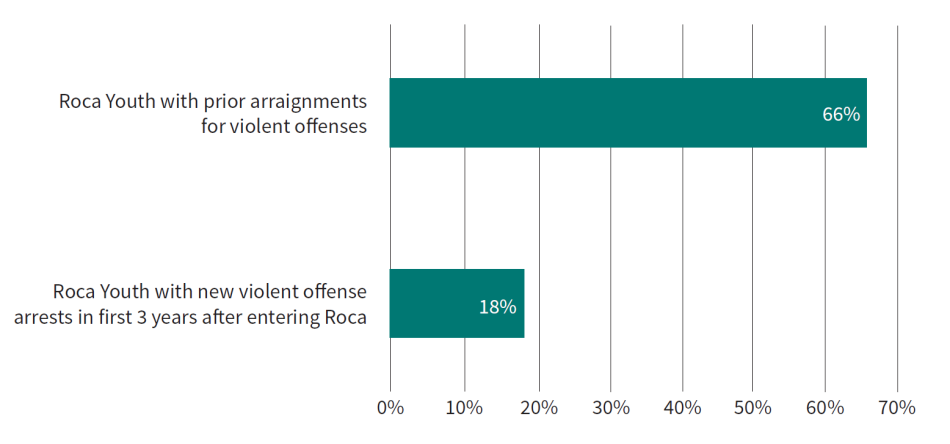
Evidence of effectiveness: In Massachusetts, 80% of the young men participating in Roca’s programs from 2018 to 2020 had been arrested for felonies. Most had been incarcerated, and half or more were involved in gangs or selling drugs. Yet just 29% of these young men were incarcerated within three years of beginning Roca – a rate far lower than the three-year reincarceration rates for similar young adults released from the state’s jails (52%) and prisons (56%). Also, whereas two-thirds of Massachusetts participants had been arrested for violent offenses before entering the Roca program, fewer than one in five recidivated for a violent offense within three years. In Baltimore, of the 352 young people Roca served in 2022, 98% had a history of prior arrests, but only 28% were arrested during their first two years in the Roca program; and 95% of participants were not incarcerated for a new offense during their first two years.
Status of and support for replication efforts: The Roca Impact Institute, the intensive coaching arm of Roca, provides support to community violence intervention efforts, probation agencies, corrections departments, law enforcement agencies, and community-based organizations across the country. Though the organization’s leadership originally sought to help other jurisdictions replicate Roca’s full intervention model, it found that, in the words of Roca Executive Vice President Jennifer Clammer, who oversees the Impact Institute, supporting full replication “turned out to be very difficult to do from afar.” As a result, the Roca Impact Institute now focuses most of its efforts on teaching personnel in interested sites to master Roca’s Rewire CBT curriculum. The Impact Institute also supports some sites in adapting other elements of the Roca model in ways that suit local circumstances.
FIGURE 3. Roca Gets Results in Massachusetts
Youth Far Less Likely to be Arrested for Violent Offenses After Enrolling
Diversionary Restorative Justice Conferencing
Overview: Restorative justice provides an alternative to traditional court processing that focuses on repairing the harm caused by an offense rather than solely ascertaining guilt and punishing the person responsible. The process typically involves the person(s) harmed and the youth who committed the offense, as well as other important people in the lives of both youth and victim. The process culminates in a conference where the victim and the youth meet, discuss the harm caused by the offense, and then craft a plan for the youth to “make things right” and to support the young person in avoiding subsequent offending and achieving success.
Though most restorative justice programs to date have focused on youth and adults accused of minor offenses, some jurisdictions have employed restorative justice as an alternative to incarceration for youth and young adults accused of serious offenses. Recent studies find that these programs – which divert participants from the court process entirely – can reduce the reoffending rates of youth accused of more serious offenses while keeping them at home, and also enhance victims’ satisfaction with the justice process.
Core elements and variations on the model: Impact Justice, a justice reform organization with offices in Oakland, Calif., and Washington, DC, leads a network of restorative justice conferencing programs across the nation that work with youth involved in felony offenses and high-level misdemeanors that might otherwise result in confinement. Impact Justice’s online toolkit explains that restorative justice conferencing is best suited to cases involving a serious offense where a person has been harmed and where there is no question about who is responsible. (The process is not appropriate in cases where the young person denies responsibility.)
The Impact Justice toolkit describes three stages of the restorative justice conferencing process.
- In the Preparation Stage, program staff reach out and build relationships with the victim(s) and with the young person responsible, as well as their family members, and other people in the young person’s life (caregivers, mentors, supporters) whom the young person wishes to participate in the restorative justice conference. The youth is asked to reflect on the harms caused by the offense and to write a letter of apology to the victim. Staff ask the victim(s) to reflect on the harms caused by the offense, and they also engage family members and other people whom the victim wishes to participate. In a series of meetings that may take several months, the program staff familiarize all participants with the goals of the process that will be followed during the restorative justice conference.
- At the Conference, the young person reads the apology letter aloud, and the victim(s) describes their experience and the harms caused by the offense. The youth responds to the victim(s) and answers questions posed by other conference participants. After other participants offer their perspectives, everyone present works together to craft a restorative plan for the youth to repair the harm caused by the offense, and to identify and secure whatever support the young person needs to succeed and avoid repeating the problematic behaviors.
- In the Plan Completion Stage, program staff outline steps the youth will follow to complete the plan, to ensure that the youth has ongoing support from family and other supporters, and to identify any resources and additional assistance that might be needed. Staff follow up with the youth as necessary, and then convene a closing meeting with the youth and their family and supporters to celebrate the conclusion of the process.
Impact Justice identifies eight core elements that underlie its model: (1) oriented around the person harmed; (2) focused on ending disparities by targeting offenses where arrests disproportionately involve youth of color; (3) structured as a diversion with no formal charges in court; (4) limited to youth whose offenses are serious and would otherwise be charged in court; (5) strengths-based, meaning it is aimed at helping build on young people’s strengths, not fixing what’s wrong with them; (6) rooted in relationships; (7) confidential, so that nothing said in the conference process can be used against youth in court; and (8) community-based, so that the process is overseen by community organizations, rather than the court.
Evidence of effectiveness: While the research is not entirely consistent, most studies find that restorative justice approaches lead to lower reoffending rates than traditional prosecution in court. For instance, a 2016 meta-analysis of restorative conferencing programs for youth and adults found that these programs lead to “a modest but highly cost-effective reduction in repeat offending.” A review of restorative justice research conducted by the United Kingdom’s Ministry of Justice found that restorative justice led to significantly lower reconviction rates than standard court processing.
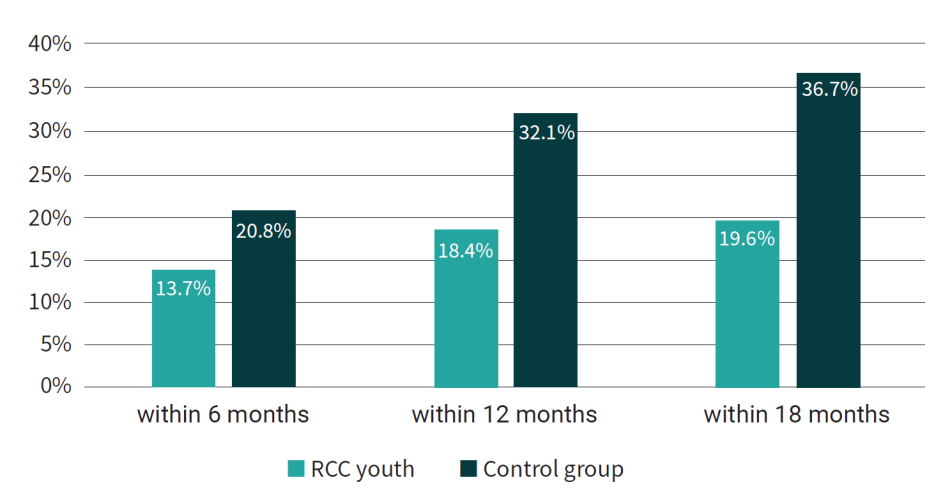
Two recent studies found that restorative justice conferencing programs for youth accused of serious offenses reduced recidivism. A 2017 evaluation of a program operated by Community Works West in Alameda County (Oakland), Calif., found that youth who were diverted from court and participated in restorative conferencing were 47% less likely to be found delinquent within 18 months than a randomly assigned control group who were prosecuted in juvenile court. This program worked with youth accused of serious crimes (62% were accused of felonies) that caused harm to an identifiable victim. More than 90% of victims reported satisfaction with the restorative conferencing process, saying they would participate again and recommend it to a friend, as did the vast majority of participating youth and their parents. A 2021 study of the “Make it Right” restorative conferencing diversion project in San Francisco, which worked with 13- to 17-year-olds accused of felonies such as burglary and assault, found that restorative justice conferencing reduced participants’ rearrest rate by 33% in the year after enrollment, compared to peers in a randomly assigned control group who were prosecuted in court.
Status of and support for replication efforts: Through its national Restorative Justice Project, Impact Justice provides extensive training and assistance to a network of 11 restorative justice diversion programs nationwide as of March 2023. For these sites, and for any other jurisdictions interested in creating new restorative justice diversion programs for youth accused of serious offenses, Impact Justice provides a series of introductory online webinars and an online toolkit. Finally, Impact Justice offers both live and virtual training and access to national and regional meetings, as well as opportunities for stakeholders (community-based organizations, court and probation officials, funders, and others) to exchange ideas with peers across jurisdictions.
FIGURE 4. Diverting Youth to Restorative Justice Works — Even for Serious Offenses
Restorative Community Conferencing (RCC) Program cuts recidivism in Alameda County, CA.
Wraparound Care
Overview: Wraparound programs offer coordinated care for children and adolescents diagnosed with serious emotional disturbances who might otherwise require placement in residential facilities. Though wraparound programs have become increasingly widespread over the past two decades, wraparound’s use for youth facing serious delinquency charges, and who might otherwise be incarcerated, remains limited. However, some jurisdictions do use wraparound widely for youth involved with delinquency courts, and several studies show that these programs can lower offending rates and vastly reduce the use of correctional confinement or other out-of-home placements.
Core elements and variations on the model: Wraparound programs provide integrated and coordinated care for youth with serious emotional disturbances who are at risk of being removed from their homes. The programs are characterized by two core features: (1) they are supported by blended funding arrangements, known as “systems of care,” that combine funds from a variety of public systems (e.g., Medicaid, child welfare, juvenile justice, adolescent mental health, education, and more) to create a vast menu of treatment services and other supports; and (2) they are overseen by care coordinators who work with families to assess needs, create individualized plans tailored to the needs of each young person, and connect children and their families to needed services. As the U.S. Office of Juvenile Justice and Delinquency Prevention has described it, this process “involves ‘wrapping’ a comprehensive array of individualized services and support networks ‘around’ young people in the community, rather than forcing them to enroll in predetermined, inflexible treatment programs.”
In Wisconsin, Wraparound Milwaukee operates a robust program serving more than 1,000 children and adolescents each year, many of whom are involved in the justice system. On an average day in 2014, Wraparound Milwaukee served 425 youth involved in the youth justice system. Wraparound Milwaukee had a total budget in 2020 of $43 million from multiple funding streams; it used those funds to contract with a vast provider network, covering everything from mental health and substance abuse treatment, to camps and afterschool programs, to emergency food and clothing and housing assistance. Wraparound Milwaukee also funds local social services organizations to provide care coordinators who create a child and family team for every young person they serve, and then work with those teams to create individualized service plans and connect youth to relevant services and opportunities.
Evidence of effectiveness: One study found that a wraparound care program in Clark County, WA, reduced participants’ recidivism rates by a third, both for felonies and for all offenses, relative to comparable youth whose cases occurred before the program began. A study in Alabama found that the likelihood of subsequent juvenile justice system involvement fell sharply for court-involved youth served by a wraparound program in Birmingham, but rose slightly for comparable youth in Montgomery who received usual treatment (not wraparound services) in the juvenile court and mental health systems. In the Wraparound Milwaukee program, participants have shown substantial improvements in mental health and school attendance, and fewer placements into foster care or residential treatment programs. As regards reoffending, just 14% of court-involved youth participating in Wraparound Milwaukee from 2012-2014 were rearrested, far lower than the 41% rearrest rate for the youth on juvenile probation who did not participate in wraparound.
Status of and support for replication efforts: In addition to Milwaukee, wraparound programs specifically targeting youth in the juvenile justice system operate in Georgia and in several Illinois counties, among other jurisdictions. In 2013, the federal government’s Centers for Medicare and Medicaid Services and the Substance Abuse and Mental Health Services Administration issued a guidance document formally endorsing states’ use of the wraparound approach to caring for children and youth with serious emotional disturbances, thus helping to accelerate a rapid expansion of wraparound programs throughout the US. A National Wraparound Initiative supports wraparound replication efforts, providing training and workforce development, technical assistance, and evaluation assistance.
Homegrown Alternatives
While the six models described above offer solid evidence of effectiveness and strong readiness for replication, they are not the only – or necessarily the best – approaches for every jurisdiction. Indeed, considerable research finds that homegrown programs which do not follow the specific protocols of any pre-established model may produce equal or better outcomes.
Therefore, in considering which alternative-to-incarceration programming to develop in their jurisdictions, local justice system leaders should convene a stakeholder group to examine the resources available in their communities, brainstorm possible approaches to providing home-based care and supervision for youth at high risk for incarceration, and weigh the merits of homegrown options against the six existing models highlighted in this report.
If they choose to develop a homegrown program, local leaders should recognize that the first key to success lies in heeding the evidence of what works by creating a model that combines several key elements.
- Limit participation to youth at high risk for reoffense who might otherwise be incarcerated.
- Work closely with families to craft and follow individualized plans tailored to the interests, needs, and circumstances of the youth being served.
- Include intensive mentoring, ideally with credible messengers who come from similar backgrounds and reside in neighborhoods where many court-involved youth live.
- Offer evidence-based cognitive behavioral therapy to help youth develop thinking skills necessary to avoid further delinquency.
- Connect youth with employment or other positive youth development activities, plus any needed mental health care, substance abuse treatment, family counseling, and other indicated services.
Finally, in order to succeed, alternative-to-incarceration programs must have strong leadership, and they must hire and adequately train highly motivated staff.