
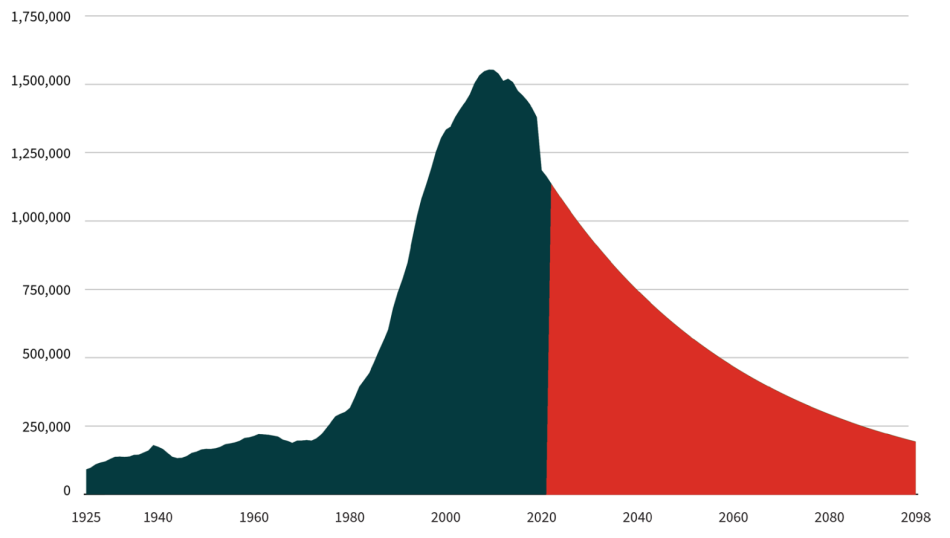

Source of historical figures: Bureau of Justice Statistics. (1982). Prisoners 1925-81; Bureau of Justice Statistics Corrections Statistical Analysis Tool; Carson, E.A. (2022). Prisoners in 2021-Statistical tables. Bureau of Justice Statistics.
Past reforms have helped to reduce the number of people imprisoned for a drug offense by 46% between peak year 2007 and 2020. The number of people imprisoned for a property offense has declined 46% between peak year 2007 and 2020. But for the majority (56%) of the prison population imprisoned for a violent crime—which generally ranges from robbery and assault to rape and murder—sentencing relief remains elusive. Overall, the number of people imprisoned for a violent offense has declined by only 10% between peak year 2009 and 2020, despite violent crimes falling by 50% between peak year 1991 and 2020. Longer prison terms have prevented this segment of the prison population from contracting amidst a historic crime drop.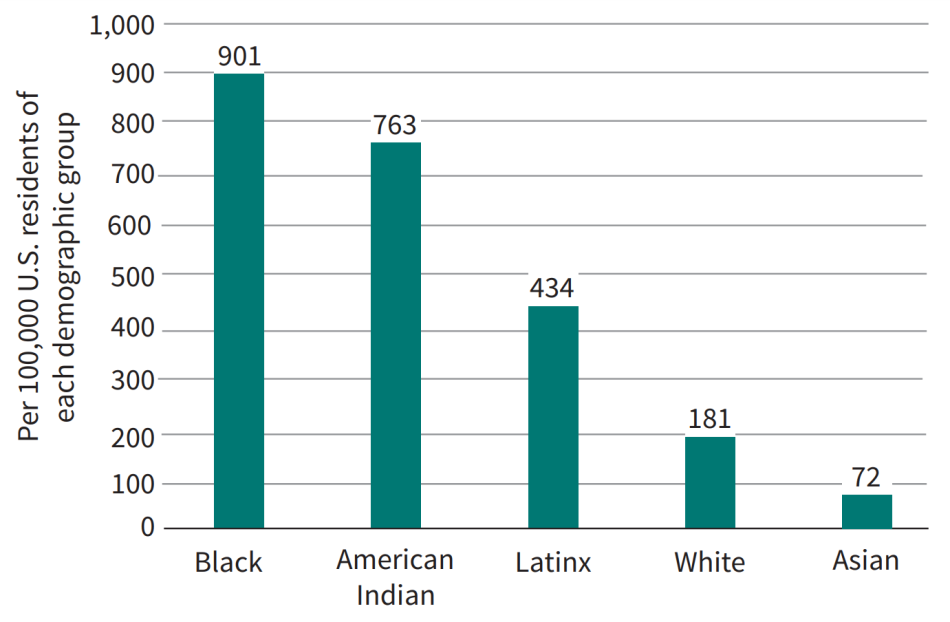
Source: Carson, E. A. (2022). Prisoners in 2021 – Statistical tables. Bureau of Justice Statistics.
These national trends represent both persistent injustices which must be corrected, as well as dramatic progress in the past two decades. While all major racial and ethnic groups experienced decarceration since reaching their peak levels, the Black prison population has downsized the most. Reforms to drug-related law enforcement, charging, and sentencing, especially in urban areas which are disproportionately home to communities of color, have helped to drive decarceration for Black Americans. While the total U.S. prison population has downsized by 25% since reaching its peak level in 2009, the Black prison population has downsized by 39% since its peak in 2002. As shown next, this trend has narrowed, but not eliminated, disparities.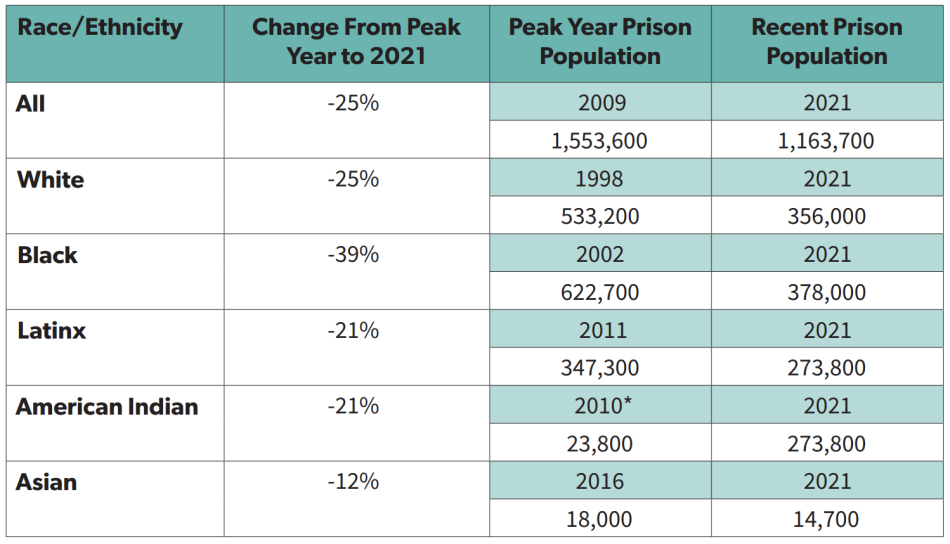
Source: Bureau of Justice Statistics Prisoners Series and Correctional Populations in the United States. *2010 is the oldest year for which comparable data are available for American Indians and may not represent the peak year.
A similar trend can be seen in imprisonment rates, which represent prison populations as a percentage of the total relevant populations. Looking at imprisonment rates by gender reveals that Black women experienced the most dramatic decline in imprisonment—70%—between 2000 and 2021. Still, Black women were imprisoned at 1.6 times the rate of white women in 2021.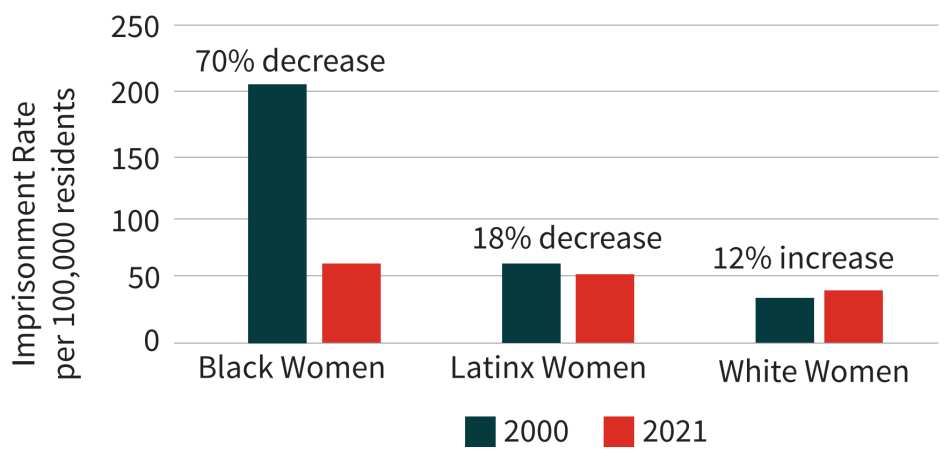
Source: Carson, E. A. (2022). Prisoners in 2021 – Statistical tables. Bureau of Justice Statistics; Beck, A. J., & Harrison, P. M. (2001). Prisoners in 2000. Bureau of Justice Statistics.
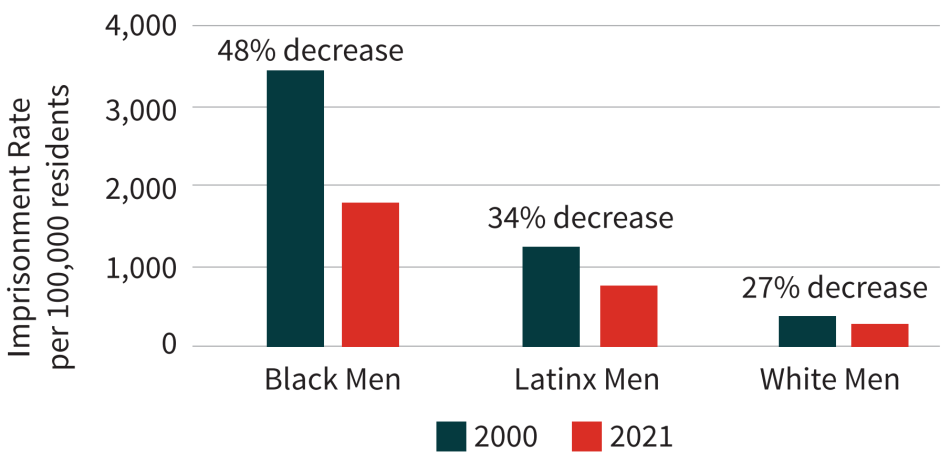
Source: Carson, E. A. (2022). Prisoners in 2021 – Statistical tables. Bureau of Justice Statistics; Beck, A. J., & Harrison, P. M. (2001). Prisoners in 2000. Bureau of Justice Statistics.
The imprisonment rate of Black men also declined substantially, falling by almost half. Still, Black men were imprisoned at 5.5 times the rate of white men in 2021. Decarceration among Latinx men and women also outpaced that of whites, but Latinx women, and even more so men, remain imprisoned at higher rates than whites. Examining the cumulative likelihood of male imprisonment over a lifetime, scholars have highlighted a “generational shift” among Black men. For Black men, the lifetime risk of imprisonment fell from 1 in 3 for those born in 1981 to 1 in 5 for those born in 2001. This 42% reduction outpaced the 29% reduction in lifetime imprisonment for white men and the 17% reduction for Latinx men. “But several factors caution against being overly sanguine,” the researchers warn, notably the persistence of mass incarceration and its disparities. Among those born in 2001, Black men were 4.1 times as likely to be imprisoned within their lifetimes compared to white men, and Latinx men were 2.5 times as likely as white men.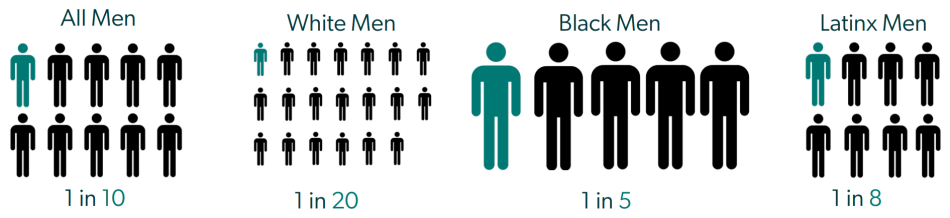
Source: Robey, J., Massoglia, M., & Light, M. (2023). A generational shift: Race and the declining lifetime risk of imprisonment. Demography, Appendix Table A6.
While these promising trends demonstrate the effectiveness of reforms to narrow racial and ethnic disparities in incarceration, far more work is needed to achieve equity.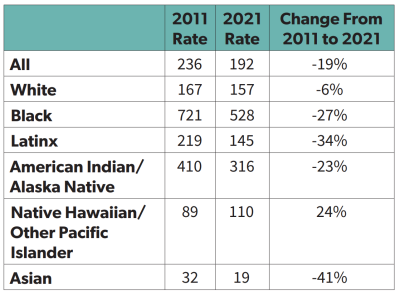
Source: Zeng, Z. (2022). Jail inmates in 2021 – Statistical tables. Bureau of Justice Statistics.
But elevated rates of jail incarceration persist, as do sharp disparities for Black Americans and American Indians compared to whites. This can also be seen best by examining the cumulative lifetime risk of jail incarceration, which is far higher than for prisons since jail incarceration is far more common than imprisonment. A study of New York City, which has dramatically reduced its jail incarceration rate, found that 27% of Black men and 16% of Latinx men, in contrast to only 3% of white men, had been in jail by age 38 in 2017. Excessively high jail incarceration levels nationwide are especially problematic given that three-quarters of people in jails are unconvicted—being detained prior to the resolution of their case—and research shows that diverting many people charged with misdemeanor crimes away from jail sentences improves public safety outcomes.