
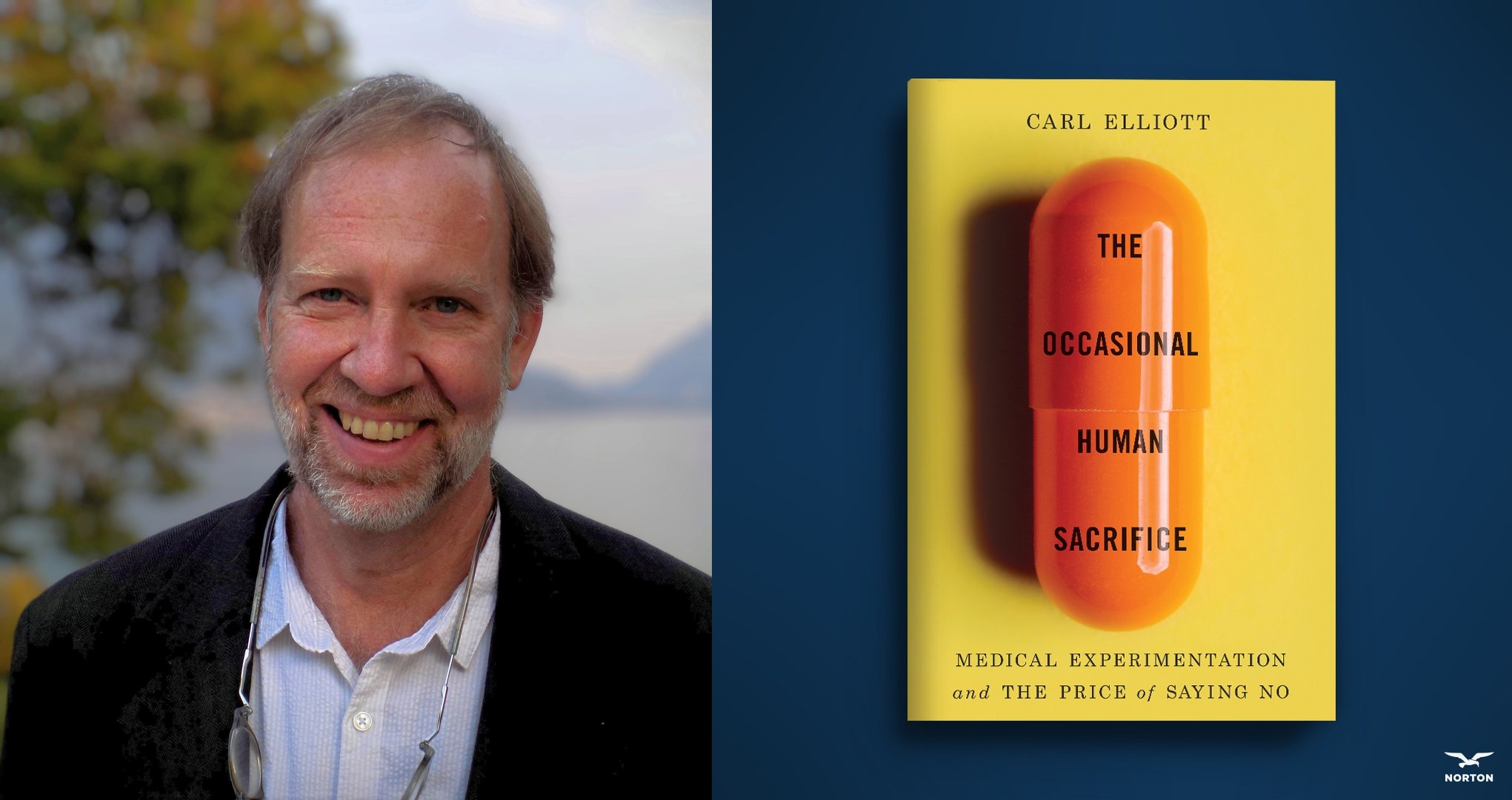
Carl Elliott is a distinguished professor at the University of Minnesota with joint appointments in the Department of Philosophy and the School of Journalism and Mass Communications.
An influential voice in bioethics, Elliott is known for his critical examination of the medical and pharmaceutical industries. His latest book, The Occasional Human Sacrifice: Medical Experimentation and the Price of Saying No, describes the harrowing experiences of whistleblowers who expose corruption and malpractice in clinical trials and psychiatric research.
Originally from South Carolina, Elliott’s diverse academic background includes a medical degree and a PhD in philosophy from Glasgow University in Scotland. His extensive postdoctoral work has taken him to institutions such as the University of Chicago, the University of Otago in New Zealand, and the Nelson Mandela School of Medicine in South Africa. Elliott is the author and editor of several influential books, including Better than Well: American Medicine Meets the American Dream and White Coat and Black Hat: Adventures on the Dark Side of Medicine. His articles have been featured in prestigious publications such as The New Yorker, The Atlantic Monthly, Mother Jones, and The New England Journal of Medicine (as well as Mad in America). Elliott’s critical work in bioethics has earned him numerous accolades, including the Erikson Prize for Excellence in Mental Health Media and a fellowship at the Safra Center for Ethics at Harvard University.
His investigative work has shed light on numerous scandals, including the tragic case of Dan Markingson, a young man who died during a controversial clinical trial at the University of Minnesota. In this interview, Elliott discusses the systemic issues that protect wrongdoers, the personal and professional toll on those who speak out, and the broader implications for ethics in medical research and practice.
The transcript below has been edited for length and clarity. Listen to the audio of the interview here.
Carl Elliott: That story begins in the summer of 2008. I got a message from a friend, a reporter Paul Tosto, who wanted to know what I made of a series about a death in a clinical trial that he and Jeremy Olson had written for the St. Paul Pioneer Press. I read it, and it hit very hard. It was a horrible story.
A young man named Dan Markingson was brought to our university’s teaching hospital in the throes of a psychotic episode. He was delusional and violent, threatening to commit mass murder and to kill his mother. He was seen by the head of the schizophrenia program at the University of Minnesota, judged to be incompetent to consent to take neuroleptic drugs, and involuntarily committed to a locked unit in our hospital. After being seen by a number of clinicians, the judgment that he was not competent to consent and that he was psychotic and dangerous to himself or others was confirmed many times, and he was placed under a civil commitment order.
But in Minnesota, there’s a stay of commitment, which means that you can avoid a locked unit if you agree to abide by the treatment recommendations of your psychiatrist. That was what his psychiatrist recommended: that he be given a stay of commitment as long as he did what was asked of him. Ordinarily, he would have been given standard treatment, but instead, he was asked to sign up for a clinical trial of three antipsychotic drugs. It was sponsored by the drug company AstraZeneca. He signed the consent form.
When his mother found out, she was alarmed and upset. She didn’t want him in a clinical trial. He was violent, threatening to kill her, and in a locked unit. He was under a commitment order, and he had been judged incompetent to consent to take neuroleptic drugs. This was a trial of neuroleptic drugs.
She was told it was his decision, not yours. He’s an adult. He’s staying in the trial. She spent the next four months trying to get him out of the trial. She could see him deteriorating, see his thinking become more grandiose. He stopped showering and became incredibly agitated. She said it was like he was about to explode any minute. All the while, she was trying desperately to get him out of the trial: sending emails, calling the study coordinator, the Department of Psychiatry, and writing letters, but she couldn’t get any satisfactory response.
Eventually, she leaves a desperate voicemail for the study coordinator, saying, “What is it going to take for anybody to do anything about this? Does he have to kill somebody or kill himself?” Three weeks later, that’s what he did. He took a box cutter and slit his own throat, almost decapitating himself, and mutilated his body, which was found in a shower in a halfway house, along with a note that said, “I went through this experience smiling.” That was the story laid out in the St. Paul Pioneer Press.
Part of the reason it hit hard for me is that these were the kinds of things that I worked on, and they were happening at my institution. I had friends in the Department of Psychiatry. I felt a sense of responsibility and shame. I got back to Minnesota and started asking around. Nobody seemed particularly upset or interested in this. I was worried that he might not be the only one. If they were recruiting this subject from a locked ward, how could I be sure that they weren’t recruiting other subjects from a locked ward who were under commitment orders?
Elliott: Depending on who I talked to, it was “Wow, that looks bad, but what can you do?” to just outright dismissal from the administrators. I was essentially told – “Look, you don’t know what happened in this study. You can’t believe what’s written in the newspapers. They obviously had it in for the university. If you actually believe that story, then you’re just incredibly naive. This stuff happens all the time. Part of the business of doing clinical trials is sometimes people die. He was obviously really mentally ill. It’s unfair to blame the psychiatrist or the university.”
It was suggested to me that Dan Markingson’s mother, Mary Weiss, was somehow responsible for his death. I decided to talk to her because she was being portrayed as vindictive and irrational, someone who had a troubled relationship with her son and was trying to blame the university.
I met with her. Her response was completely different from that of the administrators and psychiatrists I talked to. She filed a lawsuit against the University of Minnesota, but a judge dismissed it because the university, as a state institution, is protected by statutory immunity and cannot be sued regardless of the case’s merits.
Then, the university turned around and filed a notice demanding that she pay them $56,000 to cover their costs. On the advice of her lawyers, she had agreed to drop her right to appeal the immunity ruling in exchange for the university agreeing to drop that demand for $56,000.
She said, “Look, you can look at the hospital records, the depositions, anything you want to look at from that litigation. I’ll ask my lawyer to make everything available to you. You can decide for yourself on the merits of the case,” and that’s what I did. She was right, and the university was wrong. They were deceptive and misleading.
Elliott: Whistleblowers have a certain measure of idealism and optimism to them. If you’re totally cynical about the system, you won’t blow the whistle because you expect it’ll do no good. To be a whistleblower, you have to have some faith that when other people know this, they’ll be just as outraged as you are. That outrage will extend to your friends and colleagues who will stand by you, and some regulatory authority in power will leap into action and fix the problem. When they blow the whistle, that doesn’t happen.
The authorities don’t leap into action. Nobody is as outraged as they are. Often, their friends dry up and leave, and their colleagues generally stand with the institution. All this comes as a kind of existential blow—a collapse of your values and worldview.
Physicians essentially lose their professional community and their identity because they are expelled. They’re seen as traitors, like Judas Iscariot. There’s the process of trying to rebuild your identity, both socially and in terms of your values. Part of that comes from my own experience—it took a lot of allies working at the university and a lot of desperate, futile attempts to get some sort of action.
In 2010, I wrote about the case for Mother Jones, hoping that national attention and new information about the sponsor of the study would prompt outrage that would shame the university into taking action and commissioning an external investigation. That didn’t happen. I made myself extremely unpopular in the academic health center and lost friends and colleagues.
But over the next five years, we managed, with the help of a former governor of Minnesota, Arne Carlson, to get two external reviews of the university, the most important of which was by a watchdog agency, the Office of the Legislative Auditor. It confirmed everything I had written and was reported in Pioneer Press. Combined with another review that found real problems with our research oversight system, it seemed we were making progress. You want something to be done! That’s when it felt like a failure because the university did not compensate Mary Weiss. It didn’t apologize publicly. It didn’t sanction the researchers. It did agree to suspend psychiatric drug studies at the university for a period. It seemed like we’d spent all this time working for nothing.
Elliott: To get answers to these questions, I started teaching a class on research scandals. The idea behind the class is if we could study these scandals side by side, we could pick out the patterns. How do they usually turn out? Are there usually whistleblowers? It’s an incredibly depressing course.
Psychiatry is overrepresented in the way specialties are divided up, which should not be surprising to anyone. The demoralizing part is that research institutions never do the right thing when a scandal emerges. I have yet to come across a single case in which a research institution has done the right thing. They stonewall the press, vilify the whistleblowers, steadfastly refuse to apologize. Not only do they not sanction the researchers, but very often, they honor them with awards and prizes. They fight as hard as possible to compensate the victims. This is the pattern that you see again and again.
Overwhelmingly, the subjects of the abuse, the research subjects who’ve been mistreated or deceived, are vulnerable in some way. They’re mentally ill or mentally disabled or children or institutionalized. They’re in prisons. They’re poor and uneducated. In some way, they’re vulnerable to this kind of exploitation.
Whistleblowers are very rare. I picked out six cases for my book, but there are way more scandals out there. In many of them, doctors, nurses, study personnel, administrators, and attorneys had known about these cases for decades and had said nothing. It’s rare that someone speaks out, and when they do, it’s rare that they succeed.
The slight ray of hope is that there is a much higher chance of success when there is some solidarity among the whistleblowers. The other ray of hope is that when you look at the scandals that led to reform, maybe it’s not much, and it’s unsatisfactory, but something was done.
For example, the famous case in America was exposed in 1972, the Tuskegee Syphilis Study, all of the subjects who were deceived, exploited, abused in that case were poor black men. It dovetailed with the civil rights movement of the 60s and 70s. In New Zealand, their ‘unfortunate experiment,’ which was done on women with a precursor of cervical cancer, dovetailed with the women’s movement. The Willowbrook State School scandal, which included infecting institutionalized mentally disabled children with the hepatitis A and B viruses, dovetailed with the disability rights movement.
This is the challenge for those of us who work on psychiatric research abuses. There hasn’t been a case that has intersected with a larger social movement in a way that has resulted in any significant change.
Elliott: What you have to understand about medical training is that when you begin it, you know nothing. Someone who knows nothing and is allowed to be around sick and vulnerable patients can be very dangerous. By necessity, medical training is a hierarchical kind of apprenticeship. It is also (perhaps not necessarily) very authoritarian. It can be very scary to be on the wards and be afraid that you’re going to harm someone by being given too much responsibility and having so little knowledge.
Most people in unfamiliar situations look around and do what other people are doing. That makes it very easy to put aside your initial intuition about these unfamiliar situations—that there is something wrong here, that this is not right—in favor of, “This is the way it’s done, and these people know a lot more than I do.”
The case in the book that really struck me was the Willowbrook State School on Staten Island. This was an unbelievably squalid, filthy, overcrowded institution for mentally disabled children, the largest such institution in the United States. A young internist named Mike Wilkins and a colleague of his, Bill Bronston, began working there in the early 1970s. It was the Vietnam era. They were in the Public Health Service to avoid being sent to Vietnam, so there were very socially conscious left-leaning activist types.
There is a film about it you can see called Willowbrook: The Last Great Disgrace. That footage of that institution is unbelievable and wrenching. I cried when I saw it for the first time—just the worst concentration camp-like conditions. Children with no clothes on, obviously mentally disabled, lying in their own urine on concrete floors. Hours and hours and days and days of nothing to do, no one watching them. It was hellish.
What was remarkable to me is that it took these two outsiders to look at this place and say, “My God, this is a crime scene!” when hundreds of other people had been working there for decades and saw nothing wrong with it. I cannot imagine how anyone can see children in those conditions and say “this is the way it has to be”, and yet that was their response. Mike Wilkins and Bill Bronston aimed to organize the doctors, nurses, and staff to clean this place up. They themselves had no interest in that. It was only when they started sneaking parents back onto the wards that they were able to generate some pushback against the institution.
My question was twofold. One, how is it possible for anybody to work in that place for so long and resist any reform? Two, what was it about these two people who saw things differently?
Elliott: I first met Dr. Abuzzahab when he introduced himself as a clinician in private practice and said, “I was on the faculty at the University of Minnesota for many years. I’m still a clinical faculty member and have a lot of experience in ethics. I was Chair of the Ethics Committee for the State Psychiatric Association. There was some trouble with a research study that I was doing, and I was told that I had to take a class in ethics. I see that you’re teaching one. Would it be okay if I sat in?” I was very naïve back then; I would never say yes to a request like that now. I said, “Sure.”
A few years later, there was a new clinical trial site in the Twin Cities, and I saw Abuzzahab’s name in the list of investigators. I thought, “That’s the guy in my class. I wonder what got him into trouble”. I got a copy of his disciplinary action from the licensing board. There were 46 deaths and injuries in clinical trials—patients under his care, many of them in clinical trials. Some of them were in clinical trials at our own teaching hospital, including a number of suicides. The licensing board suspended his license for a short period of time, made him practice under the supervision of someone else, and ordered him to take an ethics course.
I was stunned. Why would a trial site hire somebody with this kind of record to do trials for them? Google his name, and these red flags will appear. It was in the newspapers. Dateline NBC investigated him. Bob Whitaker had written about him in the Boston Globe, and yet 46 deaths and injuries did not seem to bother this trial site at all.
It turned out they had done no background research on him. All they knew was that he was well connected to the pharmaceutical industry, was on speakers bureaus for many different companies, and had experience conducting many clinical trials. I guess they saw him as a rainmaker and a moneymaker because of his contacts with the pharmaceutical company.
Again, the subjects in those trials were very vulnerable subjects, often with schizophrenia and substance abuse issues. He was basically cycling them in and out of studies, often studies that they weren’t even eligible for, as a way of generating revenue.
Elliott: This is the pattern we’ve seen for decades now, and I don’t see change, at least not for the better, but for some changes for the worse. Conflict of interest rules exist exactly because of the problem that you identify, which is, yes, in the aggregate, ample data is showing that prescribing is influenced in a huge way by ties with industry, by gifts, being on speaker bureaus, and by doing studies for the industry. But there is no way for a single person to determine what’s happening in their head. We know that conflicts of interest affect decisions, so we devise conflict of interest rules to manage those.
For example, judges recuse themselves if they have a financial interest in the result of a court case. If a journalist has a financial interest in something they’re covering, they’re not allowed to cover it. But in medicine, the way that these conflicts are allegedly managed is just by disclosing them. In other words, you can keep taking the money as long as you don’t hide the fact that you’re taking the money. To me, that’s like saying bribery is fine as long as it’s not secret bribery. The fact that it’s in the open helps the situation very little.
Elliott: You are exactly right. The 1990s were the worst era for pharma influence. The drug industry exerted this enormous influence on physicians through gifts, speaking engagements, parties, conference sponsorship, etc. The resistance to this resulted in the creation of an open payments database. You can use it to search for any physician and discover how much money they have been receiving from the pharmaceutical industry. However, this hasn’t improved the situation. It’s almost as if people have come to accept it as the norm: everyone receives money from the pharmaceutical industry.
Elliott: My younger brother, Hal, trained in psychiatry, and this was when he just first began. He had a colleague in his first year of residency at the University of North Carolina Psychiatry Program. He came into the program with amazing credentials: MD, PhD from Harvard, PhD in Neuroscience. He managed to complete 14 months as a resident before it was discovered that he actually had no credentials at all—no MD, no PhD, and hadn’t been to Harvard. It was all a complete fake. He basically faked his way through this residency.
I interviewed several of his fellow residents and faculty members who remember that experience in the early 1990s. One of the threads that ran through their stories was the crazy lies and exaggerations that came out of his mouth. He told someone that he used to work as a filmmaker with Steven Spielberg. He told somebody else that he used to be a place kicker for the Texas Longhorns football team when he was in college. He told stories about visiting the Kennedy compound in Hyannis Port and sailing with the Kennedys.
In a session on neurochemistry, the lecturer asked, “Where should we start? Somebody name a neurotransmitter, Lee. What’s your favorite neurotransmitter?” He just froze, and he couldn’t name a single neurotransmitter. I mean, at a time when everybody in America knew what Serotonin was!
***
MIA Reports are made possible by donations from MIA readers like you. To donate, visit: https://www.madinamerica.com/
Trust this device for 30 days