
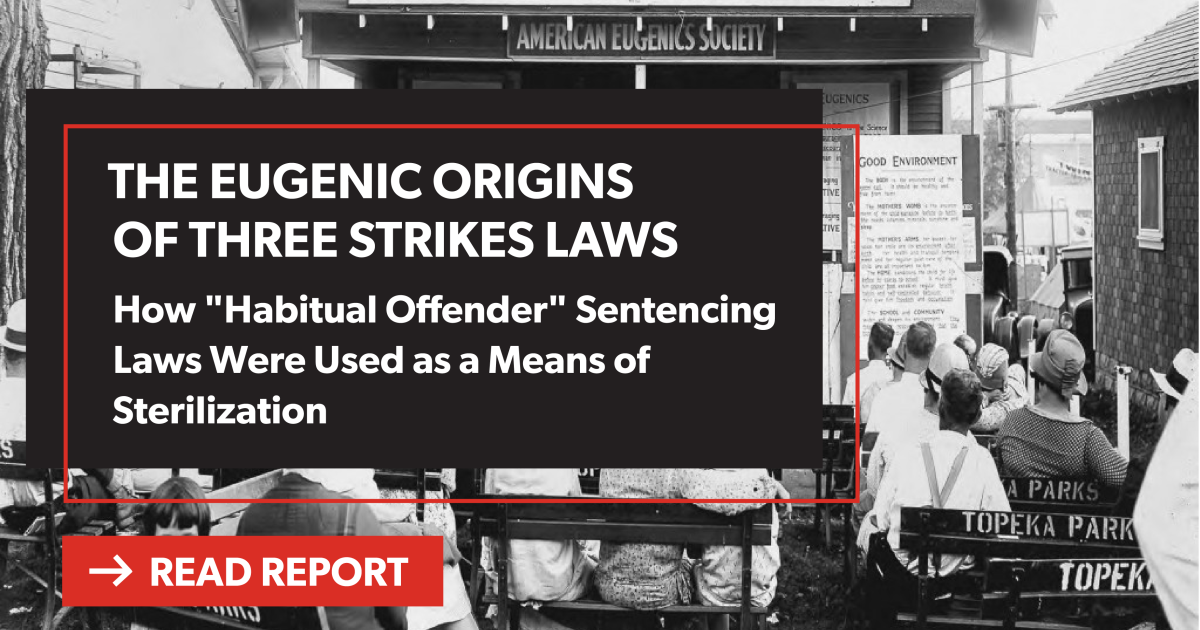
While eugenics fell into disrepute after World War II, “habitual offender” laws have endured to this day and currently operate in 49 states and the federal government.California, for example, enacted its “habitual criminal” law in 1923. In the years leading up to its passage, eugenicists called for such a law for the purpose of preventing reproduction. Paul Popenoe, for example, was a Stanford graduate and board member of the American Eugenics Society. In 1920, he wrote that “habitual criminals” require “institutional care throughout life.” And he advocated for this on explicitly eugenic grounds: “[t]he essential element in segregation,” he wrote, “is not so much isolation from society, but separation of the two sexes.” Other Californians of that era shared Popenoe’s Lombrosian belief system. University of California, Berkeley Professor Samuel Holmes, for example, approvingly quoted Cesare Lombroso in 1921, writing that “the born criminal is a brute or savage living among human beings who have advanced beyond his stage of development.” In a similar vein, a 1924 Los Angeles newspaper article claimed that for habitual criminals, “there is no hope of reform.” The article continued that, “there is a type of habitual criminal devoid of the slightest desire to reform, and perhaps the capacity, even could the desire be awakened.” A Humboldt County District Attorney echoed these Lombrosian views, writing that “the greatest number of criminals with whom the prosecutor has to deal, is born a criminal, he is a congenital criminal, he is defective from the day that he is delivered, and he will remain a criminal all of his life.” The law that passed in 1923 was typical of “habitual criminal” laws in this era. It permitted a life sentence upon conviction of a third felony, and required a life sentence upon conviction of a fourth felony. California legislators were also engaged in other eugenicist projects at this time. That same year, 1923, a California legislator introduced a eugenics law requiring couples under the age of 45 to undergo medical exams to ensure physical health before marriage. And, by this time, the state had begun involuntarily sterilizing thousands of Californians on eugenic grounds. California’s “habitual criminal” law was amended in 1927 to make it even harsher, requiring a life with the possibility of parole sentence for a third conviction and a life without parole sentence for a fourth conviction. This scheme lasted until California’s Three Strikes Law of 1994, which added a mandatory doubling of a sentence for a second strike and also lowered the threshold for prior convictions to count as strikes. These changes, though meaningful, did not alter the operative core of the three strikes law that had existed since 1923: a decades-long sentence for three convictions. Thus, despite the passage of time and the shift away from eugenics after World War II, California continues to enforce the habitual criminal sentencing scheme that emerged from the eugenics movement. Colorado’s current “habitual offender” law is similar in that it retains the same operative core as the state’s eugenic-era version. After three failed attempts to pass sterilization laws in the 1920s, Colorado enacted its first “habitual criminal” law in 1929. The last attempt to pass a sterilization bill had come in 1927, but the Governor vetoed it, noting that “the end sought to be reached by the [sterilization] legislation can be obtained by the exercise of careful supervision of the inmates, without invoking the drastic and perhaps unconstitutional provisions of the act.” The Governor, therefore, had no qualms with the goal of barring reproduction of people deemed “habitual criminals.” He just thought that an option better than sterilization would be long-term sentences. Colorado Representative Annah G. Pettee described the Governor’s 1927 veto of the sterilization bill as “the tragedy of the session.” Simultaneously, she warned of the “rapid increase of the insane, feeble-minded and habitual criminal classes.” She thus advocated for a different approach: a habitual offender sentencing bill. The legislature took that course two years later, in 1929, and passed Colorado’s first “habitual criminal” law. The law imposed a significantly longer sentence for individuals convicted of a third felony, and a mandatory sentence for the term of one’s “natural life” upon conviction of a fourth felony. Colorado’s “habitual criminal” law has been amended over the years, but the operative core—which requires reproduction-ending sentences for the repeated commission of crime—remains intact. Vermont passed its first “habitual offender” law in 1927. The Governor of Vermont proposed sterilization or long sentences for “habitual criminals” in order to “restrict the propagation of defective children.” During the 1927 legislative session, the Senate passed a sterilization bill but the bill did not gather sufficient votes in the House. The Legislature did succeed, however, in passing a “habitual offender” sentencing bill that same year. Vermont’s law mandated life imprisonment for a fourth felony offense. That 1927 version of the “habitual criminal” law remains in force today with only minor textual changes. To illuminate the changes, the text below of the current statute marks all the changes that have been made since 1927. The underlining represents words that have been added by amendment, and the strike-through represents words that have been deleted by amendment: A person who, after having been three times convicted within this state, of felonies or attempts to commit felonies, or under the law of any other state, government or country, of crimes which if committed within this state would be felonious, commits a felony other than murder within this state, shall may be sentenced upon conviction of such fourth, or subsequent offense to imprisonment in the state prison for the term of his natural up to and including life. As is evident, the text remains substantially the same. Vermont’s eugenically motivated “habitual criminal” bill remains on the books. What is remarkable about Vermont is that the state has apologized for eugenics. In 2021, the Vermont General Assembly passed a resolution making a public apology for past eugenic practices, but the focus was on sterilization, which was successfully passed in the 1930s. There was not a single mention of Vermont’s still-in-force “habitual offender” law. Somehow, although eugenics and many of its programs declined, “habitual offender” laws have endured and remain largely unrecognized as a vestige of eugenics.
Trust this device for 30 days