
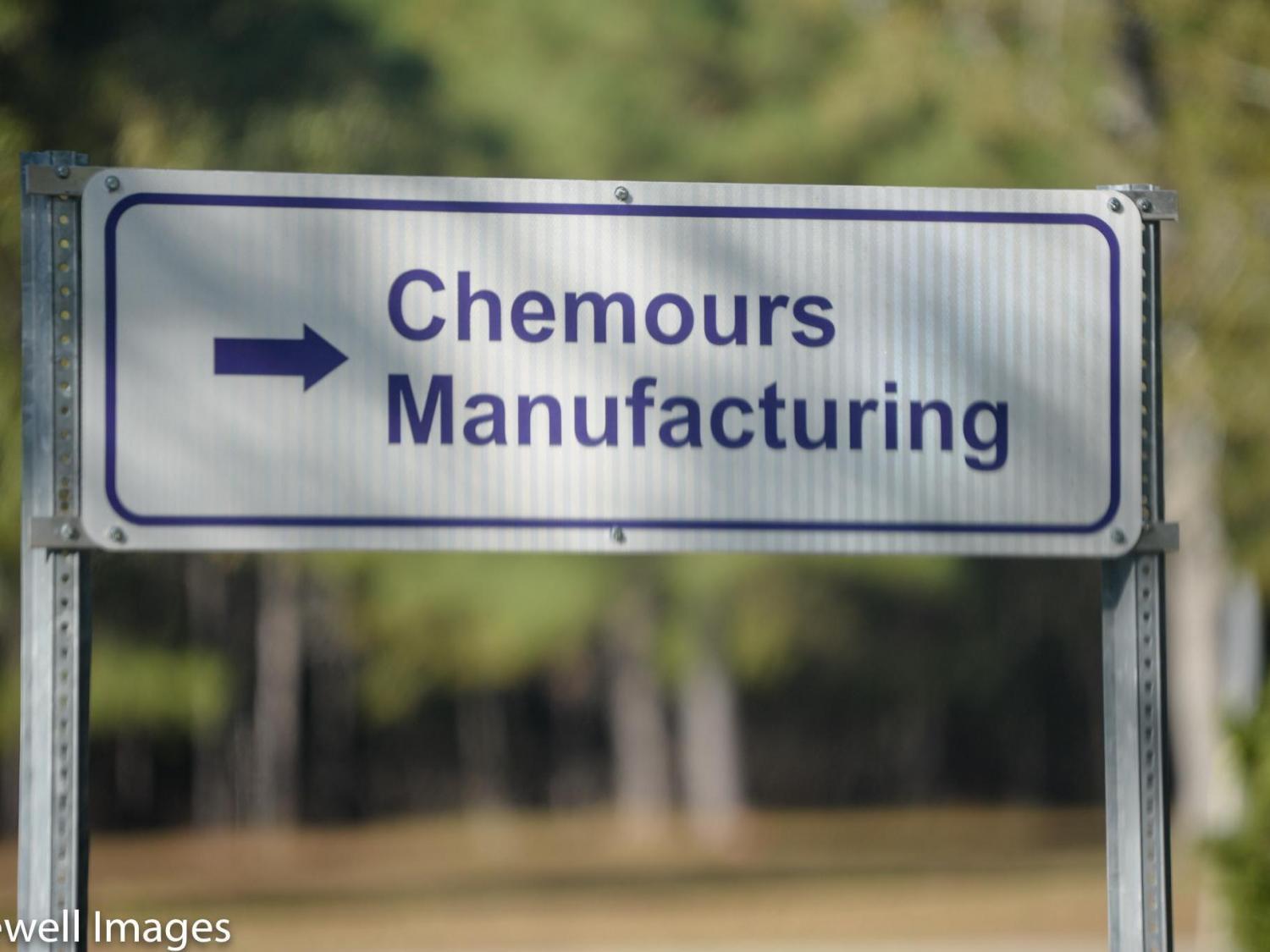
A series of campaign contributions from Chemours and its affiliated political action committee is drawing criticism from residents living near the company’s Fayetteville Works facility and others impacted by PFAS contamination across North Carolina.
Chemours, a spinoff of chemical giant DuPont, manufactures PFAS compounds — a class of synthetic chemicals often referred to as “forever chemicals” because they do not break down easily. PFAS have been linked to cancer, thyroid disease and other health problems, and have been found in drinking water supplies across the state.
Records show Chemours and its PAC gave a total of $16,500 to Republican lawmakers in late 2024. Chemours LLC gave $10,000 to the North Carolina House Republican Campaign Committee. The Chemours PAC made individual contributions, including to to House Speaker Destin Hall ($2,500), House Majority Leader Brenden Jones ($1,000), and Sen. Danny Britt ($1,000).
Rep. Jones and Sen. Britt represent Robeson County, where recent testing revealed some of the highest PFAS levels in the state. According to Environmental Working Group, the Robeson County Water System, which serves 64,000 residents, recorded PFOS at 30 parts per trillion and GenX at 33 parts per trillion. Both exceed the EPA’s new drinking water standards. GenX is a PFAS compound uniquely associated with Chemours and its Fayetteville facility.
“They messed up our water. We can’t even eat from our gardens,” said Dale Canady, a lifelong resident of the Gray’s Creek community just miles from the plant. “I don’t trust them.”
Canady said he’s lost family members to cancer and believes PFAS exposure could be to blame. He said the company’s political spending only adds to community frustration.
“My voice is just a whisper to the legislature,” Canady said. “But it feels like those with money get to scream.”
A Chemours spokesperson said the donations were employee-funded and in full compliance with campaign finance laws.
“We’ve taken a broad and unprecedented set of actions, including investing hundreds of millions of dollars, to reduce PFAS discharges from Fayetteville Works,” the company said in a written statement.
Those actions include installing a thermal oxidizer to destroy air emissions, as well as barrier walls and groundwater collection systems to reduce discharges into the Cape Fear River.
The emission cuts and pollution controls cited by Chemours were required under a 2019 consent order, reached after lawsuits from Cape Fear River Watch and the North Carolina Department of Environmental Quality. The thermal oxidizer Chemours now uses had already been implemented by its former parent company, DuPont, at a West Virginia plant decades earlier after significant PFAS pollution there.
“They knew the risks and had the technology but didn’t act until the state stepped in,” said Dana Sargent, executive director of Cape Fear River Watch. “And now they want lawmakers to shield them from paying for the damage.”
The company has also spoken publicly about pending legislation that would hold polluters financially responsible for filtration costs. During a recent House committee hearing, Jeff Fritz, a Chemours representative, told lawmakers the company had already cut PFAS emissions dramatically and warned against new liability standards.
“Chemours was always in compliance with its DEQ-issued permits,” Fritz said. “We actually taught DEQ how to analyze and measure our emissions. We respectfully suggest that Chemours should not be made liable for all other PFAS and various contaminants coming down the Cape Fear River.”
The North Carolina Department of Environmental Quality confirmed that Chemours’ emission reductions were not entirely voluntary. In a statement, a DEQ spokesperson said that in 2018, the Division of Air Quality notified Chemours of its intent to modify the facility’s air permit. Chemours then committed to installing pollution control equipment, and those steps became enforceable through the 2019 consent order.
The agency also noted that the method used to measure GenX emissions was developed collaboratively between DEQ, the EPA’s Office of Research and Development, and Chemours.
Advocates say legislation like House Bill 569 and Senate Bill 666 could shift the cost burden from ratepayers to polluters. The bills would hold manufacturers financially responsible for contamination that exceeds EPA limits.
In Fayetteville, the stakes are high. The Public Works Commission is building a PFAS filtration system now estimated to cost $111.2 million, up from earlier projections of $80 million. To pay for it, the PWC board voted in February to increase water and sewer rates by 10.9% over two years — including a 5.5% hike this May, followed by another 5.4% in 2026.
“These are companies making billions,” Sargent said. “And yet families are stuck footing the bill to clean up chemicals they never asked for in their water.”
In 2024, Chemours reported $5.78 billion in revenue and $786 million in adjusted earnings, while paying out $148 million in dividends to shareholders.
Meanwhile, the company is seeking to expand operations at the Fayetteville plant and is involved in federal litigation with downstream utilities. The Southern Environmental Law Center recently filed a motion objecting to Chemours’ request to seal up to 21,000 pages of internal documents, including sampling data and information about PFAS treatment options and health impacts.
“We’re not asking for favors,” Canady said. “We’re asking for clean water. And for the people who polluted it to be the ones who pay to fix it.”
Trust this device for 30 days