
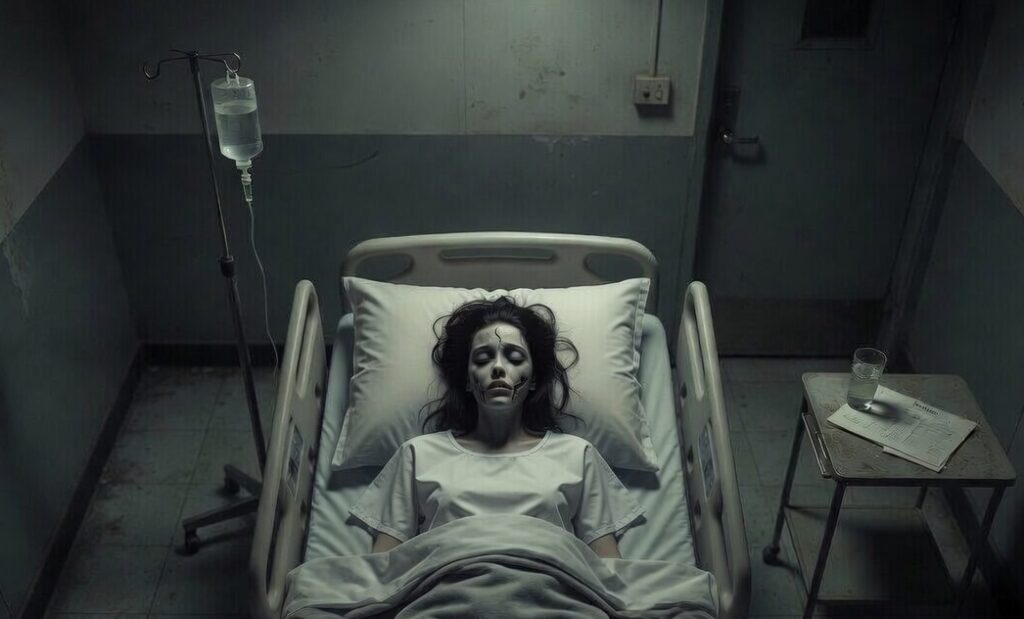
My heart breaks as I look back on little Natalie, lying in a rickety hospital bed, hallucinating, convulsing, and screaming from the torment inflicted on her by high school bullies. The nurses struggle to pin her down at the wrists as they inject midazolam and haloperidol in her IV while she kicks and screams, trying to break free. Eventually, she is tranquilized and finally falls asleep.
This episode was the result of a friendship betrayal turned “mean girl” witch hunt during my final year of high school that carried into college. Unexpectedly, I found myself the target of two twin sisters who deliberately selected me, studied me, and groomed me for psychological abuse to punish me for their jealousy over an academic accomplishment of mine.
Until recently, I couldn’t utter the words “groom,” “abuse,” or even the phrase “the twins” without experiencing an uncontrollable trauma response such as a scream or a jolt in my chest. Two years ago, I wrote an article for the Complex PTSD Foundation about this experience, along with a more recent update on my recovery. By putting pen to paper and working through my dissociation and depersonalization, I finally began to articulate what I had endured at the hands of these people.
Anyone who has been a victim of psychological abuse, often referred to as narcissistic emotional abuse, can attest to the torment that these disturbed individuals inflict on their victims. I once heard a fellow survivor describe narcissistic abuse as a “rape of the soul,” and that is exactly how it felt for me.
Psychological abusers typically target warm-hearted, empathic people who have an innate joy for life and are trusting of others, which abusers take full advantage of. Without even laying a hand on their victims, they use gaslighting, manipulation, mind games, and hot and cold behavior to establish control over their victims, working to destroy their contentment. Abusers break down the psyches of their victims until they appear crazy to outsiders, while isolating them from connections that could provide support. It’s all done without leaving a single trail of evidence to an outsider, making the victim appear even crazier and establishing a Stockholm Syndrome-style trauma bond. And of course, the nervous system responds to all of these threats with fight, flight, freeze and fawn reactions.
After months and years of this, the twins’ hatred for me permeated every cell in my body, day and night, no matter where I was, no matter what I was doing. My thoughts became theirs and my words became theirs as I walked on eggshells so as not to upset them and receive further punishment. Every day at school was a war zone. Everything I did and every word I said was wrong. I was previously quite confident, with a good head on my shoulders. However, I learned from the twins that my success, my confidence, and my joy were “my fault” and that I deserved to be punished for being myself. I spent my nights at home trying to calm my uncontrollably shaking body, wondering what was so “wrong” about me. I attempted to “fix” everything about me so they would stop hurting me. But nothing I did was good enough to stop being harmed. The sick mind games they played taunted me with a false hope for closure that never came, and the hot and cold behavior made me question my own reality, causing extreme dissociation, depersonalization, and memory loss.
During my years at school and in the years that followed, I was transported to the hospital multiple times by paramedics due to my intense and uncontrollable bodily reactions like hallucinations, convulsions, insomnia, gastrointestinal distress, autoimmune flares, and numerous neurological issues of brain fog, memory problems, and word retrieval issues. Without even touching me, my abusers took over my body to such an extent that I felt like I needed an exorcism. I began reaching out to priests, and I’m not even Catholic! The emotional flashbacks ate me alive every second of every day, making me feel like I was crawling out of my own skin. Over time, through their gradual erosion of my psyche using intermittent reinforcement tactics, they squashed my confidence and joy to the point where I felt guilty for everything I did, every word I said, and even for my very existence.
They stole everything from me. My friends. My family. My hometown. My childhood memories. My creativity. My confidence. My purity and innocence. I wanted it all back. But most of all, I wanted me back.
I don’t wish to give my abusers any more airtime than they deserve. Instead, I want to focus on how the medical system addressed my pain and how my body continues to recover a decade later.
The side effects from the trauma — hypervigilance, paranoia, amnesia, hallucinations, convulsions, and more — became intertwined with those induced by medication, intensifying my feeling of being demon-possessed ten thousand times over. Thus began a revolving door of hospital visits where I was continuously prescribed and injected with various antipsychotics and benzodiazepines by both my private psychiatrists and the doctors in emergency rooms and psych wards.
The medical providers I sought help from consistently put the spotlight on me, the victim, as the one with the issues. They didn’t understand that I could not control what was happening in my body. I received a plethora of diagnostic labels: schizophrenic, psychotic, borderline, Tourette’s, autism, and more. They misunderstood my emotional instability and suggested that I was inflicting these symptoms upon myself. I was often blamed for not working hard enough in therapy and accused of being non-compliant with their demands to take the synthetic substances. I obediently took the antipsychotics and benzodiazepines as prescribed in the desperate hope that they might resolve my symptoms, but the medication-induced psychosis, hallucinations, and paranoia only worsened.
I even encountered some predatory providers who took advantage of my vulnerability. To them, I became a museum of mockery: they labeled me with personality disorders, painted me as an abuser myself, and demanded my imprisonment in an institution due to my “disturbing” behavior.
My shame drove me into deep isolation. During my healing journey, I moved out to a cabin in the woods to protect myself from further hurt and to calm my nervous system. I shut the world out and began to listen to my own voice. Gradually, I became able to articulate how the system had pathologized my pain, and I put in the hard work to take my power back.
Here are some things I recognized during this time:
1: Regardless of how the system labeled me, I came to understand that I was not at all a bad person. I adamantly rejected the victim-blaming ideas of ill-informed medical providers and stopped putting my trust in them to help me heal.
I now look back at little Natalie sitting on those couches, desperately trying to make the “experts” understand what was happening inside her body. At the time, I didn’t know what complex trauma and emotional flashbacks were, nor did I realize that the psychiatric medications were making them worse. When I confided in therapists that the twins were taking over my mind, the professionals immediately assumed that I was the one obsessed with them. I remember one therapist creepily staring me down and condescendingly asking me: “Natalie, do you think you’re in love with these twins?” This was the same therapist who told me he “felt like a father to me,” caressed my back as I entered and exited his office, and suggested I send him photos from my upcoming beach vacation.
I was appalled. I wanted to scream that I was the furthest thing from obsessed with my abusers; in reality, it was the complete opposite. But I was mute. I wanted to rid my mind of them so desperately that I believed the only way to escape the torture they put me through was to end my own life. Seeking help in this regard made me sound even more unstable and led to harsher diagnoses like Borderline Personality Disorder and Dissociative Identity Disorder as well as orders to be institutionalized. All along, I was simply battling uncontrollable flashbacks that assaulted me like a broken record on repeat.
Throughout my healing journey, I came to understand that, as a young and vulnerable woman, I had become easy prey for the very people who were supposed to help and protect me. Those who know me know that my heart is pure and would laugh at the suggestion that I had a tendency to scrutinize others the way that was done to me. As I distanced myself from the system and spent time at the cabin, I made a commitment to never again allow myself to be in the hands of someone whose agenda was to brainwash me into believing I possessed the disturbing qualities of those who harmed me, including the therapists I once trusted.
2. In the face of mockery and invalidation, I adopted intense feelings of humiliation, shame, and guilt. During my healing journey, I had the privacy to grieve what really happened to me and allow myself to feel the emotions that were suppressed for so long.
When I first sought help, I had no idea what I was a victim of, or that I was even a victim at all. I was suffering the effects of Stockholm Syndrome and lacked the knowledge to make sense of the dynamics created by the trauma bonding process. Seeing no way of escaping these twins at school, I experienced cognitive dissonance — an adaptive behavior in the face of threat — in order to reduce my anxiety and fear. My alternating states of emotions and periods of aversive arousal made me seem like the “crazy” one to outsiders, which was ultimately what gave the medical providers the ammo to misdiagnose me. I believe it is important for therapists and psychiatrists to understand and recognize the components of Stockholm Syndrome to protect the already vulnerable individuals who walk into their offices. Unfortunately, many do not.
In reclaiming my power, I let go of all labels. I now know in my heart that everything was a misdiagnosis designed to benefit a system that profits from human suffering and pathologizes normal human behaviors.
3. For years, I was told that my bodily reactions were “wrong” and that I was “mentally ill.” However, as I learned to listen to my own voice, I realized that my responses were actually healthy responses to an unhealthy situation. I focused on nurturing my body as part of my recovery.
My experience as a victim of narcissistic abuse was not just classic playground bullying that I could easily ignore; it was a calculated scheme aimed at driving me to my death. My abusers were already aware of my suicidal thoughts when they began targeting me, as I had confided in them in our previous friendship. They utilized this insider knowledge of my struggles to attack my weakest points, almost as if they wanted to push me over the edge. I ended up regretting seeking help regarding my suicidal ideation as it only made me seem even more unstable to the therapists and psychiatrists I encountered, leading to my involuntary commitment to a psychiatric ward.
In my recovery process, I recognized that I had never dealt with healthy people, either in my personal life or in the system. I encountered people who lacked empathy and, in some cases, blatantly lacked a conscience. The professionals I met did not truly listen to me; rather, some seemed to have motives similar to those of my abusers.
It has been a decade, and I still have not fully recovered. I know in my head what was done to me, but I do not know it in my heart. I still struggle internally to accept the depth of the very deliberate harm I suffered at the hands of these con artists. I continue to blame myself for not knowing what I was a victim of, that I was even a victim at all, and for my fight, flight, freeze, and fawn reactions. It is difficult for me to accept that such despicable human beings walk among us, fooling the pure-hearted with their smoke and mirrors.
I am still disconnected from just about everything from my past that my abusers stole from me. I am still in disbelief that the so-called “experts” on human behavior are incapable of recognizing victims of abuse. Daily, I am assaulted by flashbacks that play on a continuous loop, and I am battling intense withdrawal symptoms from antipsychotics as well. I continue to feel embarrassed about my attempts to seek help from both laypeople and medical providers, only to be written off as obsessed and disturbed. How I can still have guilt or question my own realities and actions is astounding to me. However, I now consider this struggle to be a byproduct of years of indoctrination.
Since moving to the countryside and quieting the external noise, I have made remarkable progress. I am grateful that I did not give up on a therapeutic answer after a decade of bad experiences with the allopathic warlords who falsely advertised themselves as trauma-informed professionals.
Over the past two years, I have been working with three providers: one who specializes in psychological abuse and two others who are trained in somatic modalities for survivors of severe trauma. What sets these providers apart is that they are “in the system but not of the system.” They vehemently disagree with the approaches taken by their colleagues during my previous decade of treatment and they share my frustrations regarding the corruption within this system. For the first time, I have found professionals who support my choice to take a natural approach, who have not forced medication on me, and who have held my hand through the horrors of medication withdrawal. They do not gaslight, invalidate, mock, or manipulate me into feeling like I am the perpetrator.
I want to encourage anyone who has resonated with my story that you are not alone in being caught off guard by some of the most bizarre, creepy, and inappropriate human behavior. You are not alone in the ways that your body violently reacted, nor are you alone in not being believed by those around you, whether it be the layperson or the medical providers you have desperately sought help from. All the ways you were gaslit into believing that you are crazy, sick, or mentally ill were things I experienced for many years before I finally got the validation that none of it was true. I hope my story inspires you to keep fighting and not give up.
During my “cabin in the woods” healing journey, I worked my butt off to rediscover who I am at my core and retrieve my soul from my abusers, as well as from the predators in the medical system who twisted my pain into pathology. I no longer have any physical body reactions attached to the abuse, which I believe was 99% of the battle in my recovery. I am continuing to work through the feelings of guilt and blame and am practicing patience with myself.
I am slowly coming out of isolation and taking baby steps to return to my hometown without fear. I have shown myself that not everyone is out to hurt me or set me up for humiliation and failure. My determination to find genuine friends and trustworthy providers has shown me that so many people love me, care about me, and want me to succeed. As I continue to come back into “me” again, the skullduggery remnants of the twins and the lies they represent are slowly fading away. Recovering from narcissistic abuse has been an excruciating and isolating process, but I will not stop until I am 100% “me” again.
In therapy, I asked my brain to come up with some adjectives that describe the truth about my soul. My therapist jotted them down, and I made a little sign to post above my doorknob so I can read the words aloud every time I leave the house.
So, what is the truth about my soul? I am spunky, fearless, and authentic. I am kind and loving. I am generous, gorgeous, amazing, friendly, bubbly, sweet, and gentle. I am creative and unstoppable. I am placid, mellow, and natural. I am a beautiful free spirit. I am a fighter. I am a warrior.
If there’s anything I’ve learned from this experience, it’s that the people, groups, and systems of the world can crush my mind, body, and psyche into little pieces until it feels like there’s almost nothing left. However, I have shown myself that with the proper resources and hard work, I can rebuild those parts of me, retrain my brain, and feel at home in my body once again. But what the world cannot destroy, no matter how hard it tries, is my soul. My soul is indestructible.
I am Natalie Rose, and I am proud to be a survivor.
***
Mad in America hosts blogs by a diverse group of writers. These posts are designed to serve as a public forum for a discussion—broadly speaking—of psychiatry and its treatments. The opinions expressed are the writers’ own.
–
This post was originally published on Mad In America.
Trust this device for 30 days