
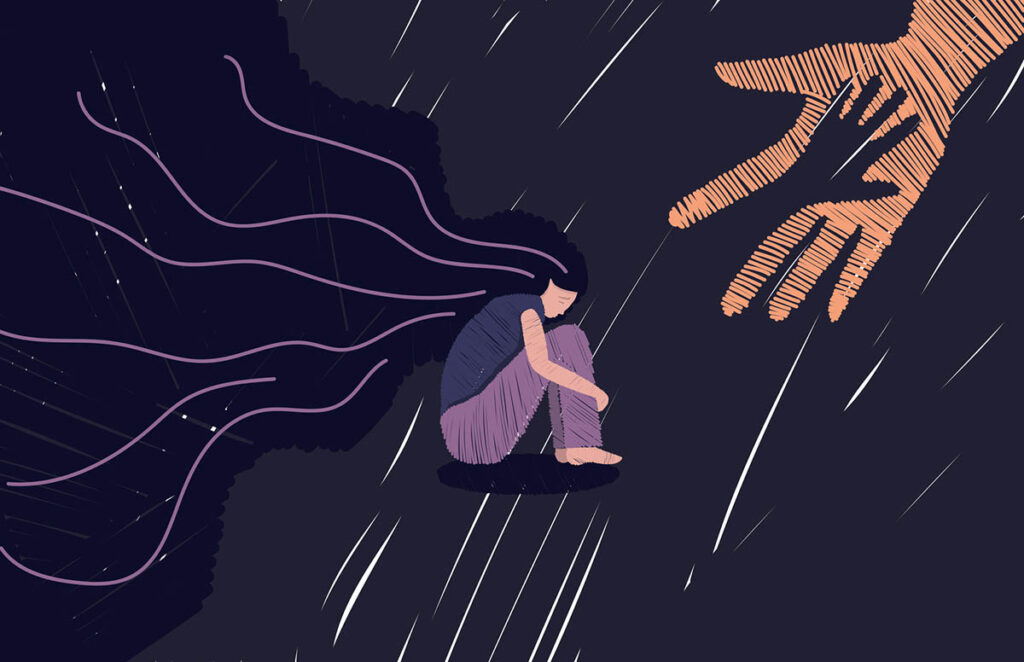
As a child, the system failed me. I was mercilessly bullied in elementary school. I had almost no friends for many years, and it imprinted on me that I was not adequate. I tried very hard to conform to the other children, but no matter how hard I tried, I was not accepted. On the first day of sixth grade, the few friends I had been able to make decided I was not “cool” enough. I was alone, frightened, and friendless.
At some point, I stopped trying to make friends because I thought it was pointless as I had been rejected so many times. In fact, I likely tried too hard. I was not given therapy or adequate coping resources as a child. I knew I needed help, but I had no idea how to get that help. I was never given permission to talk through my feelings and always felt I had to hide. I felt like nobody understood me, and I gave up on myself.
Throughout elementary school, my internal thoughts were “nobody likes me, everybody hates me,” but nobody talked to me about my feelings, so nobody knew quite how much I was struggling until I started to self-harm at age 11. At that point, other kids began to see me self-harm, although I covered the scars with long-sleeve shirts around my parents and teachers. My friends were at a loss, and disconnected. Other tweens had no idea how to react to such open self-harm. Once I started, it became an obsession, and I did not feel I could stop.
This continued until, at age 16, a teacher noticed. She called my mother and said that she thought I might be suicidal based on the self-harm. I was not a part of that discussion, but my mother came and asked me if I was suicidal. At that point, I had not even contemplated suicide. I denied any thoughts of suicide. However, once it was suggested, I started thinking about it. I could not give up the thought. Like self-harm, it became an obsession.
I heard a song from M.A.S.H., “Suicide is Painless”, and it made me think that suicide would be the easy way out. I bought sleeping pills and took a handful. I panicked, and I called a friend. The ambulance took me to the hospital, and charcoal was used to make me throw up. For a long time, I thought I was a failure because I did not succeed in committing suicide that night. I felt I had to be perfect in everything, suicide included. It took me many years to forgive myself for that attempt and to be glad that I survived.
In fact, my suicide attempt was a cry for help, but the help I needed was not that to which the system pushed me. I agreed to be admitted to a psychiatric hospital where, instead of healing, I became more suicidal. The other teens in the psychiatric hospital encouraged each other to find ways to self-harm to deceive the staff. I was watched 24/7 because I threatened to use dental floss to self-harm by wrapping it around my neck. I wanted the attention, but the kind of attention given in the psychiatric hospital was not the kind I needed to heal. Instead of being heard in the psychiatric hospital, I was told that what I needed was psychiatric medications and that I would be in and out of psychiatric hospitals for the rest of my life.
Nonetheless, while I was in the psychiatric hospital, I continued to achieve. I took the PSAT and I was awarded National Merit recognition. My parents supported me leaving against medical advice. I firmly believe psychiatric hospitals are not therapeutic. It took me a long time to mentally overcome the life sentence that mainstream psychiatry handed me at age 16. I thought I was forever damaged.
I returned to school after my suicide attempt, but I was overwhelmed. I told my parents I just could not continue in the pressured environment because I was on the verge of collapse. I desperately needed a break. I enrolled in correspondence school. I completed my homework, though it took hours each day, and I volunteered my time at an elementary school.
As I applied to colleges, I was afraid that my suicide attempt and hospitalization would make it so I would not gain admission. My parents agreed that I should cover up what had happened. Would Stanford have admitted me if they had known that I had been in a psychiatric hospital just two years prior? It is hard to say. I did not want to test it. I hid my past because I feared the consequences.
At age 20, while at Stanford, I was overwhelmed by the pressure. I was given one pill of Ativan from a friend. I became very agitated and I did not understand what was happening. I went to student health. They did not know what to do with me. The University did not think I was safe staying in the dormitory. They insisted that I stay in the psychiatric hospital for one night. I agreed to go voluntarily. Nonetheless, the paramedics came and strapped me to a gurney. I resisted with everything I had as I had stated I would go voluntarily and saw no reason for force, nor did those at student health. My mother flew out that day and we stayed in a hotel for several nights thereafter.
I firmly believe I had an autistic meltdown with high anxiety. (My neurologist changed my diagnosis to autism spectrum disorder on May 5, 2026, in my medical records. I intend to have a neuropsychological exam to further confirm the misdiagnosis, but multiple physicians have agreed that autism is the correct diagnosis.)
Instead of investigating other options such as therapy or feeling I had permission to take a year off from school to take care of myself, I was labeled as having bipolar I and urged to continue my studies in order to graduate on time from Stanford, when really there would have been no issues with taking a year to concentrate on healing.
I firmly believe that I never met the requirements for bipolar I disorder based on my medical records, although some of the criteria were satisfied. Yes, I had a distinct period of “abnormality” and persistently elevated expansive or irritable mood, lasting at least one week. However, my records at no point indicate “mania.” There is no mention of inflated self-esteem or grandiosity in my records at the time of the diagnosis, nor is there a mention in the records of decreased need for sleep. I was admittedly more talkative than usual, although there is no indication that my thoughts were racing. The only mention of pleasurable activities that had a high potential for painful consequences in the records reflect that I had a “buying spree” when I went to Ross and bought two skirts for under $100, which is hardly diagnostic.
Further, the DSM-IV required that “The mood disturbance is sufficiently severe to cause marked impairment in occupational functioning or in usual social activities or relationships with others, or to necessitate hospitalization to prevent harm to self or others, or there were psychotic features.” However, my records indicate I did not have suicidal or homicidal ideation, nor were there psychotic features, so this required element could not be met. Further, a “marked impairment in occupational functioning” was not established as I graduated on time from Stanford, graduating with distinction and departmental honors. I did take one quarter off, but at that point my mother had breast cancer, and taking a quarter off at Stanford was a right freely exercised by any student who wanted a break for any reason without question. Thus, the diagnostic label of bipolar I disorder was never satisfied.
The doctors rushed to a diagnosis and a label, instead of treating me as a person. Once I was told I had bipolar I disorder, I looked it up and acted the part. My parents were frequently a part of my sessions with psychiatrists, and I did not feel I could speak openly about my thoughts at those appointments. I did not trust the psychiatrist and I panicked at every appointment. Had I had a psychiatrist I had trusted with my thoughts, I would have felt safe in expressing what was truly happening. I did not believe I had a voice or a choice.
At the time, I trusted mainstream psychiatry, and my psychiatrist told me at age 20 that a little pill could solve my problems. I was quickly prescribed various antipsychotics, including Haldol, none of which were effective. I wanted an easy and quick solution so that I would not have to take time off from school. Like so many others, I knew nothing at all about the detrimental effects of psychiatric medications when I started taking them. How could I have? Nobody bothered to tell me. Therapy was not even suggested at that time.
I experienced numerous side effects due to antipsychotics, including blunting my personality, making it difficult for me to concentrate, and making me gain weight. Because of these side effects, my doctors kept switching me to other drugs, before I was finally given clozapine (clozapine for bipolar is an off-label use).
At 25, I became physically disabled by tardive dyskinesia, a side effect of antipsychotics, although a more recent evaluation states that it is tardive dystonia, which is in the same family. I was a teacher, but I could no longer stand in front of a classroom because I was too physically disabled. I therefore decided to go to law school. I graduated from Rutgers at age 29. I then practiced as a medical malpractice attorney. I also practiced as a Social Security disability attorney. I saw time and time again that people were denied benefits because they did not wish to use psychiatric medications—instead treating their anxiety with coping techniques like using ice packs or breathing through panic attacks.
Eventually, I resigned from on short-term disability. Although I am not currently practicing, my bar has never been in jeopardy and I will maintain my bar.
I have a power of attorney, a legal document, saying do not commit me to a psychiatric hospital for any reason, unless I am a danger to others, although I suspect it would not be respected by an emergency room. I have never been a danger to others. Instead, my preference would be that my mother or my best friend be called in the event of a mental health emergency. I believe that when a person is struggling, they should be seen as an individual and shown compassion.
Recently, my psychiatrist decreased my antipsychotic dose far too quickly. I became a complete insomniac on the last night of my bad taper off antipsychotics. I was desperate, but I held out a month. I was urged to take other antipsychotics, and I refused. I finally agreed to take benzodiazepines for insomnia. Although they initially helped, very quickly my tolerance grew and my insomnia increased. No psychiatric medication helped my insomnia.
I am now in benzodiazepine withdrawal, despite following the directions of my doctor and taking medication exactly as directed.
I now speak publicly about the detrimental effects of psychiatric medications that took my physical vitality for 20 years when I was disabled by tardive dystonia, that changed my personality, and that diminished my mental acuity. The side effects of psychiatric medications are often not fully disclosed by psychiatrists. Many people would not take psychiatric medications if the risks had been fully disclosed in advance. I know I never would have.
I did not go public for attention. I went public because I did not want anyone to suffer the way I have, which is unnecessary. Had my mainstream psychiatrist provided truly informed consent, I would never have ingested benzodiazepines. True informed consent does not merely mean signing a piece of paper. It means having a transparent conversation about the risks of a psychiatric medication before physical dependency results. I don’t believe anyone should ingest benzodiazepines for more than the recommended two to four weeks, except in some extreme cases, given my experience.
When people decide to step into the public eye with a deeply personal story, they do not always fully understand the risks they are taking. Suddenly, their story belongs not just to them, but to the world. When I went public, I did not completely comprehend what that would mean. I tell my story without shame in the hope that others will not suffer as I have. I went public because I feel I have a message and a viewpoint that few others could offer. There are many who disagree with my positions, and the topics I discuss openly are not frequently addressed publicly. As a result, people sometimes do not know what to say to me.
Without complete transparency, consent cannot be considered truly informed. While silence may feel safe, it keeps us immobilized. I advocate for patients to report psychiatrists to the medical board because psychiatrists also make mistakes, as can any doctor. Reporting psychiatrists is easy and not traumatic because it can be done anonymously. I have filed a lawsuit against my psychiatrist for failure to provide truly informed consent. Unfortunately, few attorneys are willing to take these cases. I intend to keep moving forward, speaking my truth in the hope that future generations do not become stuck in harmful mental healthcare patterns.
I filed not for revenge or with the expectation of a monetary reward, but rather to prevent this psychiatrist from taking as much from anyone else as she took from me. This is traumatic for me, but it is something I feel obligated to do as a medical malpractice attorney. It is difficult to litigate psychiatric malpractice cases. However, if an attorney takes the case and believes it to have merit, the client often has to do little else besides appear for a deposition. No qualified attorney will take a case for which there is no expectation of success because of the significant expenses. If a case is taken on by an attorney, this means that the likelihood of success is fairly high. Thus, I believe that individuals should reach out to counsel to have their cases evaluated if malpractice is suspected. The trauma of being deposed may be far less than the expense of remaining silent.
***
Mad in America hosts blogs by a diverse group of writers. These posts are designed to serve as a public forum for a discussion—broadly speaking—of psychiatry and its treatments. The opinions expressed are the writers’ own.
–
This post was originally published on Mad In America.
Trust this device for 30 days