

What if the upcoming midterm election for the first time sends a politician to Washington who is publicly on record against forced psychiatry? What if abolition, a cornerstone psychiatric survivor movement demand, is no longer languishing and losing ground, but has an ally on Capitol Hill? Could a new leader push a mental health policy of human rights, evidence-based research, and voluntary community services—and make a real difference?
If Chris Bennett wins the race for House of Representatives California district 3, we are going to find out.
Bennett, a US Army veteran with a disability, says he was awakened to activism by the Bernie Sanders campaign in 2016. “I was hearing a lot from Bernie that got me digging deeper into the history of US wars. I had a realization that patriotism is about standing up for what’s right, even if that goes against US government policy. For me, the best way to truly serve my country is to get the billionaire Epstein pedophile class out of power and achieve basic human needs—like universal health, child care, a living wage, and affordable housing.”
But it was the wave of ICE street abductions that was Bennett’s biggest motivation to enter electoral politics. “I asked myself, Ok, I’m an activist, but what would it take for me to really dedicate my life to making change? To really make an all-in commitment? And my answer was this: if the government starts snatching people off the street, that’s a red line for me. I knew from reading the history of fascism that when a government crosses that line against the most vulnerable and marginal, the rest of us are next.”
Bennett’s fears materialized when Trump sent ICE agents out into communities nationwide. “I saw the writing on the wall,” he says, “when immigrants protesting the Gaza genocide were being picked up off the streets by ICE—I knew that the US wasn’t just headed for fascism, fascism was already here. My congressional district is controlled by corporate Democratic Party frauds, doing nothing to challenge the fascist system. So I decided at that point to get involved with electoral politics, and run for Congress.” Bennett will be competing in the Democratic Party primary against a long-term incumbent who relies on corporate donors, takes money from the Israel lobby, and, Bennett says, has abandoned constituents in favor of monied interests.
After his campaign launch (in a new district up for grabs after the Proposition 50 re-draw passed in November by California voters), Bennett said he had a chance encounter that brought him face-to-face with coercive psychiatry.
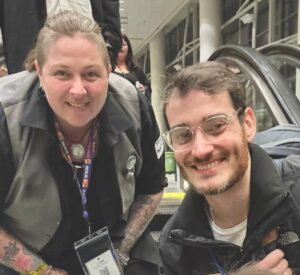
He and his friend (and now, campaign manager) Mack Wilson were volunteering during a mutual aid shift on the streets of Sacramento. While handing out food and survival supplies, the two met a man who desperately needed medical attention for a physical injury. “We offered to drive him to a clinic to get treated,” Bennett explained, “but the man refused. He was in visible distress from his pain, and he was also emotionally overwhelmed. We asked him why he didn’t want to go to the clinic, and he told us “I’m not going back to the hospital. They just say I’m crazy, lock me up, and then treat me like an animal.’” Bennett said it was an “aha” moment for him to see firsthand that force and coercion were harming, not helping, people in need.
A few days later I met Bennett for the first time at a candidate meet-and-greet, as part of a “solidarity strategy” of organizing I’m pursuing. I told Bennett about the Abolish Forced Psychiatry initiative I helped create to see if he would endorse it—not realizing he had recently (synchronistically) had this encounter on the street that showed him the real-life impact of coercive psychiatry. His campaign relies on community members to deepen the connection to crucial issues, and Bennett asked me to help him understand forced psychiatry abolition. “I learned how ending forced psychiatric treatment is a natural fit with my campaign’s existing commitment to disability rights and against punishment-based carceral criminal justice,” Bennett said. “The whole problem was on clear display in that street encounter doing mutual aid.” Wilson is also a long-time jail decarceration activist already against forced treatment—but no one had yet asked the campaign to make it an official part of their platform. Now, Bennett has added the Abolish Forced Psychiatry statement as a policy plank on his website.
Abolish Forced Psychiatry is an international effort to put ending coercion in mental health on the public agenda and highlight mental health advocacy that truly aligns with human rights in psychiatry. The statement reads:
Abolish all involuntary psychiatric and psychological interventions, including forced hospitalizations, forced drugging, and related coercive practices. End all legal and social discrimination based on psychiatric or psychological diagnostic labeling or actual or perceived disability. Establish non-coercive supports and services for people when they experience emotional distress or life crises, including, but not limited to community mutual aid, peer support, voluntary crisis sanctuaries, as well as the right to voluntarily access all mainstream services and affordable housing free of coercion. Reject the criminalization and forced psychiatrization of social problems, difference, disability, and struggles for survival. Recognize the social and economic causes of emotional distress, and work to meet everyone’s basic needs in the community, including ending poverty, overcoming social exclusion, and promoting disability justice, human rights, and carceral system transformation.
With his endorsement, did Bennett become the first US political candidate to embrace the psychiatric survivor movement’s goal of ending forced treatment? “I think so!” said Leah Ida Harris, a longtime rights advocate, psychiatric survivor, writer, and journalist covering mental health and disability justice. Harris wrote prominently about Bernie Sanders and how the survivor movement could find a voice in the firebrand democratic socialist’s 2020 campaign, and so she was a natural person to ask about Bennett.
“Bernie’s presidential campaign was about not expanding involuntary treatment,” Harris added, “and that was the most progressive stance yet. But Bernie didn’t go as far as calling for abolishing forced psychiatry. And while limited opposition to expanding outpatient commitment does exist among politicians, that doesn’t impact force and coercion overall as standard practices. I can’t think of any state or local legislator who has taken a stance to end all force in psychiatry.”
Rob Wipond, another journalist investigating forced psychiatric care and author of Your Consent Is Not Required: The Rise in Psychiatric Detentions, Forced Treatment, and Abusive Guardianships and the podcast and blog PsychForce Report, agreed. “It’s not uncommon for politicians to say they’d like to reduce use of force—even some pro-force ones will say their ultimate goal is to reduce force.” said Wipond. “But I’ve seen very few openly, clearly call for abolition of forced psychiatry. A draft of the Breathe Act bill did call for an end to civil commitment. Bennett goes much further by openly endorsing the entire set of principles from the Abolish Forced Psychiatry group—that’s a strong statement.”
Elected US politicians, however, are notorious for ignoring what voters actually want. I’m often reminded of the prominent research study showing it’s not the positions of the voters that ever get translated into US policies, it’s the interests of corporate donors. Could Bennett make a difference—at least in getting mad movement issues some attention?
“Bennett could be another important voice speaking out,” said Wipond. “In effect, he already is that, and that in itself is immensely valuable, when we know so many people are understandably wary of speaking out on these issues. We hear extremist, pro-force rhetoric all the time from Treatment Advocacy Center (TAC) and NAMI. TAC and NAMI’s pro-force messaging heavily influences politicians on the left and right, and dominates the media and public spheres. It’d be fantastic then if Bennett could become a high-profile voice questioning and countering the false claims and manipulated research of the pro-force lobby. And I like that he identifies as having a disability—we need more folks who’ve had experiences of different disabilities in positions of political influence. He isn’t shirking from speaking out about what he genuinely believes, and expressing across his platform critical, informed views combined with strong values of compassion, community, and support for human and civil rights.”
But will this lead to real change, not just symbolic gestures? What about, for example, Bennett’s commitment to push to ratify the Convention on the Rights of Persons with Disabilities (CRPD), which advances protections against forced treatment and has strong mad movement support? “It’s great to say ‘ratify the CRPD’ as Bennett does,” said Harris, “But let’s be for real—we are moving in the diametrically opposite direction as a country. The CRPD has not been ratified here in two decades, even under more liberal administrations. In today’s atmosphere of resurgent eugenics on both sides of the aisle, how does Bennett plan on moving this vision towards reality? I’d also like to know what he will do in the face of overwhelming opposition any anti-forced psychiatry proposals are going to face.”
Wipond told me a story about his own efforts related to electoral organizing. “Many years ago,” he recounted. “I collaborated with some survivor-activists and academics to write a mental health policy for the Green Party of British Columbia that called for aligning with Canada’s Charter of Rights and the UN Convention on the Rights of Persons with Disabilities. The policy was passed unanimously—unfortunately, when several Greens got elected and held some voting sway in the legislature, they threw the entire policy out.” While the California Green Party is independent of its Canadian namesake, Wipond’s comment does highlight that the Party’s recent endorsement of Abolish Forced Psychiatry hasn’t been tested in power (and Butch Ware, Green candidate for Governor, is being forced off the ballot by some shady Democratic Party shenanigans).
Wipond also pointed out that at this political moment, the longer-term goal of abolition—as well as any incremental reform—is up against the immediate reality of rising authoritarianism. “Trump is showing us that draconian executive orders can be used to run roughshod over virtually all legal and political due processes,” said Wipond. “Even though civil commitment is under state law, Trump is managing to pressure states to increase involuntary commitment more than they want to. It’s really horrific—and I think every politician in Congress of every stripe should stop enabling this and start working to bring back some semblance of democracy.”
“I think it’s important for people to speak out and carry the flag, so to speak, of the goal of abolishing forced psychiatry.” said Wipond. “But the current political climate is going in the other direction. So, being pragmatic, I see that many, many things could be done that won’t abolish force, but could still dramatically reduce the harms it is causing in meaningful ways for many people. And those are initiatives the federal government could have sway over and other politicians might support, such as requiring better tracking and public reporting on involuntary commitment and forced psychiatry, establishing more robust third-party monitoring and accountability mechanisms over coercive facilities, helping fund the continuum of supportive, non-coercive housing, and so on. The whole system of forced psychiatry is so deeply corrupted by unchecked powers, it’s hard to look anywhere and not see ways it could be readily improved.”
That sounds good—but none of it is actual liberation. Isn’t narrowing our goals to short-term defensive advocacy alone exactly what has gotten us where we are today? Aren’t movement activists too ready to accept crumbs as victories, and too easy to give up even speaking about the real goals, mad liberation and systemic change for all people in the US—including ending all poverty and homelessness, reversing inequality, and stopping wars? It’s a US political impasse that drives us deeper into more impasse—activists shift focus to fight for the lesser of evils, and the overall situation just… gets more and more evil. Every political moment in the US seems to push aside long-term goals in favor of defensive actions.
So how do we combine short-term goals with actually winning long-term?
Bennett is a member of Democratic Socialists of America (DSA; Zohran Mamdani, Bernie Sanders, and Alexandria Ocasio-Cortez are also members) and the group’s strategy isn’t just to elect people who merely sound good and then hope for incremental change to happen in that electoral cycle. DSA aims to hold representatives accountable to building a popular movement, as part of a long-term strategy to actually win by defeating the powers at the roots of the problem: corporate capitalism and imperialism. That strategy includes building people power and endorsing candidates, but then also withdrawing endorsement to exert leverage from below (which DSA recently did with Alexandria Ocasio-Cortez when she decided to vote pro-Israel on House bills). DSA points to other movements that have combined popular protest mobilizing with electoral politics, such as the Black Panther Party. It’s hard to imagine how to change the power behind the psychiatry industry without seeing change at the political level.
Bennett’s campaign fits closely with this DSA strategy of a long-term grassroots mobilization. Several of his planks are not just immediate reforms, but would fix the electoral system itself to no longer be driven by corporate money and political elites (such as the National Popular Vote campaign that upgrades our slavery-era electoral college, which has put into office more than one President who actually didn’t win the most votes). And Bennett has his connections deep in area activism, often seen at anti-ICE and No Kings protests. “This is about a long term movement for liberation, not just winning one election.” says his campaign manager Wilson. So maybe a public endorsement and clear commitment—not just informal reassurances on vague promises—can ensure accountability to this activist base when elected?
That approach caught Wipond’s attention. “It takes a lot of voices and people to create a real movement for change,” said Wipond. “Bennett is refusing dark money. And so if he gets elected, that would likely mean that a lot of volunteers, a grassroots movement rallied around him to help get him elected. If that kind of broad, diverse political movement emerges into the mainstream, openly supporting the idea of abolishing forced psychiatry, it would be extremely significant. It would be absolutely ground-breaking in North America since the movement that got asylums shut down in the 1960s and 70s. That would be a harbinger of real change.” It also, Wipond notes, opens up more struggle ahead “But it would also likely bring counter-moves from the really big financial players in the pro-force industry—private equity, nursing homes, private psychiatric hospital chains, and so on.”
So is Bennett not only voicing mad liberation issues—currently heard nowhere in the national political discussion—but also part of a long term, effective strategy?
If elected, Bennett would be the first ever federal politician on the side of abolishing forced psychiatry. It’s a clear sign we’re not giving up, and it might even be a step towards something the mad movement has almost lost sight of: winning.