
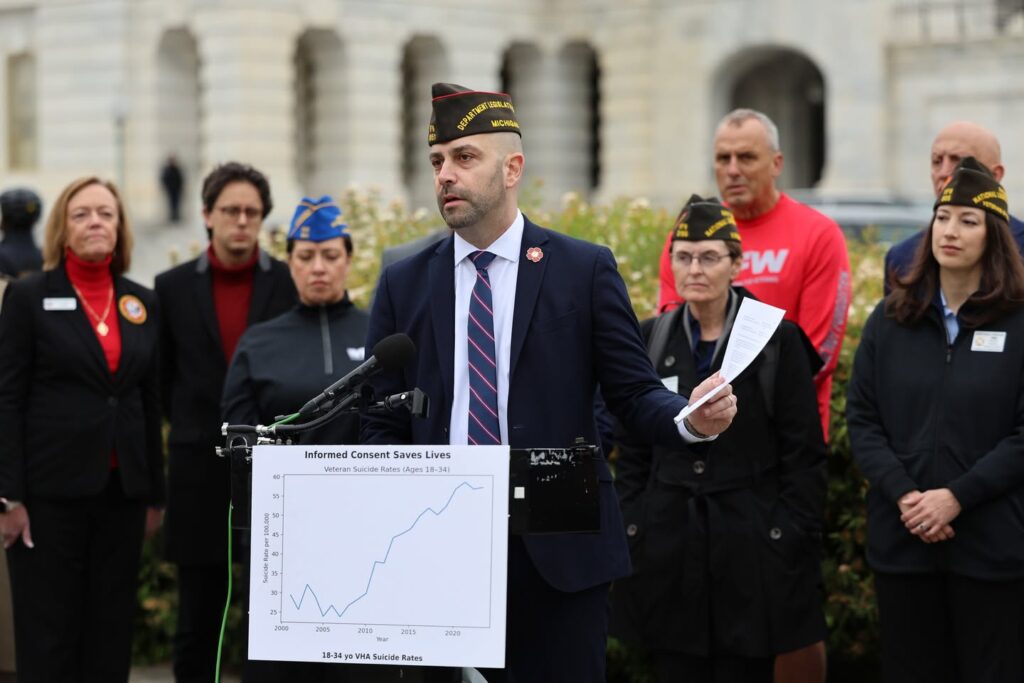

On the morning of April 29, representatives of 35 veterans’ service organizations (VSOs) gathered under cloudy skies on Capitol Hill for a press conference to announce a joint letter to Congress calling for the passage of the Written Informed Consent Act (H.R. 4837 / S. 3314) and for strengthened oversight of the Department of Veterans Affairs’ (VA) prescribing practices for high-risk psychotropic medications. Specifically, the bill seeks to expand the VA’s written informed consent protocol beyond long-term opioids to a range of other drugs, including antipsychotics, stimulants, antidepressants, anxiolytics, and narcotics.
Sponsored by Reps. Gus Bilirakis (R-Fl-12), Don Davis (D-NC-01), and Tom Barrett (R-MI-7), the House bill is currently gaining co-sponsors and interest across the House and Senate. The press conference was meant to showcase “growing bipartisan momentum” and “unified support from the Veteran community” for “enhanced transparency and accountability in health care decision-making,” according to a press release from Rep. Bilirakis’ office.
Mad in America’s ongoing coverage of veteran advocacy has documented the journey to this moment, which has taken the better part of eight years thus far. In 2018, Air Force veteran Derek Blumke had barely emerged from his own polypharmacy nightmare when he began advocating and organizing among the veteran community. He co-authored with Robert Whitaker the blockbuster 2019 report “Screening + Drug Treatment = Increase in Veteran Suicides.”
A few years later, Blumke partnered with the GruntStyle Foundation (GSF), alongside Veterans of Foreign Wars (VFW), Burn Pits 360, and many other major national VSOs. After this broad coalition secured victory on Iraq and Afghanistan veterans’ exposure to burn pits with the passage of the PACT Act in 2022, they set their sights on the next battle: VA overprescribing and the veteran suicide epidemic.
By June 2024, GSF launched the War Cry for Change campaign to drive reform at the VA to include implementing written informed consent, among a host of increased prescribing safety measures. Veterans and military families impacted by suicide gathered on Capitol Hill in June 2025 for a daylong summit, rallying support from several members of Congress and administration officials who attended and spoke at the event. Momentum has continued to mount as the U.S. Senate Committee on Veterans’ Affairs held a hearing on medication management in VA healthcare last December.
As Robert Whitaker reported in Mad in America, previous efforts by advocacy groups to implement safer prescribing practices at the VA have been blocked by the American Psychiatric Association, until now.
Blumke, veteran impact fellow at GSF and emcee of the event, provided a solemn grounding in the urgent need for Congressional action. He began by reading a partial list of veterans who died by suicide while under the care of the VA: “Connor Brumfield, US Army veteran, 22 years old. Hunter Whitley, US Marine Corps veteran, 23 years old. Mark Miller, US Navy veteran, 53 years old. Ian Fishback, US Army veteran and my friend, 42 years old. These are just a few of the names we’ve lost to suicide and gaps and the way we provide care to our nation’s veterans.”
Affixed to the podium sat an image of a graph with a fever line going nearly vertical. “This line tells a story and it is one of tragedy,” he continued, referencing how it represents a 108% increase in suicide rates for 18 to 34 year-old veterans over the last twenty years. Nearly 70% of veterans under VA care are prescribed psychotropic medications, more than three and-a-half times the rate of the civilian population. Polypharmacy is so rampant that it has its own nickname: the “combat cocktail.”
“Despite nearly $200 billion invested, what our nation has been doing is not working,” Blumke said. “And that is why we’re here today . . . Our message is not one that medications are bad. The message is that if we’re prescribing medications that do have risks, we should be smarter and safer in the way in which we do so.”
Megan Coleman, associate director for health at VFW, spoke about a member named Eric, who eventually ended up on 30 separate medications for chronic health conditions, some of which should not have been taken together.
“He reached a breaking point,” Coleman said. “Not because he rejected care, but because he didn’t understand it. He couldn’t tell what was happening from his conditions and what was coming from the medications. And those conversations about how these medications interact, what cumulative impact looks like, and what alternatives exist did not happen clearly in the beginning of treatment when they would have mattered the most.”
Luckily, Coleman explained, Eric finally got the support to reduce the number of medications he was taking by nearly two-thirds, and “finally got his life back.”
Like many other speakers, Coleman underscored that this bill was not about removing choices or resources from patients, explaining that it “does not restrict care” but “strengthens understanding.”
“Informed consent is not just a signature. It’s truly the ability to say, ‘I understand what this means for me,’” she said.

In a political atmosphere characterized by ever-increasing polarization and fragmentation, consensus on written informed consent is building across the aisle. In his remarks, U.S. Marine Corps veteran Brian O’Callaghan thanked the bill’s sponsors, noting: “None of this legislation is going to get them headlines. It is not going to generate fundraising in a very busy year. It is going to save lives. It is going to keep families whole. It is going to keep veterans out of the justice system. It is the very type of serious legislation and serious policy that our veterans deserve.”
“This legislation is about something very simple but incredibly important: Respecting our veterans with full transparency when it comes to their medical care,” said Congressman Bilirakis, the first of the bill’s three original sponsors. “They deserve it.”
“The Written Informed Consent Act has earned strong support from veterans advocacy organizations,” he continued, “because it reflects what they have been asking for: accountability, clarity, and respect in medical decision making … Let’s get this done, folks.”

Blumke next introduced Rep. Tom Barrett, U.S. Army veteran who served as a helicopter pilot in Iraq, and who also happens to represent him in Michigan. “When I called and asked for help, it wasn’t even a blink,” he said.
“We’ve seen the devastating effects of a far too high and chronically out of reach veteran suicide epidemic that we’ve faced,” Rep. Barrett began. “This is something we’ve tried to confront and address through advocacy, awareness, all these other ways that we have tried to confront this scourge that we have faced in our country. And those efforts, frankly, have fallen short.”
“We can’t continue to do the exact same thing and expect different results and just run more TV commercials about veteran suicide awareness,” he added. “People are aware of this problem. It’s not that we are unaware of it. It’s that we need to confront the underlying risk factors that exist. So, this legislation today is critically important to take a first step in that effort. I look forward to getting this across the finish line.”
U.S. Air Force veteran and Democratic Congressman Don Davis began his remarks by turning to face the representatives of the various VSOs assembled behind him, saying, “I want to thank all these veterans who are not only trying to advance this policy perhaps for themselves, but more importantly to be strong advocates for so many other veterans.”
“There are potent medications out there, ” Rep. Davis said. “We know this and we also understand some of those medications have real side effects. Our veterans deserve a full understanding of what they’re taking and what those side effects might be.”
Referring to the 35 veteran and military organizations supporting the bill, he noted, “It speaks volumes. A unified voice sends a clear message. We’re standing united today to send a clear message through the halls of Congress. The least we can do is ensure that when veterans come home, their care is grounded in transparency, respect, and accountability.”

After the remarks from Congressional sponsors, a number of other VSO representatives continued to speak out in support of the bill. Candace Wheeler, head of government relations for the Tragedy Assistance Program for Survivors, or TAPS, a national organization that describes its work as providing comfort, care, and resources to all those grieving the death of a military or veteran loved one, shared a sobering statistic about their service-users. “Of the survivors seeking our care in 2025,” Wheeler noted, “twenty-nine percent were suicide loss survivors.”
“Ensuring veterans and their families are aware of the potential side effects of high risk medications will empower veterans to make informed decisions, reduce suicide, and help save precious lives,” she said.

“I can’t take out a mortgage without about a sheaf of paper this thick requiring my signature every third page so that I have written informed consent,” said U.S. Army Major General Jeff Phillips, representing the National Defense Committee.
“And yet picture yourself as a veteran sitting across from a VA doctor who has just informed you you have stage three cancer. And has told you … that you’re going to be taking a lot of medications. Some of them, psychotropic Black Box. You have no idea what these are, and the amounts of these drugs add up…”
“You have no instruction manual telling you what’s going on with these drugs, which were prescribed in good faith. And maybe down the line you make a very tragic decision about your own life, that becomes a tragedy to those who love you.”
“Written informed consent is a pivotal decision that our government must take,” Phillips continued. “And if it takes the passage of this act, this bill, then that’s a great step forward.”
The event concluded with remarks by Le Roy Torres, who along with his spouse Rosie Torres founded Burn Pits 360. The couple were instrumental in the passage of the PACT Act. Torres told a story of how he was given multiple medications by VA doctors who had not yet recognized that he had an undiagnosed toxic brain injury. In emotional and physical agony, Torres was going to end his life by firearm when his dog Hope physically intervened and interrupted the act.
“Hope saved my life through loyalty and instinct,” Torres said, “This bill can save thousands more through transparency and respect for the veterans’ right to know.”

Following the press conference, a number of VSO representatives and veterans hand-delivered their joint letter to Congressional leadership.
“For the veterans still being prescribed medications they were never warned about, and for the families of those who did not survive them, the message is simple: the country is finally listening, and the work is finally moving,” GSF and VFW said in a joint statement celebrating their recent advocacy victories on written informed consent and access to alternative therapies.
Reflecting on this advocacy work over the past eight years, Blumke admitted to Mad in America that he never imagined he’d still be engaged in this battle. “I don’t think any of us imagined that we’d be working on this for so long. Because we all agree that it’s common sense. It’s absurd that we’re having to fight for this,” he said.
“Our ‘dangerous’ ask is, ‘Make sure you tell us about the treatment you’re going to give us.’”