
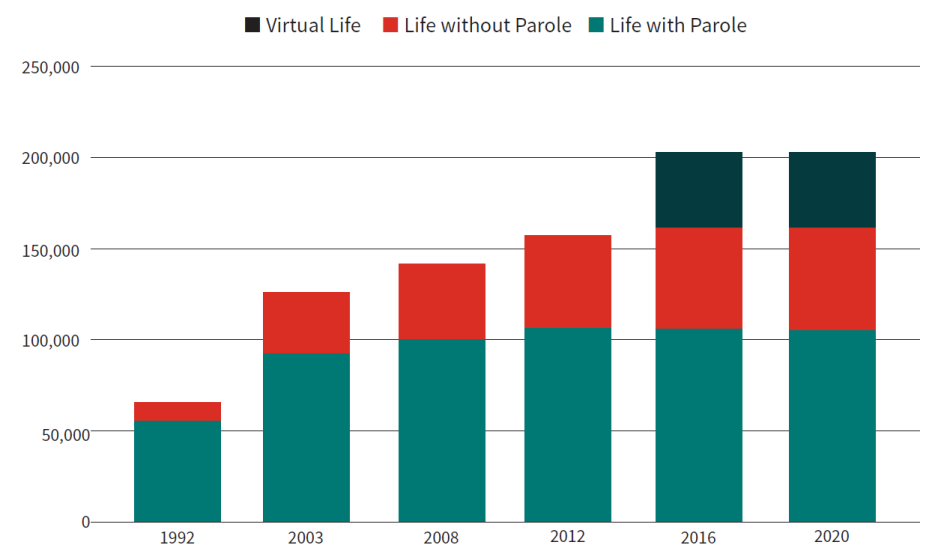

Mass incarceration’s toll on human dignity is no more apparent than with the staggering proliferation of life sentences; today one in seven imprisoned people is serving a life sentence. Life sentences have consistently been included as a sentencing option, but their use expanded dramatically during the era of mass incarceration. Historically, life sentences came with the expectation of release; they were used to encourage good behavior among people who were incarcerated. Individuals were typically released in 10-15 years through parole or executive clemency.
Sources: Figures for 1992 obtained from: Maguire, K., Pastore, A. L., & Flanagan, T. J. (Eds.) (1993). Sourcebook of Criminal Justice Statistics 1992. Bureau of Justice Statistics. Figures for 2005 obtained from: Liptak, A. (2005, October 5). Serving life with no chance at redemption. The New York Times. Data for 2003, 2008, 2012, 2016, and 2020 were collected from each state’s department of corrections by The Sentencing Project.
Official statistics of persons serving life were first published in 1984, showing that 34,000 people were serving life sentences, though these figures did not distinguish sentences of life with parole and life without parole. As depicted in Figure 8 above, In 1992, 9,404 people were reportedly serving LWOP and another 57,888 people had parole-eligible life sentences. By 2003, the number of people serving LWOP had more than tripled and parole eligible lifers had increased 62%. By 2020, six times as many people were serving LWOP, reaching an all-time high of 55,945; the total population of people serving LWP rose 82% over these years.
Evidence shows that criminal careers are relatively short, in the range of 10 years, meaning that continued incarceration beyond this point produces diminishing returns on public safety, wasting limited resources that could be put toward effective crime prevention strategies. Concluding that long sentences deter criminal behavior assumes rational, uncompromised decision making and a fairly sophisticated understanding of the criminal code, neither of which is likely before the commission of a crime. Among youth, research finds that brain development impacts behavior, and therefore punishments must accommodate this reality.
The growth of life imprisonment is echoed by the growth of long prison terms more broadly. Sentences of all lengths have expanded during the era of mass incarceration. The infamous “Rockefeller Drug Laws” (1973), which mandated 15 years for possession of marijuana and other drugs, was the first in a broad range of state-level mandatory sentencing schemes. In 1984, Washington state adopted the nation’s first “truth-in-sentencing” law that required people to serve 85% of their sentences, and 27 states quickly adopted similar laws over the next 15 years. Fourteen states had eliminated parole altogether.
Nearly one in five people in U.S. prisons—over 260,000 people—had already served at least 10 years as of 2019. This is an increase from 133,000 people in 2000—which represented 10% of the prison population in that year.
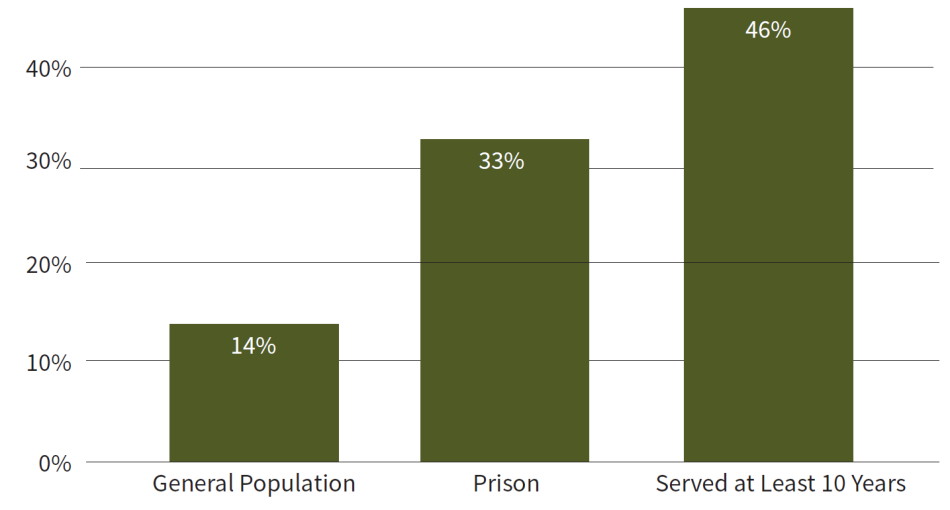
While Black Americans are vastly over-represented in the prison population, this disparity widens for those serving lengthy sentences. As depicted in Figure 9, in 2019, Black Americans represented 14% of the total U.S. population, 33% of the total prison population, and 46% of the prison population who had already served at least 10 years.
Racial disparities in the criminal legal system are at their most extreme among people serving life sentences; Black Americans comprise 55% of those serving life without the possibility of parole, the most extreme life sentence.
Sources: U.S. Census Bureau, 2019 American Community Survey 1-Year Estimates; Carson, E.A. (2020). Prisoners in 2019. Bureau of Justice Statistics; Bureau of Justice Statistics. National Corrections Reporting Program, 1991-2019: Selected Variables. Inter-university Consortium for Political and Social Research [distributor], 2021-07-15.