Part 5: Recommendations
The United States continues to be an international outlier due to the sheer number of people stripped of their voting rights as a result of a felony-level conviction. The states of Maine and Vermont should be applauded for their historic enshrinement of voting rights for all its citizens.
For incarcerated citizens who can vote – those with misdemeanor convictions or awaiting resolution of their charges but also those completing felony-level sentences as in Maine and Vermont – the United States also lags behind other countries in providing access to voting. Many countries, such as Chile, Croatia, and the Netherlands, have removed logistical barriers to voting by including polling stations within their prison system. In the United States, Cook County (Chicago, Illinois), the District of Columbia, and Harris County (Houston, Texas) have been successful in establishing polling stations inside jails – facilities where transitions from incarceration to release happen much more quickly compared to prisons. Given the extent of mass incarceration in the United States, it is especially important to protect democratic rights by disentangling voting rights from criminal sanctions.
The logistical complexities of voting while in a prison environment are significant, but upholding our democratic commitment to an inclusive and representative government is worth the investment to improve voter education and voting access for everyone. Based on what we have learned from our study of Maine and Vermont, The Sentencing Project offers the following recommendations to advance voting access in our nation’s correctional facilities:
Universal Recommendation: Implement In-Person Voting in Prisons
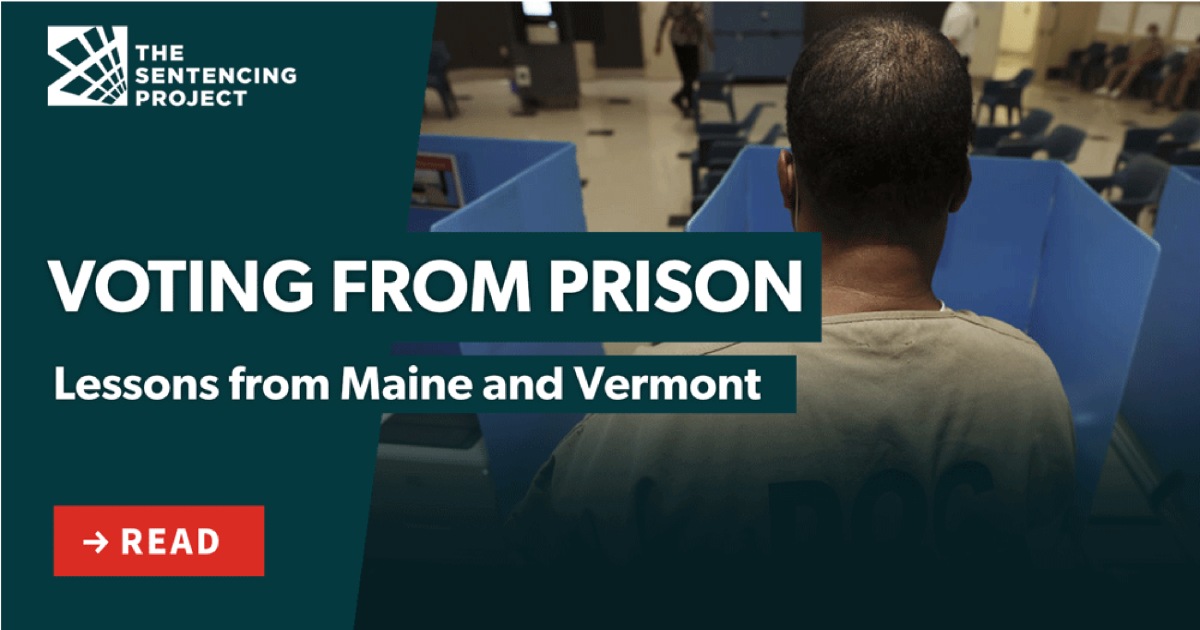
To truly provide equitable access to voting and democracy, The Sentencing Project advocates for the implementation of on-site polling locations in all prisons and jails where there are eligible voters. Based on our interviews with corrections staff who work in Maine and Vermont, as well as the vast majority of stakeholders who support voting rights work, there is support to reimagine how incarcerated residents vote – to make in-person voting a reality within the facilities.
- “If we wanted to reduce barriers, [by] having in-person polling stations I think we would increase our turnout dramatically…There wouldn’t be those extra extra hoops to jump through…” – Staff member, Vermont Department of Corrections
- “I think on voting days, somebody should be running a voting station in here. This is a community, right?” – Staff member, Maine Department of Corrections
In Maine and Vermont, the majority (65%) of survey respondents stated they would like the option to vote in person. Incarcerated residents commented on how having on-site voting would make it easier for them to vote.
All Departments of Corrections should consider affirmatively supporting legislation and any policy that permits on-site polling locations at correctional facilities. Incarcerated people should have the opportunity to vote in person.
Recommendations for Developing Institutional Policies and Practices for Departments of Corrections Leadership and Staff
(1) Create an official voting rights policy and a corresponding staff guidance document on voting rights work in all Departments of Corrections.
Create a stand-alone institutional-wide voting rights policy that affirms, or reaffirms, incarcerated residents’ right to vote, making clear that they do not lose their right to vote upon incarceration. A voting rights policy should also be included in all facility-level handbooks and orientation packets distributed to incarcerated residents.
A staff guidance document should formally outline staff roles and responsibilities in relation to voting rights work, increase efficiency of time that staff allocate to duties, create staff understanding of when and how voting rights work is to be conducted throughout the year and during election cycles, inform decision-making resulting in improvements to the voting rights work, and increase consistency across facilities.
Policies and guidance help create institutional knowledge, assist when training new staff, and guide supervisor and staff decision-making.
(2) Create opportunities for all-staff education on incarcerated residents’ voting rights and the basic process of assisting incarcerated residents who are voting from correctional facilities.
While particularly relevant for corrections staff tasked to execute this duty, all staff can benefit from learning how to assist incarcerated residents exercise their right to vote. These learning opportunities can be merged with events for incarcerated residents (e.g., orientation, voter education opportunities), but also included in new hire training and continuing education programs so that all staff have baseline knowledge. In Maine and Vermont, the imperative, baseline knowledge for all staff starts with a firm understanding that incarcerated residents retain their right to vote. Their training should go on to include an overview of voting policies and guidance documents, as well as how to help incarcerated residents when they inquire about voting. Such continuing education would also increase the number of staff who can serve as points of contacts for partner agencies and volunteers who help facilitate registration and ballot access.
Tailored training opportunities should be given to staff with voting rights duties. This training can be offered by a partner agency (e.g., Secretary of State) with expertise. This will result in designated staff (e.g., volunteer services coordinators, case managers) having the knowledge on how to assist incarcerated residents to register, update their voter registration, request absentee ballots, and return completed ballots. This is particularly relevant if staff are allowed to help incarcerated residents register online using state-run online registration websites.
(3) Create, formalize, and strengthen working relationships with voting rights partners across government agencies and other organizations.
Voting rights staff or designees should take an active role in cultivating and maintaining relationships with helpful external and internal partners. The Secretary of State’s Office, local chapters or branches of the League of Women Voters and the NAACP, Disability Rights offices, incarcerated resident-led groups, and other non-profit groups and volunteers, can assist with in-person voter registration drives and other processes, including innovations related to voting while incarcerated. These working relationships can help to streamline workflows that would help incarcerated residents and external partners address errors and corrections on voting rights forms. As suggested by one stakeholder, having more than one staff member as a point of contact speeds up the efficiency in correcting any errors on voting forms.
External agencies are not always aware of incarcerated residents’ limited access to the internet or the additional steps needed to navigate the voting process. Through better information-sharing among corrections staff and other agencies and partners, innovations may evolve that streamline the voting process during incarceration. It may also help to ease the workload (e.g., automatically being sent registration forms during election years without the need to request them).
Recommendations to Assist Incarcerated Voters with the Voting Process
(1) Increase education for incarcerated residents about their voting rights and how to vote.
We recommend leveraging partnerships with external and internal stakeholders who work with justice-impacted individuals and understand the many complexities of voting while incarcerated.
- Provide information about the residents’ right to vote at multiple touchpoints. For consistency, require informing all incarcerated residents about their voting rights during their intake process and orientation. Add additional touchpoints during case management sessions to remind incarcerated residents they can vote while they are incarcerated. Be sure to include information about voting rights in written policy and other documentation, like residents’ handbooks.
- Conduct quarterly voting rights informational sessions while concurrently providing more registration opportunities. Offering these general information sessions about voting and how to vote in one’s jurisdiction would give staff and voting rights partners four touchpoints throughout the year to register interested voters. As well as discrediting the misperception that incarcerated residents cannot vote, the goal would be to increase overall understanding of the voting process. Because in-person registration drives close to an election may not have the capacity to serve all interested incarcerated residents, distributing this work throughout the year may alleviate capacity and access concerns.
- Introduce “absentee ballot clinics” during election cycles. Following in-person registration drives, these clinics would help incarcerated residents learn what to do after they register to vote and receive help, if needed, to request their ballot. This will assist with closing any information gaps about the steps that must be taken between registering and casting a ballot (e.g., completing a ballot request form, addressing any Town Clerk challenge letters, etc.). Consider updating voting guidance documents to reflect this requirement.
- Introduce more opportunities for education about subjects like government and voting. Incarcerated residents who responded to the survey indicated that classes or other programming would be very helpful. A corrections staff member suggested using recordings that could be uploaded to tablets and made freely available to incarcerated residents. To this end, one might inquire if the in-state League of Women Voters or another partner organization would be able to make one or more such videos for incarcerated residents.
- Train incarcerated residents to be peer mentors so that they can offer assistance to other incarcerated residents who would like to vote, or learn about voting. As suggested by a staff member, incarcerated residents who are peer mentors could be a good resource to assist incarcerated residents with voter education. Peer-to-peer mentoring could play a crucial role in helping first-time voters navigate the voting process.
(2) Increase access to candidate information and voter referendum information.
- Aim to host one candidate forum each election cycle. Incarcerated residents’ survey responses strongly indicate there are not enough avenues for them to learn about candidates. Hosting a candidate forum would be a powerful way to increase education about an upcoming election. If permissible, these could be recorded and shared on tablets.
- Ensure access to permissible media without additional fees. National newspapers, regional and local newspapers, and other permissible publications should be widely available, and available electronically. Incarcerated residents should be able to access news media on their tablets without incurring surcharges.
- Allow nonpartisan candidate guides created by external partners to be available as hardcopy and on tablets during election cycles. While state-dependent, various organizations create voter guides for residents. In our work, we have come across such guides created by the Secretary of State’s Office and Disability Rights Vermont. These should be easily accessible to incarcerated residents.
Recommendations to Minimize Additional Logistical Challenges to Voting from Correctional Facilities
(1) Increase access to voting forms.
- Make more widely accessible the forms needed to register to vote. Staff members should stock an easily accessible supply of blank voter registration forms at each facility. Forms can be provided in shared communal spaces, including in any existing libraries and classrooms. New residents should receive a voter registration form in their orientation materials.
- During in-person voter registration drives, permit approved external partners – such as representatives from the in-state Disability Rights office or the Secretary of State’s Office – to use their work laptops or an assigned Department of Corrections computer to register voters online and request ballots if such services are available. This would help alleviate some of the logistical barriers and steps for incarcerated residents (i.e., the back-and-forth of mail). It also permits stakeholders to check on voter registration status, mailing addresses, and so on, in real time.
(2) Create a simplified calendar that clarifies timelines and due dates.
This is relevant for requesting or submitting registration forms, requesting an absentee ballot, and guidance on when completed absentee ballots are required to be received by the Board of Elections or Town Clerk’s office.
(3) Leverage the use of tablets at no cost to incarcerated residents.
Within policies and staff guidance documents, in addition to hard copies, permit and encourage staff to use tablets for sharing information on voting rights and voting events with incarcerated residents. Make available electronically any voting materials provided by external organizations (e.g., Disability Rights offices, Secretary of State’s Office, League of Women Voters). Tablets can also be used to send incarcerated residents reminders about deadlines and due dates for voter forms and ballots. Incarcerated residents should not have to pay to access voting rights information on their tablets.
(4) To address mail delays and the unpredictability of the mail system, if such services are available, allow incarcerated residents the option to register to vote online, and also to request and track their ballot online.
Access could be permitted through tablets with appropriate security settings, as well as implementing security settings on any other computers permitted for use (e.g., for education, law library). As an example, in Maine, the Department of the Secretary of State has valuable and relevant information on their website, including pages such as a voter lookup service, an absentee ballot request status tracker, and the listing of municipal clerks and registrars that helps incarcerated residents find their Town Clerk. Allowing incarcerated residents to use an official government website for voter-related tasks like registration mirrors what one would do if they were living in the community. Such normalizing prosocial behavior is a core principle of the Maine Department of Corrections. Assistance with online registration and other voting-related tasks could occur during in-person registration drives, absentee ballot clinics, and other informational voting rights events.
(5) Design internal mail policies for voting rights materials that ensure speed of delivery, have the status of legal or privileged mail, and outline proper staff handling of voting rights/legal mail.
Ensuring residents get their voting-related materials in a timely manner is of utmost importance. Establishing policy that directs staff to prioritize distribution of voter materials during election cycles would help speed up the traditional absentee voter process. The policy should make clear for both staff and incarcerated residents which voting materials are classified as legal mail. We advocate for registration forms, ballot requests, and ballots to be designated as legal mail. At minimum, ballots should be considered legal mail. The documents should not be photocopied. Staff working in the mail room must be kept up-to-date on the legal mail classification for voting forms, as well as how to handle those documents in line with security protocols and legal mail classification.