
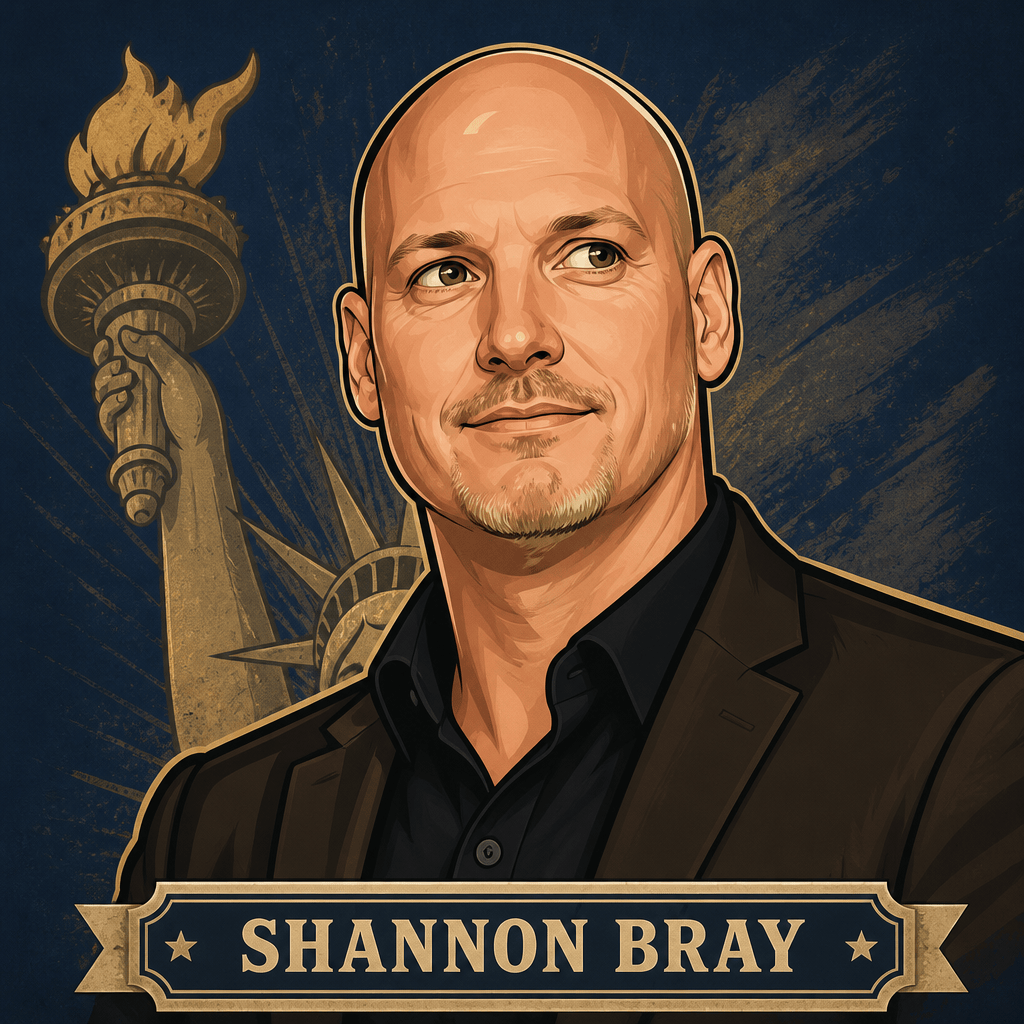
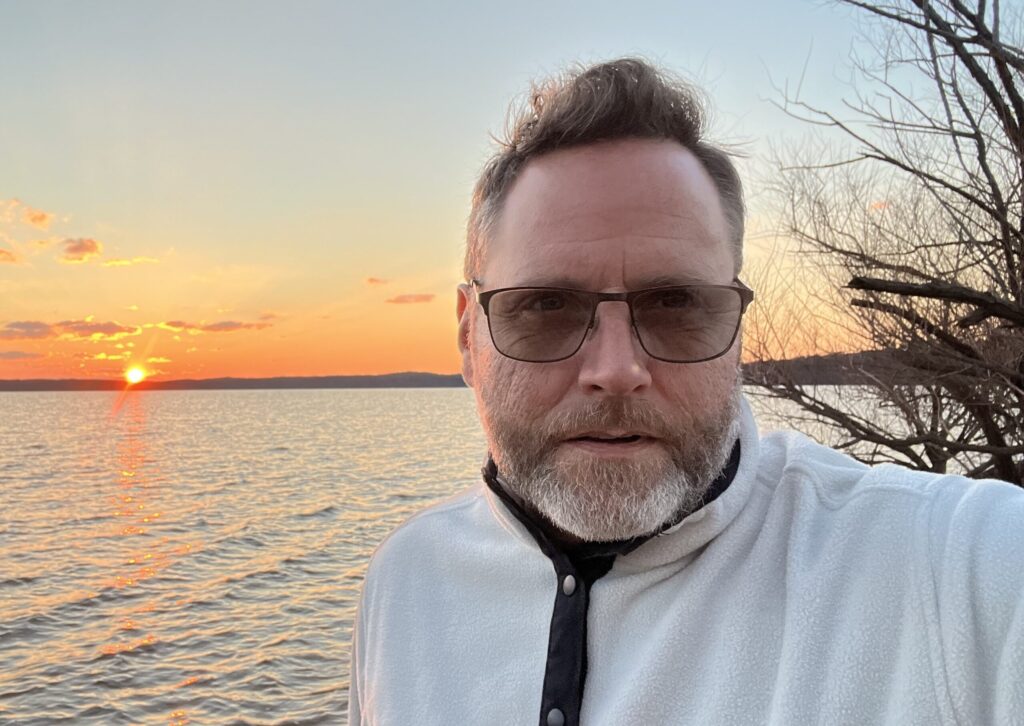
As the 2026 North Carolina U.S. Senate race approaches, invōk is proud to endorse Shannon Bray, the Libertarian candidate. Our endorsement stems from a desire for accountability, transparency, and a shift away from the entrenched two-party system that has long failed to serve the people.
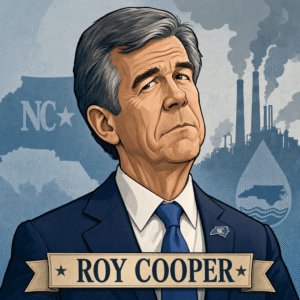
During Roy Cooper’s administration, North Carolina faced a significant environmental crisis. Chemours, the company that has been discharging PFAS/GenX compounds into the Cape Fear River — the drinking water source for hundreds of thousands of downstream residents — for 40 years, was never charged criminally in connection with the contamination.[1] The state’s response was a 2019 consent order and civil penalties. Not one executive faced jail time for knowingly discharging these chemicals into the air and water supply of the Cape Fear region.
Purdue Pharma tells the same story. The company pleaded guilty to federal criminal charges in 2020 — but that conviction landed on the corporate entity itself, a legal entity that cannot sit in a jail cell.[2] The Sackler family and Purdue executives who signed off on marketing opioids as safe and non-addictive, fueling an epidemic that has killed tens of thousands of Americans, faced no personal criminal accountability. No individual went to prison for the lie or the deaths.
The same pattern — regular people absorbing the cost while large corporations profit — played out again during the pandemic. Roy Cooper’s stay-at-home orders and “essential business” restrictions, beginning in March 2020, shut down or severely limited independent restaurants, retailers, gyms, salons, and countless other small operations across North Carolina. Within weeks, the NC Chamber of Commerce reported that roughly 25% of the state’s small businesses had already closed, with industry groups warning that more than half could shut down permanently if the restrictions continued — and the National Federation of Independent Business found that 92% of small business owners were reporting significant negative impact, with small-business optimism hitting its lowest point since the survey began in 1973.[3] North Carolina’s restaurant industry alone lost roughly 70,000 workers — about 17% of its entire workforce — and never fully recovered to its pre-pandemic size.[4]
These were not abstract statistics — they were family-owned restaurants, local retailers, salons, and gyms that had spent years building something, wiped out in weeks by government order, with no meaningful path to recoup the loss.
Meanwhile, the country’s largest corporations — the ones deemed “essential” and permitted to stay open and expand — didn’t just survive the lockdowns; they profited enormously from them. Nationally, Amazon and Walmart alone booked a combined $10.7 billion in additional profit during the pandemic, while passing on only a fraction of that windfall to the frontline workers who kept their stores and warehouses running — wage increases of roughly 7% at Amazon and 6% at Walmart, nowhere close to matching the scale of their gains.[5] Walmart’s e-commerce revenue jumped 97% during the same stretch that independent local retailers were being ordered to close their doors or restrict foot traffic entirely.[6] Big-box chains had the scale, the balance sheets, and the “essential” designation to weather the storm and even expand market share — small business owners had none of those advantages, only the closures.
This is the same corporate double standard that runs through every section of this endorsement: the people who could least afford it bore the weight of the crisis, while the corporations best positioned to absorb it came out ahead — and no governor, of either party, structured pandemic policy to change that outcome.
Here is the double standard at the heart of both cases: a corporation is legally shielded from the consequences a person would face — no executive goes to prison when the company is fined — while during these same years, tens of thousands of North Carolinians were arrested for simple drug possession. In 2024 alone, North Carolina recorded roughly 28,700 arrests for drug possession offenses out of about 31,700 total drug arrests statewide[7] — a pattern repeated year after year throughout Cooper’s tenure, adding up to hundreds of thousands of low-level possession arrests over his time in office.
Put plainly: an individual caught with a small amount of a controlled substance can be arrested, jailed, and saddled with a criminal record that follows them for life. A corporation that poisons a region’s water supply for 40 years, or funds a fraud campaign that killed thousands, pays a fine out of shareholder funds and continues operating. The corporate veil — the legal wall that treats a company as separate from the people who run it — protects executives from the jail time an ordinary citizen would face for far less harm. That is the double standard: corporations are shielded like individuals when it benefits them, but never punished like individuals when it should cost them.
This double standard becomes even harder to defend once you look at how corporations are treated as individuals: under Citizens United v. FEC (2010), the Supreme Court affirmed that corporations have a First Amendment right to spend money on political speech, extending “corporate personhood” into the electoral arena.[8] The result is a system where a corporation is legally a “person” with free speech rights and the ability to pour unlimited money into campaigns — but is not a person when it comes to criminal liability for poisoning a river or fueling an overdose crisis. Corporate personhood is invoked selectively: real enough to fund elections, conveniently fictional when it’s time to assign blame. Both parties — Democrats and Republicans alike — have built their campaigns on this same corporate-money architecture, which helps explain why neither has moved to close the accountability gap.
While corporate figures escape justice, North Carolina’s jails continue to fill with low-level drug offenders — a policy priority sustained under both Democratic and Republican leadership. The justice system’s aggressive enforcement against minor drug possession, expanded surveillance, and broadened police authority stand in stark contrast to the leniency shown to corporate offenders. This is the double standard in action: individual liberty is treated as expendable, while corporate liability is treated as untouchable.
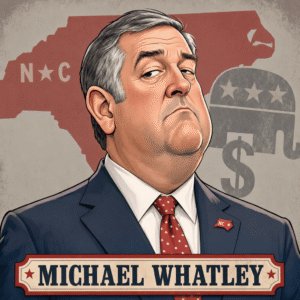
Before Michael Whatley was the GOP nominee for Senate, he was chairman of the North Carolina Republican Party and then chair of the Republican National Committee — installed there specifically because he was, in his own words and in the words of national reporters who covered him, a “stop the steal guy.”[9] Whatley spent years amplifying Donald Trump’s false claims that the 2020 election was stolen, telling audiences that Democrats had a “long-term strategy” to win through fraud — claims with no evidentiary basis.[10] Trump and his allies took those claims to court more than 60 times after the 2020 election. They lost virtually all of them, including in front of judges Trump himself had appointed, with courts repeatedly finding the fraud allegations baseless or “frivolous.”[11] Whatley didn’t just tolerate that campaign — he helped run it, then was rewarded with the top job in the national party for his loyalty to the narrative.
That same loyalty defines his current candidacy. Whatley has aligned himself with, and campaigned on, the full expansion of Trump’s second-term security and enforcement agenda:
ICE’s detention budget has more than tripled to roughly $45 billion, and the agency has moved to buy private detention facilities outright from operators like CoreCivic — a deal reported at $1.5 billion — specifically to reduce state and local oversight of conditions inside.[12] CoreCivic’s net income has jumped nearly 70%; GEO Group has likewise posted record profits converting warehouses into detention space.[13] This is indefinite immigration detention run as a for-profit business model, funded by taxpayers, with less independent inspection than before.
Flock Safety’s ALPR camera network has expanded to roughly 120,000 cameras nationwide. Civil liberties groups, including the ACLU and EFF, have documented misuse of that data to track political protesters, conduct discriminatory searches, and monitor reproductive-healthcare-related travel — all while independent audits show the vast majority of scans are never tied to any crime.[14]
Through 2026, the administration has repeatedly threatened and prepared military strikes on Iran amid a deteriorating standoff over the Strait of Hormuz, alternating between threats of “striking very hard” and last-minute stand-downs — an unstable pattern that has already disrupted global shipping and oil markets and increased the cost of goods for everyday families.[15] Trump himself has publicly accused oil companies of profiteering from the resulting price spikes, even as his own administration’s brinkmanship helps drive them. All while Trump has increased his net worth to over two billion dollars.
The same enforcement infrastructure — expanded surveillance, expanded detention capacity, and an emboldened federal enforcement posture — has coincided with growing documented use of ALPR and monitoring tools against protesters and advocacy groups, raising serious concerns from civil liberties organizations across the political spectrum about the criminalization of lawful dissent.
Congress passed the Epstein Files Transparency Act, which Trump signed into law in November 2025, requiring the DOJ to release all unclassified investigative files within 30 days. The DOJ has since released roughly 3.5 million pages — but missed its own deadlines, withheld material, and drawn a formal watchdog investigation into its compliance, with lawmakers from both parties now pushing a stronger follow-up bill (EFTA II) specifically because disclosure has been so incomplete.[16] The DOJ maintains that claims against Trump “lack credibility,” and no court has found otherwise — but the slow-walked, partial compliance itself is a documented, ongoing controversy, and voters deserve a senator willing to demand full compliance rather than defend the delay.
Whatley has offered no meaningful pushback on any of this. A candidate who spent years building his political career on debunked fraud claims, and who now stands behind an agenda of expanding detention-for-profit, mass surveillance, and unresolved transparency failures, is not a credible check on unaccountable power — he is part of the machinery that protects it.
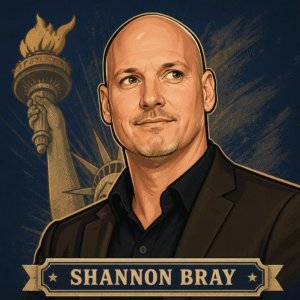
invōk urges voters to reconsider their options and choose leaders who will prioritize justice and civil liberties over corporate interests and the police state. Support Shannon Bray in the upcoming election to foster genuine change in North Carolina and to put the establishment on notice that we will no longer be their cattle or victims.
This blog post reflects invōk’s endorsement and aims to promote awareness of alternative political options.