
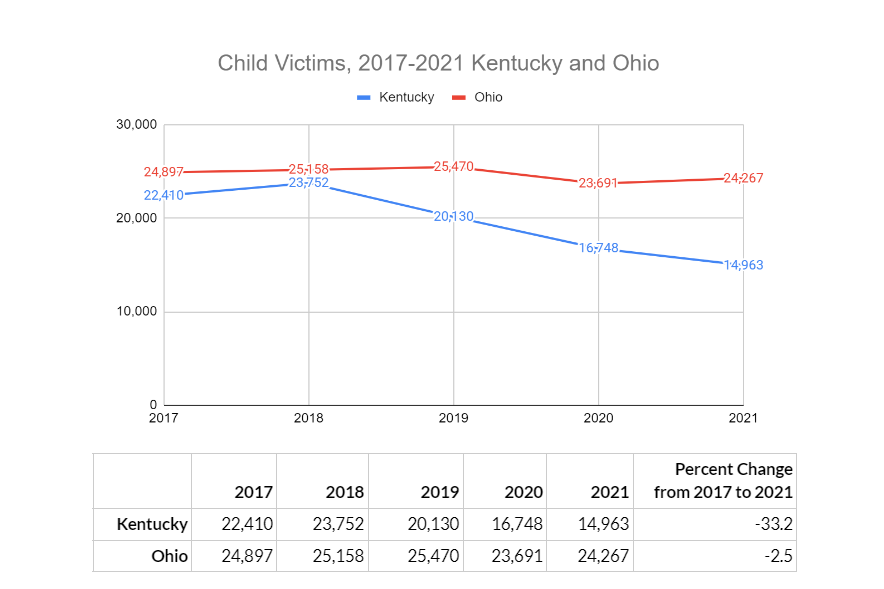
It is damnably difficult to establish causation in such matters. It’s impossible to do controlled experiments. However, the only significant change in Kentucky law during this period was the enactment of the presumption of equal shared parenting.
Within Ohio, we find more evidence that undermines concern that presumptions of equal parenting time put children at risk. Ohio law requires every county court to have a local “standard parenting time” rule. National Parents Organization has reviewed and evaluated the parenting time rules of Ohio’s 88 counties. The 2020 NPO Ohio Parenting Time Report uncovered radical variations in these local rules. Some guidelines provided children with equal or nearly equal time with each parent; but the overwhelming majority (58 counties) had guidelines marginalizing one parent in the children’s lives, allowing the children only every-other-weekend-and-one-evening-a-week time with one parent, or less. NPO’s report graded the counties based on their parenting time rules with those providing for equal or nearly equal parenting time receiving ‘A’s or ‘A-’s and those providing the outdated every-other-weekend-and-one- evening-a-week schedules grades in the ‘D’ range.
In 2022, NPO undertook a study correlating the grades counties received in the 2020 report with data from the Annie E. Casey’s Kids Count project.³ The results of that research show a very strong correlation between the county’s local parenting time rule—and, so, the parenting time arrangement that is more likely to be prevalent—with the lowering of the incidence of child maltreatment. Those counties with equal or nearly equal parenting time rules have consistently shown lower, and declining, rates of child abuse and neglect.
There could be multiple explanations for this consistent correlation and further research is needed to determine the causes. It could be that by reducing parental legal conflict over parenting time, courts are able to attend more closely to those cases that present significant risks of child maltreatment, stemming some of the harm to children. It could be, also, that lowering the conflict between the parents over parenting time reduces antagonism that spills over to the children. And, of course, part of the explanation could be that, where two parents are equally engaged in rearing their children, neither is as likely to feel overburdened and stressed out by child care responsibilities and both can serve as a watchful eye over the children’s well-being.
Whatever the mechanism, the study shows a stunning correlation between the incidence of child maltreatment and a county’s local parenting time rule.
Trust this device for 30 days