
Editor’s Note: This piece originally appeared on the Mad in America Substack.
Ever since the FDA issued a black box warning in 2004 that antidepressants increased the risk of suicidal behavior in children and adolescents, there has been the frequent publication of articles, in both psychiatry and public health journals, asserting that the warning led to a decrease in the prescribing of antidepressants to youth, which in turn led to an increase in suicide among this age group.
This claim is, in fact, easily rebutted. Suicide rates among youth ages 10 to 19 declined from 2005 to 2007, which was a period when, following the issuance of the black box warning, prescribing rates declined. When prescribing rates began to rise again, starting in 2008, suicide rates began to steadily rise as well. Even so, the publication of papers asserting the opposite has continued, with the mainstream media regularly reporting on their “findings.” Indeed, ask this question of AI—”Did the black box warning lead to an increase in youth suicide”—and it will likely spit out this answer:
Yes, multiple studies suggest the 2004 FDA “black box” warning led to unintended adverse consequences. The warning caused a significant drop in antidepressant prescriptions for youth, which was followed by a documented increase in youth suicide attempts and completed suicides.
The latest eruption of this claim occurred this spring, in an article by psychiatrist Arif Khan that appeared in Regulation, a policy magazine published by the CATO Institute. He and his co-authors wrote that ever since 2004, the black box warning had “discouraged” the prescribing of antidepressants to adolescents, leading to the “excess deaths of 2,365 children and 3,593 young adults.”
Three former FDA medical officers, Marc Stone, Andrew Mosholder and Tarek Hammand, published a stinging rebuke to Khan in the summer issue of Regulation. They pointed out that the Khan article was “factually inaccurate in ways that are directly verifiable from the evidence their article, itself, presents.”
For Mad in America, their stinging rebuke serves as a validation of our previous reporting on this issue. My hope is that with this Substack post, more attention will be directed to the reply article by Stone, Mosholder and Hammad, as it reveals how defenders of psychiatry and its drug treatments cannot be dissuaded by facts that tell of drug-caused harm.
We published our first report on this topic in 2012, and a second one in 2018.
In the first years following its issuance, the attack on the black box warning was led by Robert Gibbons, Director of the Center for Health Statistics at the University of Chicago. In a 2007 Journal of American Psychiatry article, he set forth the core argument that has been sounded again and again in attacks on the black box warning. He wrote that youth suicide rates in the U.S. increased by 14% between 2003 and 2004, and that SSRI prescriptions decreased by 22% after the black box warning was issued.
With that article, he had planted a story of harm done that the media dutifully echoed in its headlines. Gibbons, the Chicago Tribune reported, had “documented a close correlation between declining use of the antidepressants known as SSRIs and rising suicide rates among young people up to age 19.” He told the paper that the FDA’s black box warning had a “horrible and unintended effect” and should be withdrawn.
Now as critics soon pointed out, Gibbons had employed what could only be called a statistical sleight of hand to make his argument. He had matched the increase in suicides in 2003-2004 with a decline in prescribing in 2004-2005. The increase in suicides had occurred before the drop in prescribing occasioned by the black warning. As critics of his paper noted, a noticeable drop in prescribing to youth occurred from 2005 to 2007, and the youth suicide rate dropped in those years. But this information never made it into the newspaper headlines.
However, that data didn’t give Gibbons pause, and in 2012 he published two articles in the Archives of General Psychiatry asserting that antidepressants were quite effective in youth, and that in his review of RCT data for fluoxetine and venlafaxine, he had found “no evidence of increased suicide risk in youths receiving active medication.”
The media found this to be a compelling story, with headlines telling a story of harm done. As Gibbons told NPR, when the black box warning was issued, “I worried that what we might end up with was a real epidemic of suicide. And the data suggests that this is exactly what happened. Rather than the black-box warnings leading to decreases in child suicide rates, they were followed by some of the largest increases in child suicide rates both here in America and around the world.”
In response to those two articles, several critics, including David Healy and Mickey Nardo (a psychoanalyst who wrote the popular blog 1boringoldman), detailed the “tricks” that Gibbons had employed in his two papers. Nardo, in a series of posts, described the “inappropriate data selection, “opaque methodology,” “obvious arithmetic errors,” and “deceitful presentation” in the two papers. He sent a “Letter to the Editor” of the Archives of General Psychiatry, which the journal refused to publish in its print edition. Instead, it published his criticism online as a “Reader’s Reply,” which meant that it wouldn’t be indexed in PubMed, and thus wouldn’t show up in this primary archive of research findings.
At that time, I wrote a blog titled “The Triumph of Bad Science,” which reviewed this history as an example of how the psychiatric journals, in concert with major media, had presented to the public a narrative that could easily be shown to be false. I also noted that Gibbons had served as an “expert witness” for Wyeth and Pfizer Pharmaceuticals in cases related to antidepressants and suicide, which, of course, made his published results invaluable to makers of SSRIs.
After that, several more papers were published echoing the claims made by Gibbons, and invariably critics pointed out their flaws, but to little avail in terms of influencing the public narrative of “harm done.” Then, in 2018, STAT published an opinion piece by Stephen Soumerai, a professor of population medicine at Harvard Medical School, and Ross Koppel, from the University of Penn, in which they asserted—once again—that the black box warning was “continuing to dampen effective drug and non-drug treatment and monitoring for depression,” and that this had led to a steady rise in suicide among youth 10 to 19 years old.
Now, STAT has presented itself as a reliable publisher of health news, and indeed is staffed by a number of first-rate, experienced journalists. Yet, once I read the article, I could see that it was a classic example of how the mainstream media, including an outlet understood to provide sophisticated coverage of scientific findings, regularly publishes information about psychiatric treatments that is misleading and easily debunked.
In their article, Soumerai and Kopple published a graphic that was presented as the “smoking gun” in their argument that the black box warning had led to an increase in youth suicides. Here is the graphic:

If you look closely, you can see the visual sleight of hand they had employed to make their case. They had imposed trend lines that seemed to show that suicide rates had dramatically increased since the black box warning had been issued in 2004. The black box warning, they wrote, had dramatically decreased the prescribing of antidepressants to this age group, and their trend line told of a steady increase in suicides as this decrease in prescribing occurred.
However, if you ignore the trend line, you can see by looking at the individual dots marking suicide rates for each year that, in fact, the suicide rate for youth 10 to 19 years had declined from 2004 to 2007, and then had begun to slowly increase in 2008, and had continued to increase in the following years.
And with a little digging into the relevant governmental data, I published the actual correlational data:
Here is the graphic on suicide rates from 2004 to 2007 that we published in our 2018 report:

Although I am not sure of this, I believe our report was the first that detailed this step-by-step correlation between prescribing rates and suicide rates in the 12 years following the issuance of the black box warning, data that powerfully told of how SSRIs prescribed to youth raise their risk of suicide.
Even so, our report could be described as an act of ordinary journalism, as we had simply fleshed out what the critics of Gibbons and others had already made known, which was that the suicide rate had declined in the first years following the 2004 black box warning. Today, the debunking literature includes a 2018 article by Martin Plöderl and Michael Hengartner, a 2021 Letter to the Editor by Glenn Spielmans, and several articles by Marc Stone. But their criticisms did not turn into mainstream media headlines, and that was true too of our 2018 report, which was titled: “Adolescent Suicide and The Black Box Warning: STAT Gets It All Wrong.”
In their Regulation article, titled “In Defense of the Black Box Warning, Stone and colleagues set forth three fundamental facts.
First, Khan and colleagues characterized the RCT data that the FDA had evaluated before issuing its black box warning as “mixed and inclusive” regarding the risk of suicide in youth and as having “failed to showcase statistical significance.” In fact, Stone and colleagues noted in their reply, their 2004 analysis of pediatric trials found a relative risk for suicidal thinking or behavior of 1.95 (e.g. nearly twice the risk) in those taking an antidepressant compared to placebo. This was a result, they wrote, that was, “by any standard, statistically significant.” They also noted that in an FDA meta-analysis of 372 double-blind RCTS of antidepressant trials in adults, the risk of a suicide attempt for those under age 25 was 2.3 times higher for the antidepressant cohort compared to placebo. Thus, the RCT data convincingly told of an age-related higher risk of suicidal behavior in younger adults.
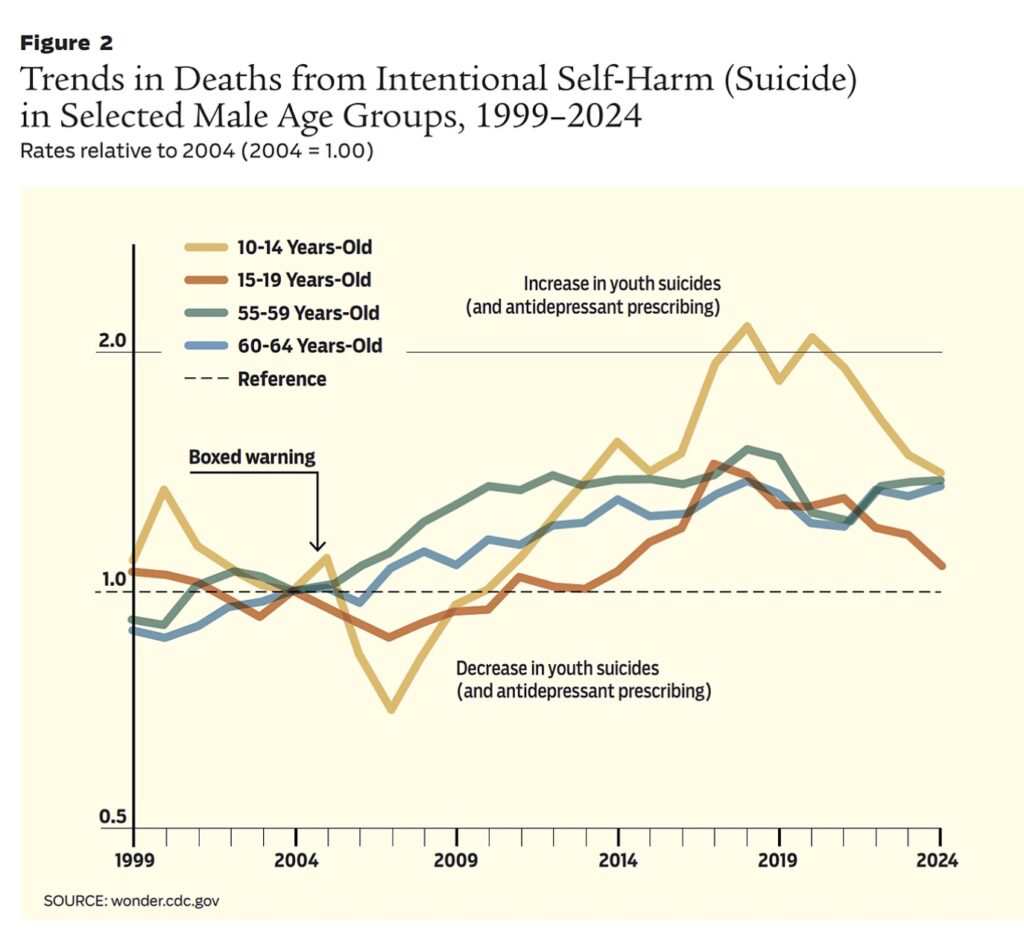
Second, they noted that Khan’s own “Figure 2” showed that the “suicide rate among 10 to 14-year-olds decreased for several years after the 2004-2005 warning and did not begin rising until 2007-2009, three to five years later.” Here is Khan’s graphic:
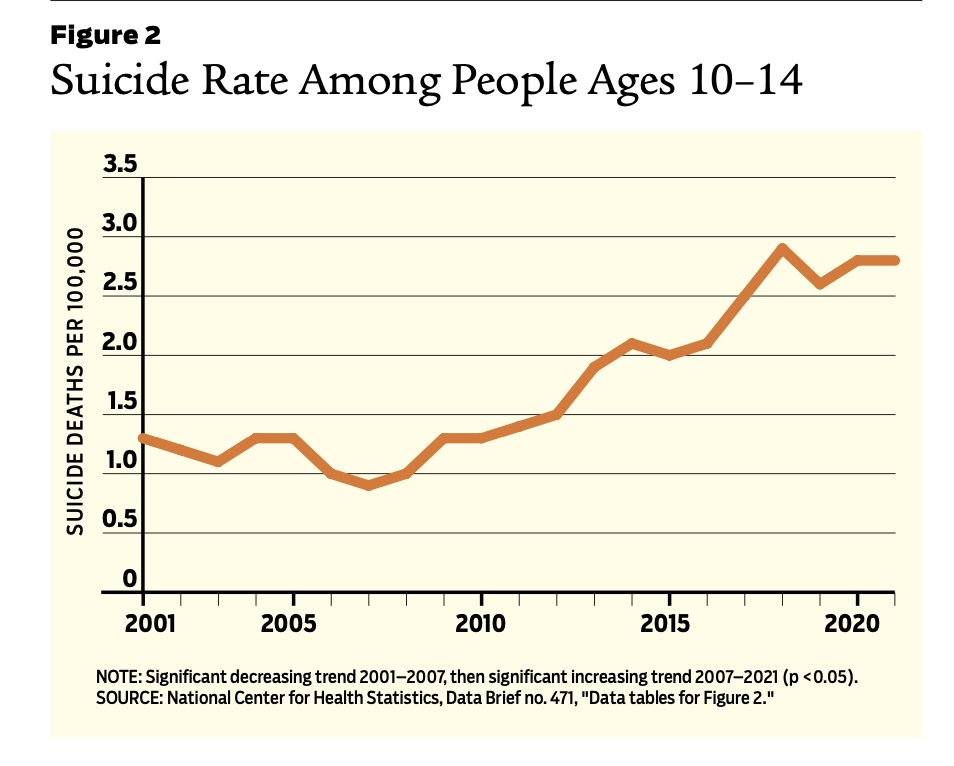
Indeed, they wrote, “between the issuance of the boxed warning in early 2005 and the end of 2007, a period during which the rate of youth antidepressant prescribing declined by 20 percent, suicide rates for girls aged 10-14 and 15-19 decreased by 46 percent and 30 percent, respectively. For boys, the declines were 29 percent and 13 percent, respectively.”
Third, they noted that prescribing of antidepressants to youth began to increase in 2008, returning to 2004 levels by 2011, and that after 2011, youth prescribing rates steadily increased, with suicide rates for girls and boys continuing to rise until at least 2017. They published two graphics showing this historical correlation between antidepressant prescribing and suicide rates in girls and boys 10 to 19 years old.

Stone and colleagues concluded: “On examination, the causal account advanced by Khan et al. is inconsistent with trial evidence, prescribing data, timing patterns, and healthcare-contact realities, and cannot account for observed suicide trends. The methodology underlying their cited evidence has been shown in peer-reviewed publications to be invalid for this purpose—publications Khan et al. possessed but did not cite.”
After the Stone rebuke was publishered, there was a further back and forth between the two parties. Khan and colleagues sought to defend their assertion, and Stone and colleagues responded by reviewing the longer history of such assertions, including a note on how Gibbons kicked it off with his 2007 sleight-of-hand paper that “presented two graphs not aligned to the same period.”
For two decades, defenders of antidepressants have periodically published articles claiming that the black box warning led to a decrease in prescribing of antidepressants to youth and an increase in youth suicides. Yet, such claims were easily shown to be false. But the defenders of antidepressants, rather than acknowledge that the RCT data and the correlative data told of how antidepressants increased the risk of suicide in adolescents, simply ignored these facts. By doing so, their publications greased the way for a dramatic increase in prescribing of antidepressants to youths, far above the prescription rate prior to the black box warning.
Thus, when Khan and colleagues calculated the excess deaths present in the increase in suicide rates, they were, in fact, telling of the harm they have caused with their spurious publications telling of how the black box warning increased the risk of suicide. In their article, they were subtly accusing the architects of the black box warning with responsibility for the “excess deaths,” but if one wanted to do an assessment of who has “blood on their hands,” in this instance you would only need to ask who published articles that provided reason for prescribers to ignore the black box warning.
There is, in fact, a curious addendum to this story. Prior to submitting their article to Regulation, Khan and his co-authors sent a draft to Stone and Mosholder for their feedback. Stone and Mosholder sent back a critique that “identified specific errors and directed the authors to published work contradicting their conclusions.” However, Khan ignored their feedback, and as Stone and Mosholder wrote, “given the importance of this issue, we were concerned to see the article published without correcting any identifying error and without citing the published literature.
That is quite the telling anecdote. If Khan and his co-authors were truly interested in investigating this topic, they of course would have addressed this feedback and followed up on the published work “contradicting their conclusions.” But they made no such changes in their draft, evidently disinterested in reviewing facts that belied the claim they were poised to publish.
As Stone and Mosholder wrote, this is an important topic. One hopes that their Regulation paper will be read and discussed, and that the New York Times or other major media will report on their paper, and detail how, in fact, there is powerful evidence that a failure to heed the warning, which resulted in soaring prescribing rates, led to thousands of “excess deaths” due to suicides in youth 10 to 19 years old.
–
This post was originally published on Mad In America.