Source: Data were obtained from individual state departments of corrections in 2020. Maine and West Virginia do not report any individuals serving LWP or virtual life for crimes committed when under 18.
* = These states have recently enacted reforms that extend JLWOP bans to other extreme sentences which affect some or all LWP or VL sentences, depending on the statute. For instance, in 2021, Virginia enacted a law to allow parole review for all persons who were under 18 at the time of their crime and have served 20 years. The state’s legislative analysis predicts that a total 720 individuals, including those noted in the table above, qualify for reforms under this Act. For a complete list, see Feldman, B. (2024). The second look movement: A review of the nation’s sentence review laws. The Sentencing Project. Appendix I. The Sentencing Project.
Despite the reality that people “age out” of criminal activity as they approach adulthood, jurisdictions impose lengthy and life sentences for young people under the misconception that long sentences serve a deterrent, rehabilitative, or retributive function. Yet recidivism among those resentenced and released from life sentences is rare.
Many of the 8,600 individuals identified in Table 2 have already served decades in prison beyond their risk to public safety. In most instances, the underlying crimes were serious: over three quarters were convicted of a homicide and 8% were convicted of a rape or sexual assault. Twelve percent of those serving parole-eligible life or a virtual life sentence were convicted for assaults and robberies. Drug and property crimes were among the least represented offenses, but 57 individuals were serving life with parole or virtual life sentences for these nonviolent crimes.
Race
An abundance of evidence shows that Black Americans receive harsher sentencing outcomes than whites across the sentencing spectrum, from the initial decision of whether to incarcerate to the length of sentence imposed. Recent research has noted that racial disparities are especially extreme for lengthier sentences. Black people make up 53% of young people sentenced to LWP and virtual life sentences. In the following states, at least 80% of people serving these sentences are Black: Alabama, Georgia, Louisiana, Maryland, and Mississippi. Disproportionality is not limited to states in the south: in Indiana, all five people serving life with the possibility of parole are Black. In Wisconsin half of the youth serving life with parole are Black.
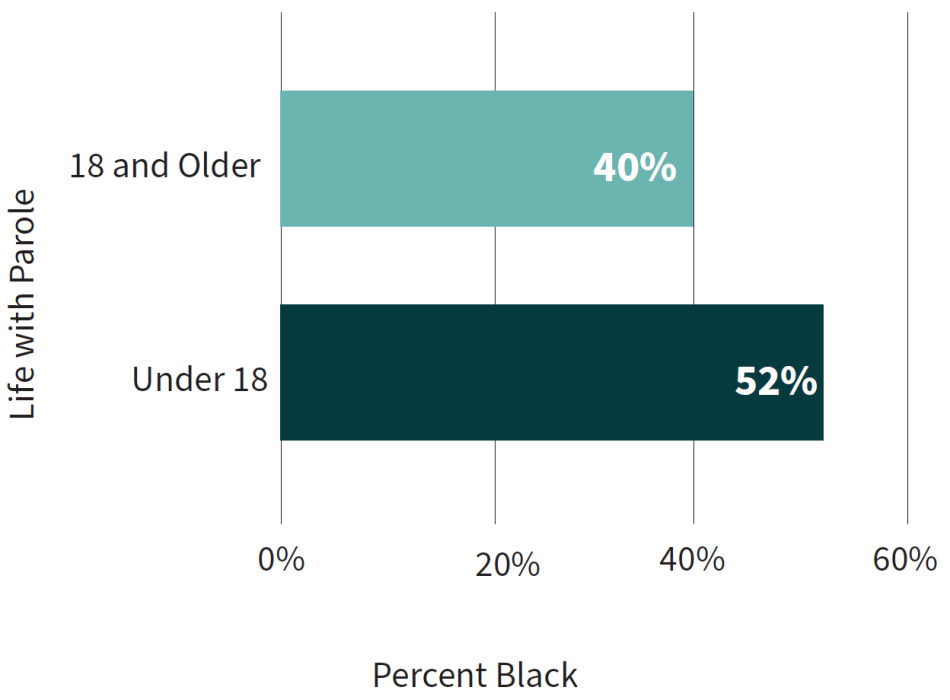
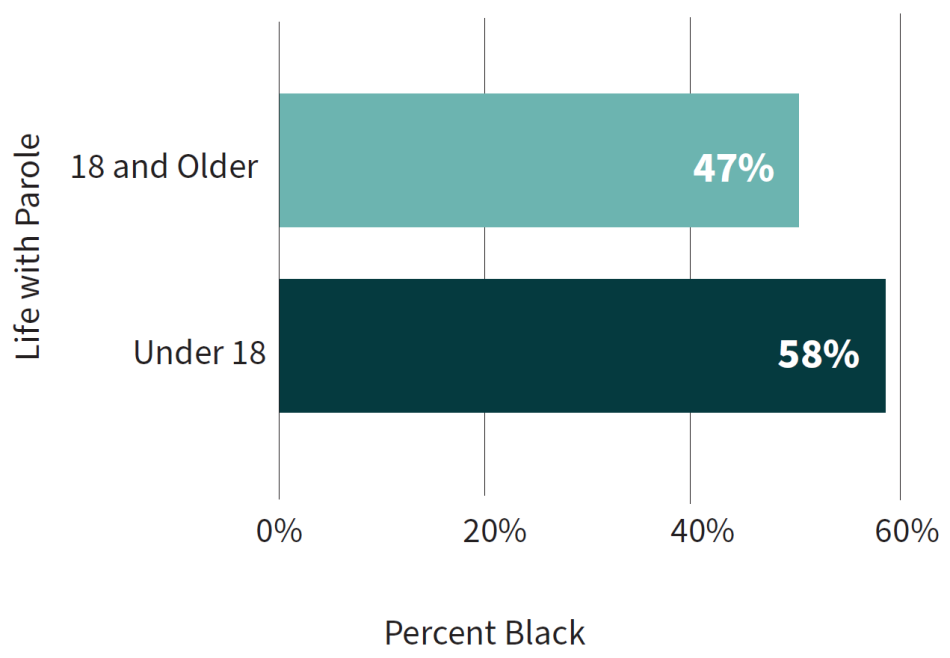
When looking at the racial composition of people serving LWP and virtual life sentences, these statistics reveal that Black youth are disproportionately represented in the population of those serving these severe sentences, compared to Black adults. Figures 2 and 3 show that 40% of adults serving life-without-parole sentences are Black, compared with 52% juveniles who are Black. Similarly, while 47% of people 18 and older who are serving virtual life sentences are Black, 58% of juveniles serving virtual life sentences are Black.
Figure 2. Race, Juvenile Status, and Life with Parole Sentences
Figure 3. Race, Juvenile Status, and Virtual Life Sentences
Life Sentences Still Widely Imposed on Emerging Adults
A broad range of experts across the fields of neuroscience, sociology, and psychology agree that juvenile and emerging adult defendants share similarities in their reduced culpability and developmental immaturity. Cognitive, emotional, and physical developments occurring between the ages of 18 and 25 or even later are consequential to behavior. As such, emerging adults have maturity levels more like individuals under 18 than those who have fully developed into adulthood.
To explore the population of emerging adults further, The Sentencing Project examined state-level sentencing data of 30,000 individuals sentenced to life without parole (LWOP) between 1995 and 2017. Here we found that two in five individuals sentenced to LWOP had been 25 or younger at the time of their conviction. In Pennsylvania and Michigan, half of the LWOP population falls in the category of emerging adults. Overall, the peak age at conviction for people sentenced to LWOP is 23 years old. This is a critical finding, since this age falls well within the standard boundaries of emerging adulthood.
Additionally, being Black and young produced a substantially larger share of LWOP sentences than being Black alone: two thirds (66%) of emerging adults sentenced to LWOP were Black. Among people sentenced to LWOP in adulthood, 51% are Black. Though we cannot make causal connections from these data alone, racism clearly plays a role in Black people’s experience of the criminal legal system from start to end.
Expanding Reforms to Emerging Adults
As awareness of the diminished psychological capacity of emerging adults increases, more than a dozen states have introduced or implemented reforms to protect emerging adults from some punishments that would be unduly harsh given their stage of development. Some reforms extend to those serving life sentences. In 2019, the Illinois legislature voted to allow parole review at 10 or 20 years into a sentence for most crimes, exclusive of LWOP sentences, if the individual was under 21 at the time of the offense. Those going before a parole board now have a right to an attorney and at least one member of the board must hold expertise on the issue of adolescent development. In its review process, the parole board is required to give great weight to the hallmark features of youth and subsequent growth in making its parole decision. Unfortunately, the law does not apply retroactively.
Also in Illinois, the legislature moved to end LWOP for individuals under 21 years old in most instances, permitting review after 40 years. Though the law is not retroactively applied, reforms are underway to remedy this. If successful, the reform would allow the possibility of eventual release of as many as 3,000 people.
In January 2024, the supreme court of Massachusetts ruled in
Mattis v. Commonwealth that life without parole sentences for those who were between 18 and 20 would violate the state’s constitutional protections against cruel or unusual punishments. This ruling extended the court’s previous decision in
Diatchenko v. Massachusetts, which banned LWOP for persons who were under 18 at the time of the crime. Basing arguments on the latest understanding of emerging adulthood, lawyers for Mr. Mattis successfully argued that older adolescents share markers of neurobiological maturity more like younger adolescents rather than adults.
In California, individuals whose crime occurred when they were between 18 and 26 are classified as “youthful offenders” and, with the exception of LWOP sentences, are afforded a specialized parole review within 15-25 years, depending on age at offense.
In 2024, Washington’s highest court rendered a favorable ruling in
State v. Monschke. This case tested whether LWOP was appropriate for persons under 20 years old. The court determined that mitigating qualities of youthfulness for people under 20 demanded a new sentence.
In 2022, a Michigan appellate court ruled, in the case of
People v. Parks, that it is unconstitutional to sentence 18-year-old defendants convicted of first-degree murder to life without parole. Citing neurological research in its ruling, the court held that the state constitution “prohibits imposing sentences of mandatory life without parole for 18-year-old defendants convicted of first-degree murder, given that their neurological characteristics are identical to those of juveniles.”
Conclusion
The Sentencing Project continues to advocate for the resentencing of youth and emerging adults with LWOP sentences, understanding that lengthy prison sentences ignore the fact that most people who commit crime, even those who have committed a series of crimes, age out of criminal conduct. Dozens of empirical studies reflect the fact that people are most at-risk for committing crime in the late teenage years to their mid-twenties, which is consistent with neurodevelopmental brain science.
The Sentencing Project plays a crucial role in educating the public and policymakers about the alarming trend of extreme sentences for crimes committed in youth. As policymakers design reforms for the criminal justice system, these changes should align with neurobiological research and encompass all forms of life imprisonment and extreme sentences. Youth and emerging adults who committed crimes during adolescence should receive a sentence review within the first ten years, with a rebuttable presumption of release after fifteen years. This recommendation stems from decades of observing the ineffectiveness of severe punishments, as social science consistently shows that extreme penalties offer little public safety benefit.