

The mainstream psychiatry literature contains the common and mostly unchallenged claim that schizophrenia is roughly 80% heritable. This figure is reported largely uncritically in the media, on trusted websites, and by influential bloggers. To cite one of countless examples, the WebMD site states, “Research shows that almost 80% of the risk for schizophrenia lies in [the] genes.”
A 2003 twin study meta-analysis by leading genetic researchers Patrick S. Sullivan, Kenneth S. Kendler, and Michael C. Neale (hereafter, SKN) is often cited in support of the 80% heritability claim. (Some critics reject the disease model and argue that the non-medical term psychosis much better characterizes people’s experiences.) A meta-analysis is a research method that systematically synthesizes or merges the findings of independent single studies using statistical methods to calculate an overall or “absolute” effect. The title of the 2003 SKN publication is “Schizophrenia as a Complex Trait: Evidence from a Meta-analysis of Twin Studies.”
In a recent article published in the Review of General Psychology, I deconstructed SKN’s twin-study-based claims. The title of my article is “The ‘Schizophrenia is 80% Heritable’ Fallacy.” Here, I summarize the main points.
Before I described the individual twin studies SKN meta-analyzed in 2003, in the first half of my article I argued that the 81% heritability estimate they produced is invalid because:
The classical twin method used in schizophrenia twin research compares the behavioral resemblance of reared-together MZ twin pairs with that of reared-together same-sex DZ pairs. MZ pairs are assumed to share 100% of their segregating genes, whereas DZ pairs are assumed to share on average 50%. Twin-method results usually show that, at a statistically significant level, MZ pairs are more behaviorally similar or correlate more strongly on psychological tests than same-sex DZ pairs. I designate this finding “rMZ > rDZ” (where r represents the behavioral correlation or concordance rate).
Twin pairs are concordant for a psychiatric condition when both members are affected (diagnosed), and discordant when only one member is affected. Twin researchers in schizophrenia and other areas of psychiatric research interpret higher MZ versus same-sex DZ concordance rates in favor of genetics by assuming that both types of twins grow up experiencing “equal” environments. This crucial assumption is known as the “equal environments assumption,” or “EEA.” Twin researchers and their supporters assert that the EEA is valid and argue that the only behaviorally relevant factor influencing differences in MZ and DZ group concordance rates is the greater genetic similarity of the former (100% versus 50%). They go on to estimate heritability by doubling the difference between the MZ and DZ concordance rates using “Falconer’s formula”: Heritability = 2(rMZ – rDZ). For example, researchers finding 40% MZ and 10% DZ schizophrenia concordance would estimate heritability at 60% (2x rMZ – rDZ). Although SKN and other modern twin researchers often use more sophisticated statistical methods (such as the “ACE Model”) to estimate heritability, all methods must assume that the EEA is valid.
However, following the work of earlier analysts, I have argued since 1998 that the evidence overwhelmingly shows that MZ pairs grow up experiencing environments that are much more similar than those of DZ pairs. In addition, MZ pairs experience much higher levels of identity confusion and attachment to each other. Modern twin researchers usually recognize that MZ environments are more similar, but then devise illogical arguments and cite faulty or p-hacked “EEA-test” studies in defense of the EEA. Therefore, contrary to what twin researchers and most psychiatry textbook authors claim, behavioral twin studies are unable to disentangle the potential influences of heredity and environment.
SKN endorsed the EEA in a single statement. Otherwise, they did not inform their readers that the assumption had been disputed since the 1930s. They did not discuss the EEA in their “Limitations” section, nor did they cite evidence or prior research in support of its validity.
Hardly anyone disputes a schizophrenia twin study finding of rMZ > rDZ. The dispute has always centered around how to interpret rMZ > rDZ, and genetic interpretations are not supported. The widespread and century-long misinterpretation of behavioral twin studies in favor of genetics (including studies of so-called “reared-apart” twins) is a fallacy of epic history-of-science proportions. Because non-genetic factors can explain the results, psychiatric twin studies should be abandoned, and all previous studies should be re-evaluated and re-interpreted.
After showing that the main assumptions underlying schizophrenia twin research do not hold up (the EEA, the reliability and validity of “schizophrenia,” and the production of heritability estimates), I went on to discuss how Sullivan, Kendler, and Neale (SKN) conducted their twin study meta-analysis, and I examined their decisions on which studies to include. They chose to “relax” their initial inclusion criteria because only four studies qualified. This arbitrary decision led SKN to add 8 methodologically inferior studies, increasing their meta-analysis sample from 4 to 12 studies (the 12 unshaded rows in Table 1 below). Among the eight studies they added, we find mid-20th-century investigations conducted by researchers with strong genetic confirmation biases who, as SKN reported, did not define schizophrenia (“diagnostic criteria unstated”) or make blindfolded diagnoses.
I divided the body of schizophrenia twin research into the six “classical” studies (1928-1961) and the 12 methodologically improved “contemporary” studies (1963-present). Without explanation, SKN failed to mention or count one classical and two contemporary studies (marked with an x in Table 1), even though co-author Kenneth Kender was familiar with at least two of these studies and had written about them in psychiatry textbook chapters published well before 2003 (see Kendler’s chapters here and here).
One of these missing studies was Irving Gottesman and James Shields’s well-known 1966 report. In their 1972 book Schizophrenia and Genetics: A Twin Study Vantage Point, Gottesman and Shields described their study in greater detail, including twins’ case histories and diagnoses made by a panel of expert judges. Curiously, despite omitting the famous schizophrenia genetics authority Gottesman’s twin study without explanation, SKN acknowledged him for reviewing earlier drafts of their meta-analysis. “We thank Irving I. Gottesman, PhD,” they wrote, “for critical comments on earlier drafts of this article.”
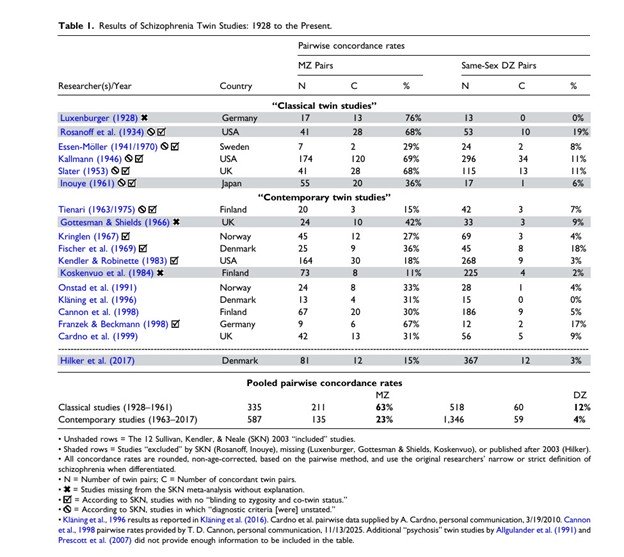
As shown in Table 1 (reproduced from my Review of General Psychology article), concordance rates in the classical and contemporary studies differ dramatically. Pooled MZ pairwise concordance in the methodologically inferior classical studies (Luxenburger through Inouye) is 63% (211/335), but is only 23% (135/587) in the methodologically improved contemporary studies (Tienari through Hilker). Pooled DZ pairwise concordance in the classical studies is 12% (60/518), but only 4% (59/1,346) in the contemporary studies. Nevertheless, without producing any concordance-rate or sample-size data, SKN claimed that what they called the newer “methodologically superior” and the older “methodologically inferior” studies produced “similar point estimates for additive genetic effects.”
The first five classical study authors were trained or inspired by German psychiatric genetic twin researchers based at the Swiss-German psychiatrist Ernst Rüdin’s late-1920s and 1930s “Munich school” of psychiatric genetics. Rüdin is the undisputed founder of psychiatric genetics. Psychiatric twin research was born and developed at the Munich school.
Rüdin, Hans Luxenburger, Franz Kallmann (who left Germany in 1936), and others were eugenics (“racial hygiene”) ideologues who knowingly and enthusiastically produced the “science” used concurrently by the National Socialist regime to maim (forcibly sterilize) hundreds of thousands of people in Germany and later its occupied territories. Their names should be included in discussions of other German twin researchers who committed or were complicit in atrocities, such as Otmar von Verschuer, Josef Mengele, and other “Nazi doctors” described by various authors. Most likely, Munich school-supplied population, twin, and psychiatric research records helped the regime identify people (victims) to be forcibly sterilized, or later killed in its T4 “euthanasia” program.
Munich school researchers were inspired in part by fellow German “racial hygiene” (eugenic) ideologue Hermann W. Siemens, who invented the classical twin method in 1924. In his Forward to the 1933 fifth edition of his German-language book on genetics, racial hygiene, and population policy, Siemens welcomed the 1933 National Socialist “national uprising” in Germany, which he said would become a “great and decisive turning point in the destiny of the white race” if it succeeded in implementing “scientific racial hygiene.” By the 1937 eighth edition, Siemens was pleased to report in a new Forward that what was once “racial hygiene as utopia” had become, in Nazi Germany, “racial hygiene as government policy.”
SKN, in contrast, whitewashed this history and described the early psychiatric genetic twin study investigators, trained by Rüdin and others in Munich, as “heroic” and “prominent and highly respected researchers.”
The pooled MZ pairwise concordance rate across the five first-generation Munich-performed or inspired studies (Luxenburger, Rosanoff, Essen-Möller, Kallmann, Slater) is 68% (191/280), almost three times higher than the 24% MZ rate across the 11 subsequent studies (155/642). Readers of the SKN meta-analysis would have to look elsewhere to find these results.
If we justifiably disregard the results of the Munich-inspired classical studies, we are left with the contemporary studies. However, even if one accepts SKN’s unsupported explicit or implicit assumptions, (1) that the EEA is valid, (2) that twin studies are largely free from other types of biases, (3) that “schizophrenia” has been a reliably identified valid construct since the 1960s, and (4) that heritability estimates are meaningful and measure the strength of genetic influences, the methodologically superior contemporary studies produce a heritability estimate of roughly 38% (2x MZ pooled 23% minus DZ pooled 4%), not 81%.
It is not the task of critics to establish the “true heritability” of schizophrenia, or to demonstrate that it is zero. Both concepts, “schizophrenia” and human behavioral research heritability estimates, are of doubtful scientific validity. This conclusion casts doubt upon the claim that the “heritability of schizophrenia” qualifies as a valid or meaningful concept for research purposes, even if genes play a role in producing the wide and widely distributed range of mental experiences, beliefs, and behaviors that might lead those exhibiting them to be diagnosed as psychotic.
The SKN meta-analysis reproduced the folly of psychiatric twin research more generally, in which researchers overlook or validate obviously false assumptions and then present and interpret data in ways that confirm their strong beliefs in biological and genetic explanations. In addition, high schizophrenia heritability estimates help justify continuing the lavish funding of DNA-based (molecular genetic) research that Sullivan, Kendler, and others have participated in. Patrick Sullivan currently serves as the head of the Psychiatric Genomics Consortium.
The evidence suggests that SKN’s confirmation biases led them to identify in advance a desired/expected schizophrenia heritability range, and then work backward to select, interpret, include, and omit studies to produce a meta-analysis heritability estimate falling within that range. Pre-registration of research has been promoted in the “replication crisis” era to help prevent such misleading practices.
Textbook and authoritative review article authors usually accept twin researchers’ mistaken genetic interpretations of rMZ > rDZ. These secondary sources are then cited by many psychologists, psychiatrists, journalists, and others in support of the pervasive claim that “schizophrenia is highly heritable.” Although schizophrenia/psychosis twin studies provide no valid evidence in support of genetic influences, psychiatry needs these studies to help maintain its fictional claim that “schizophrenia” is a reliably diagnosed and genetically caused brain disease.
The schizophrenia/psychosis causality puzzle pieces will fit together much better once we remove the twin study “genetics” pieces. These pieces remain on the table only because psychiatry has never undertaken a serious, objective, and balanced evaluation of twin studies and their underlying assumptions. In light of the ongoing decades-long failure to discover causal genes, a thorough re-evaluation of the entire 110-year “genetics of schizophrenia” research fiasco should begin forthwith. Because genetic studies of other psychiatric diagnoses contain similar problems while causal gene discovery attempts continue to come up empty, a re-evaluation of the entire body of psychiatric genetic research should also begin without delay.
***
The link to Jay Joseph’s (paywalled) article “The ‘Schizophrenia is 80% Heritable’ Fallacy” here.
For a thorough critical evaluation of the entire “genetics of schizophrenia” literature, see Joseph’s 2023 book, Schizophrenia and Genetics: The End of an Illusion. See also Joseph’s 2025 MIA article, “The 110-Year ‘Schizophrenia Genetic Research’ Train Wreck.”
–
This post was originally published on Mad In America.