
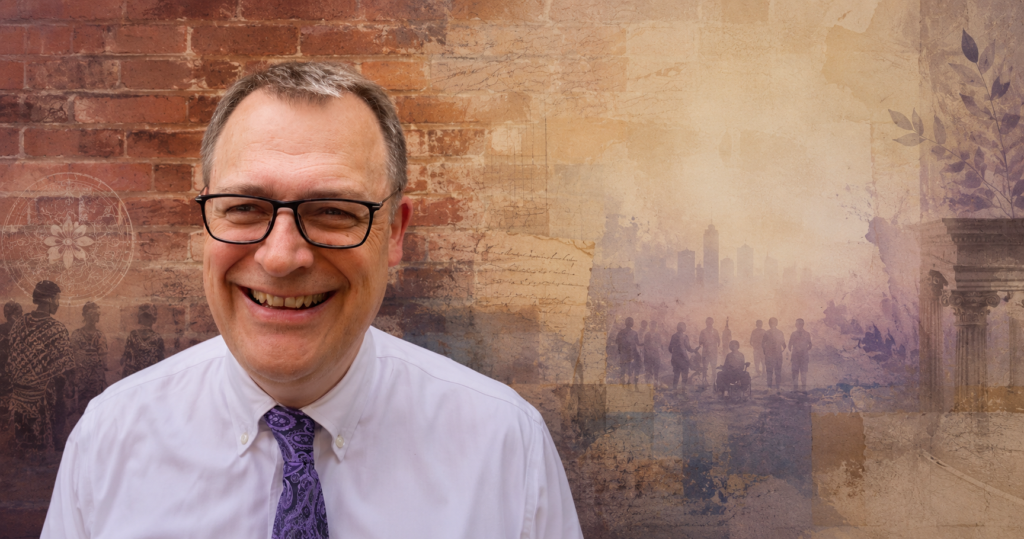
Eric Jarvis is a Professor of Psychiatry at McGill University whose work brings attention to areas often overlooked in mainstream psychiatry, including religion, coercion, the social determinants of psychosis, and culture. He directs the Cultural Consultation Service, the First Episode Psychosis Program, and the Culture and Psychosis Working Group at the Jewish General Hospital, and is Editor-in-Chief of Transcultural Psychiatry. His research looks closely at how religious belief, spiritual practice, moral worlds, language, migration, racism, and social context shape how people experience distress, meaning, and healing.
In this conversation, we explore how faith, culture, and power shape mental health practice. We discuss Jarvis’s work on religion and spirituality in cultural psychiatry, his research on culture and the social causes of psychosis, and his studies of coercion in first-episode psychosis.
We also talk about category fallacies, looping effects, and what happens when biomedical explanations of suffering collide with spiritual, familial, and community-based understandings of distress.
The transcript below has been edited for length and clarity. Listen to the audio of the interview here.
Eric Jarvis: Thank you for the question. Religion and spirituality are, I believe, a central part of any evaluation, any contact, any clinical contact. I think it is sadly neglected by most clinicians in most settings because a lot of clinicians are not very religious themselves. I mean, some are.
Many people are not very interested or do not feel that it is a very important part of life, or they might feel that religion is taboo in clinical practice. They might feel like they should not talk about religion or spirituality. Those are the kinds of things that psychiatrists and mental health professionals do not address. Maybe even governments have sort of decided that those things are off the table or should be kept private.
Sadly, I think you are raising an important point, but a lot of clinicians are not engaging properly in this part of people’s lives. On the other side are patients and clients. Many of them are very religious. It is part of their everyday experience. In fact, some people might have religious practices they do multiple times every day. I think many are very reluctant to talk about that with us as clinicians.
Honestly, I think they just do not think the clinic is the place to bring this up, because when a person walks into a clinical interaction, walks in to meet their doctor, their psychiatrist, their psychologist, they are evaluating them. What can I tell this person? Are they going to be open to what really is important to me? Do I have to play the game, the patient game? Do I have to really reveal what is appropriate in this context, or what I think is assumed to be appropriate?
A clinician can give off a sort of vibe of being uninterested in religion, mental health, and in other aspects of culture and social problems. They can be brusque. They can be busy. They can say, “Well, let’s move along. That’s important. Thanks for telling me that. What about, are you sleeping at night?” Things like that.
Ultimately, I think the burden is on the clinician to make this a central part of the evaluation. When they do that, they will discover an entire world of importance for the patient, and also for the clinician, because religious belief systems provide context for people in times of difficulty, in times of grief. They provide resources and networks for people.
Not for everybody. You mentioned that you do not want to romanticize religion as being somehow a perfect solution to life’s problems. A lot of people struggle with their religious communities and religious beliefs. But for a lot of people, they manage and they make their religious lives function well for them, and it is an important part of them, one that they do not ignore or neglect. We as clinicians need to offer this opening in our interactions.
Jarvis: Well, as I mentioned before, patients are evaluating us. How much can they trust us? Can they really tell what is at stake for them? If they get the sense, yes, if we sort of open the door a little bit. If we know it is Ramadan, for example, Ramadan just ended. We know it is Ramadan. We have a Muslim patient. We are seeing a Muslim family. I mean, we do not have to assume Ramadan, but we can just say, “How was Ramadan?” in our interview. That gives a signal to them that you are open to that discussion.
Now, they may say, “Oh, it was fine. Don’t worry. I have other things to talk about.” Or they might get into a rather long discussion about Ramadan and about how it affected them and what they did and how their family relationships were affected. As a clinician, you are kind of throwing out little signals like that. The patients will pick up on what you are saying, and they will respond.
If you do not open that door, it is like you are closing a window onto a vista, a whole aspect of their lives. As mental health professionals, I think we are keenly interested in our patients’ lives, psychological lives. We do not want to intentionally block out what is at stake for people.
Jarvis: Kind of like religion in the clinic, recovery as well is varied. In the old days, I think we kind of imposed a recovery model on a lot of people: eradication of symptoms and going back to school, all the usual things. But recovery is really becoming more and more seen as an individually tailored process. It is a negotiation between the team, the treatment team, the client, and their family and community. There are really no two recoveries that are the same.
Now, for a lot of people, religion and spirituality are part of that recovery. We did a study a few years ago. I direct a cultural consultation service in Montreal at McGill University. We evaluate the role of culture, religion, language, racism, and so on in the expression and the development of mental health problems, and the treatment as well.
In this context, we looked at a year of referrals and found that quite a majority of people referred to us had a religious or spiritual component to their presenting problem, which was surprising to us. I had not even really picked that up. I had seen most of those patients myself, not everyone.
But I had not really picked it up, and we went back and systematically reviewed all the transcripts of the interviews. We discovered that there was this very powerful link between religion and spirituality for a lot of patients and the cause or the cure of their problems. They also introduced, sometimes, predicaments, religious predicaments, and sometimes they turned to religion for comfort. These were the major themes we found.
All these things were very important in trying to guide people to that kind of individualized, culturally relevant, organically driven recovery. These are some of the ideas around recovery that we have been trying to emphasize.
I think most of what we are talking about in cultural psychiatry is trying to make things relevant. The danger is we sort of impose this abstract, foreign notion of illness, of recovery, of treatment. This is really what we are trying to avoid. We are trying to ground the process so that things really become much more vital for people.
Jarvis: It kind of goes back to what we were talking about, trying to find what is vital and at stake for people. If you come to a person’s lived experience, their religious experience, their community experience, cultural experience from this kind of external perspective, and you are rigidly positioning yourself as a mental health professional, and you are interpreting all that you are seeing in psychological terms, I think it essentially discounts the validity of what the person thinks is important, because you are saying, “Well, these are epiphenomena of deeper, truer principles,” right?
Like, we know what is true and deep, and people out there, they are kind of living their lives not aware of the deeper, truer things. It manifests in all these different ways, and we can get to the essentials. “Let’s get to the real essentials,” you are sort of assuming. If you do that, you are creating a barrier between you and your clients. They are going to feel that. You may not say it so much, of course, but it is your line of questioning. It is how you react to their experience. They will kind of pick up that you see that what they are doing is odd, or maybe a little bit backward, or something like that.
This is the problem. What we are trying to do, I think, in cultural psychiatry is to genuinely accept experiences. You may not believe everything somebody is telling you, of course, but you are trying to understand how it affects them, and you are trying to understand the vital nature of that to their view of the world, to their relationships. It is real for them. It is something that is so critical for them, and you want to be sympathetically trying to open up the discussion about it. Then you will start to see its real effects on them.
Jarvis: Psychosis is often seen in the psychiatry medical world as a neurologic condition, and because of that, a lot of people feel it is relatively independent of outside influences. It sort of has a life of its own. There is this idea, I think, that the more biologic or neurologic something is, the less it has its own independent internal life to the person, and the less important culture becomes.
I think psychosis fits into that. Schizophrenia, for example, and other psychotic disorders are often treated with medications, hospitalization, and certain kinds of very focused therapies. Because of this, sadly, psychosis has often been on the side of a lot of discussions about culture and how culture might influence psychosis.
Psychosis really means, in medical terms, a disconnection from reality in some way. It is kind of not a true definition, but it defines what we call positive symptoms of psychosis, which are things like hallucinations, auditory hallucinations, visual hallucinations, delusional thinking, false fixed beliefs in a certain cultural context.
But there are other kinds of symptoms of psychosis, like deficit symptoms, such as not being motivated, not being able to express yourself so well, being socially withdrawn. These are other kinds of symptoms of schizophrenia, for example, and may be attached to some psychotic disorders.
This disconnection from reality is an important part, maybe, of the current way we see schizophrenia and its related problems. What I have found most interesting through various kinds of work is that culture is highly relevant, not just to how people express their symptoms, but even to the onset of what we count as psychotic disorders, and also to the way we treat and work with people with psychosis.
I can give you a few examples. There has been a lot of literature talking about high rates of schizophrenia in migrant populations. Why might that be the case? Well, it turns out that there are certain stresses in life. One of them might be migration. Others might be discrimination. These are sometimes called the social causation of psychosis. They may actually precipitate, in vulnerable people, a psychotic episode or a psychotic brain episode.
The surrounding environment actually can push toward or protect from psychosis. That is a very important thing to think about. The expression of psychotic symptoms is also open to a lot of discussion, and culture affects the discussion of the symptoms. I think everybody would accept that our current culture is inundated by the internet. We have the internet all around us. It is natural that a lot of people have internet-related delusions.
But clearly, if you went back 50 or 30 or 40 years ago, there is no way people could have an internet-based delusion because there was no internet. This is just a clear example, to me, of the role of culture and society in driving the expression of psychotic symptoms. If you believe that you are being invaded or observed by a computer, and all your information is being sent out onto the internet to different people, this is a culturally based delusion.
Then the treatment of psychosis is also culturally needy, or has cultural aspects. A lot of people may distrust the treatments we have to offer for psychosis, like medication, because some communities have long histories of being misunderstood or actively oppressed by mainstream society, by mainstream institutions like the law and psychiatry.
If that is the case, you suggest what would be the usual treatment, a medication, or following a certain program at a hospital. Some people may be very reluctant to proceed, especially if, as we have been talking about with religion and mental health, they have a different understanding of what is going on with their psychosis symptoms. They may look at their psychosis as deriving more from a spiritually related problem, and it may require a spiritually related cure.
If we do not enter into that discussion with them and try to create a hybrid explanation, where maybe God is giving gifts to all of us, and one of the gifts might be medication, or doctors, or medication in general. If we do not talk like that with people, they may just never come back and may just drop out of treatment entirely. This is just giving you some ideas of how culture and psychosis is a very relevant relationship.
Jarvis: Those are really interesting questions. I do not think everybody who has psychotic symptoms needs hospitalization or medication. In fact, I think if you do population surveys, you find that maybe far more people, maybe 10% of the population, might experience hallucinations of one kind or another during their lifetime. Maybe they will experience delusion-like beliefs, too. That does not mean they have a psychotic illness. It means they just have a certain way of seeing the world that may be a little bit different from the mainstream.
I think members of cultural minority groups may have more different ways of seeing the world than, say, the mainstream, meaning psychiatry, medicine, people who are clinicians there, maybe. So we have to be very cautious about how we apply these categories, these diagnoses. Some people can live their lives with different beliefs, and that is okay. They do not need to be coerced into care or have these beliefs eradicated or changed.
In our cultural consultation service, we are often referred clients, and the question is, is this person psychotic? If they are, does it matter? Do we have to do something? We receive quite a few of these kinds of requests, and it is not so uncommon for us to do a very thorough evaluation. It is really a long discussion with the person to see what their goals and needs are, what is at stake for them.
We work with the clinical team as well. In the end, we might decide, well, they have some beliefs that are different. It could be causing some trouble for them in some areas of their lives, but overall, they are not really suffering too much, or they do not really want any care. I do not think care is what they need at this time. I think they should continue in the community. Maybe you could check in on them from time to time. I would try to pay attention to what they are saying, listen to their experience, be respectful.
An example was one man who came to us. One of his only possessions was a very well-worn Bible. He was a recent arrival in Canada from another country. He had a religious view of how his life was unfolding and felt that he was in the better hands of God. People were concerned because he had been homeless for a number of years since coming to Canada, homeless and essentially living in a shelter. But he was kind of satisfied with that.
He was not trying to change what he was doing. He was waiting for something to happen, it turned out. He was waiting for a sign from God that his life should advance this way or that way. He had not received this direction yet. But he read the Bible every day. The Bible was, like I say, extremely well-worn. It was an interesting book to look at.
We had a long discussion with him. He is one of these individuals where we felt that active treatment was not needed. It was more a matter of following up with the team on the outside to see if he could find his path. When he finds his path, it is important that it be his path.
Jarvis: Thank you for reading some of those quotations. These are very poignant reminders that hospitalization is traumatic, or can be traumatic, for people. This study was particularly about African-Canadian men and their experience. I was just struck by how every one of these respondents had negative stories to tell. Very, very negative. To them, they did not feel they were being helped.
Some people leave the hospital and say, “Okay, it wasn’t so great, but I was being helped there.” That could happen as well for African-Canadians, but a lot of their stories were more about it being a sentence. They were being sentenced, almost like a punishment. I just found that so sad to read because, ultimately, as a clinician, I am a white clinician, a white male, of a certain age.
I realized that is probably how I am coming across to a lot of my patients. It is just the gut reaction that might be there. I have a lot of work to do. This is what I learned from the study. I have a lot of work to do to undo these perceptions. When I walk into a room and I see a young Black male client and the mother, father, or other family member there, I have to work very hard to be as humble as I can, to be as reassuring as I can.
In some cultural consultations, I may spend 30 to 45 minutes just trying to establish rapport, trying to help the client know that I am there for them. Really, it is confidential. I am there to try, in whatever way they think is best, to help them. This is a long time. It is almost as long as a normal consultation. We give two to two and a half hours for the first visit of a cultural consultation. A lot of the work is around this. It is because of these sorts of stories.
Now, sometimes, despite all my efforts, I feel trapped as a clinician. I feel trapped in my role. It is very disheartening, but it is something I have not been able to quite understand how to undo yet. I will explain what I mean. If I am working in the emergency department, people will be brought into the emergency department. I have to assess them and say, can they go, or do they have to stay? If someone is brought in by the police in handcuffs, with the report of some altercation in the community, and I cannot get a full history, I really have to keep them.
Often, this might be young Black men who have been brought in by the police. They will ask me, “Can I please leave? Has there been anything wrong?” I will see the situation setting itself up. There I am, the gatekeeper, and I have a role to play. I will realize I am going to have to keep the person because I do not have enough information. But I see that the age-old historic relationship is setting itself up: white oppressor and Black patient who is being coerced to stay and have psychiatric care, observation, and treatment.
I try to talk to them if they are amenable to discussion. I say that I am doing the best I can, and I am sorry they have to stay a bit longer. I need to gather more information. It is not necessarily that they did anything wrong, but rather how we have to operate in this kind of setting. That is how I try to explain it. But it is not satisfactory. I often leave realizing that I have replicated this dilemma, this coercive dilemma.
Jarvis: I really like what you are saying. I wanted to add a little bit on that because I believe that is one of our cultural values in North America that is harmful to our clients and to our families, too. We are too focused on individual autonomy and not enough on family involvement and shared responsibility. If I could change anything, I would try to move more toward a family-centered treatment model.
Jarvis: One example, as I was talking about earlier, is this idea that individuals are autonomous, free agents who operate independently of families and communities. I do not know how this started in our societies, American, European, maybe backgrounds, but the assumption is that the individual is the key part of the puzzle. We owe our confidentiality to the individual. We exclude family and community often. Not just exclude them, but actively sort of belittle them or minimize their role in ways that are very harmful, I think, to the overall recovery of our patients.
This is a core value of our society, and it works its way all through mental health because the primary component, or the most basic component, of health care is the clinician-patient or clinician-client dyad. Cultural psychiatry is really about opening that up. It is important, of course, to be confidential and to pay attention to the individual, but I think we need to open up to other inputs, allow the family more of a role, allow the community more input.
When we have people visiting from China, from Japan, coming to visit our center at McGill, they are often very surprised by this individual focus and how it plays out in the clinical interaction. I say, “Well, what happens where you are from?” They say, kind of like you are saying, “Where we come from, we talk mostly to the family and the individuals.” Not that the person’s wishes are not there, but the families are more important.
I often think it would be nice to find a middle ground between these two systems. It might be the best way to go. That is one core value that finds itself throughout all of our theory and practice in mental health that we need to challenge, I believe.
Jarvis: Every day in our clinics, we see people who have different stories about their lives, different basic assumptions. Category fallacy is applicable. It is a term that came from Arthur Kleinman in the 1970s. It refers to what happens when the interpretation of symptoms occurs through categories derived from an outside culture, and they are applied to somebody who may not understand or buy into the category you are suggesting they have.
I suggest in the paper that it can result in diagnostic error, but I think it is really not so much an error as a problem of inappropriate diagnostic assignment. Because the category of schizophrenia, just for example, may be present. You may diagnose schizophrenia in 100 people, but the problem with the category fallacy is that you are imposing that category on people who do not believe in it, or they do not understand it. It has no relevance to them.
The trick of mental health, psychiatry, and psychology is helping our patients to work together, to collaborate with us in their care and in their recovery. If your category is meaningless or offensive in some way, or it does not make any sense to them, they may have some other way of explaining what they are going through. We really need to spend time trying to understand.
Just for example, if I see a patient and I hear a bunch of psychotic symptoms, and then I am thinking to myself, “Oh, pretty clear diagnosis of schizophrenia,” and then I ask them what they think is going on, and they say, “Well, my parents tell me this is a spiritual attack,” I have work to do now trying to bridge the difference between those categories.
I do not want to impose. I do not want to make a category fallacy by suggesting, “Oh no, spiritual attack is not really what we are talking about here. We are talking about schizophrenia.” I want to hear a lot about spiritual attack. I want to talk to his parents. I want to understand what that means to them and what the problems might be, and what the recovery might look like for spiritual attack.
An inappropriate assignment of a diagnostic category, usually from an outside culture, onto another belief system, is what we are talking about with the category fallacy. The looping effect you mentioned as well?
Jarvis: It is. Looping effects are another kind of phenomenon we might see. It was developed by the philosopher Ian Hacking in Canada, and looping effects refer to the tendency for social categories to reshape human experience so that it confirms the category.
Really, what it is talking about is that we are in constant dialogue with our surroundings, with what is going on around us. It is an ongoing dialogue and negotiation. Human beings are able to change through this dialogue with culture and society around them. We are not just inert to these things.
If you, for example, get diagnosed with depression, and then along with depression comes a treatment, certain symptoms we are looking for, and so on, suddenly you might say, “Oh, I did not know that when I was crying I was depressed. I thought I was worried about my children,” or something like that.
Suddenly, you are adopting a sort of identity, a depressed-person identity. That might start changing the way you react or interact with your family, with the feelings you are having. It might certainly change how you interact with your doctor and your treatment team. You take medications now. All of these things are having looping effects, meaning they are informing a new way of behaving.
You move forward again into a brave new world, start to act in this new way, and the looping effects keep reoccurring as things change and new treatments and categories are assigned to you. It is really referring to this sort of constant dialogue we have.
Jarvis: It depends on the setting, how these categories are accepted or how they are taken and understood. For some people, like you say, a medical diagnosis might be a relief. They might say, “Oh, that is what has been happening all these years. Now I can finally understand. It was not my fault. I was trying to get a job, and I just could not get out of the house.” A medical diagnosis may come with some degree of relief.
In other cases, it might be stigmatizing to have a medical diagnosis, like depression or schizophrenia or something else. In those cases, people may resist the label, even the category they are being assigned to. They may prefer another explanation. They may say, “Well, I was having a spiritual problem, a faith crisis. That is what I was going through.”
Then you have to understand the cultural setting and community that people come from. For some people, depression may not be accepted in the community. A depression diagnosis may carry so much stigma that it may affect their status in the community, and it may affect the status of their children. It may affect the marriageability of their children. But a spiritual frame, a spiritual explanation for the problem, might garner a lot of support and sympathy. It might be face-saving for people in some cases.
We have to be very careful and aware of the effects that our diagnoses are having on people. We may need to change the delivery or change the way we talk.
Jarvis:
The answer is to be very cautious. Be cautious. Most clinicians, I think, just accept the DSM or ICD categories because that is what they have been trained to know. However, if you look carefully around the world, and some have done this, Rose et al. in 2017, for example, and other work has looked at this. It is an exhaustive survey of the quality of studies of depression around the world, and it found that DSM categories or DSM symptoms of depression do exist. You can find them in people around the world. They are fairly common.
But there are other kinds of symptoms that are not DSM symptoms that come up repeatedly in different places. This means there is a lot of heterogeneity in the kinds of symptoms people would put forward when you are talking to them about depression or discouragement or disappointment.
I will give you some examples. Symptoms like not sleeping well, not eating well, maybe poor concentration, those kinds of symptoms can be found everywhere. Symptoms like overthinking or thinking too much, maybe feeling lonely, maybe being excessively tearful, or maybe having a heavy heart, may be common in some parts of the world but are not in the DSM.
What this tells me, when I see patients in my own office in Montreal, in Canada, is that I have to be very careful to consider other ways of being depressed that may not manifest with the standard questions I am asking, the standard symptoms I am looking for. That goes for every mental disorder. Depression has been relatively well studied. Psychosis has been well studied as well.
But I will just mention here for psychosis: what is really not well investigated to date, I think, or well evaluated to date in psychosis, is that when people have psychotic symptoms, we have to do a careful trauma history. Trauma is probably at the root of some of the psychotic symptoms we are seeing in patients from diverse backgrounds, especially in migrant and refugee models. I will just throw that out there. We do not want to misdiagnose schizophrenia in people who have PTSD.
Jarvis: Thank you.
***
MIA Reports are supported by a grant from Open Excellence and by donations from MIA readers. To donate, visit: https://www.
–
This post was originally published on Mad In America.
Trust this device for 30 days