
Genetic testing to guide antidepressant selection is already being sold to the public, but the evidence is less than convincing. A new study failed to show efficacy in its primary outcome, its secondary outcomes imply a potential benefit for only 2% of patients, and it contradicts the findings of a previous study, leaving interpretation uncertain.
Many people don’t benefit from antidepressant drugs, and some people experience adverse effects like metabolic problems, sexual dysfunction, and emotional numbing. Identifying who is most likely to respond to specific antidepressants, and who is at risk of adverse effects, would dramatically improve depression treatment. So far, researchers haven’t been able to accomplish that goal.
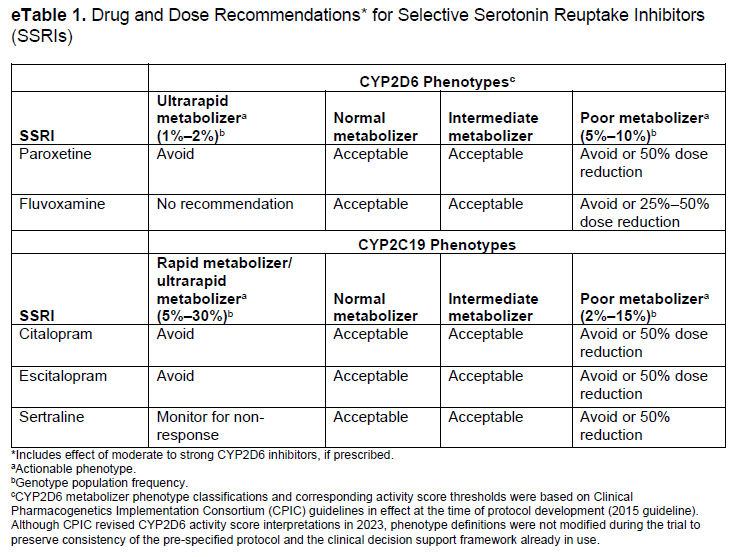
But precision psychiatry promises to change all that. Proponents suggest that genetic tests could be used to guide antidepressant selection. Genetic differences, particularly in the cytochrome P450 enzymes CYP2D6 and CYP2C19, can affect the body’s ability to metabolize some antidepressants. The drug may be broken down too quickly or too slowly, which could explain lack of efficacy or more severe adverse effects. Indeed, these tests are already being sold to the public and presented to clinicians as an option in official physician publications.
It’s hard to argue against the hopeful ideal of these tests: If the right antidepressant could be given to the right person, in theory, then side effects will be minimized and effective treatment will be optimized. And early studies demonstrated this promise. Yet these studies have met with criticism that it is difficult to judge whether their mixed results were trustworthy or clinically significant.
Perhaps the most well-known study was the large PRIME Care randomized clinical trial, which appeared to show some initial positive effects on depression symptoms, but by the time a few months went by, there was no difference between groups. That is, genotype-guided antidepressant treatment failed to improve outcomes over time.
The researchers in that trial write that “Pharmacogenomic testing for drug-gene interactions in MDD […] had small and nonpersistent effects on symptom remission.”
So researchers argued that more research was needed before these tests could be considered evidence-based enough to guide clinical practice. Now, a new study claims to provide that evidence.
The study, published in JAMA Network Open, was called ADOPT PGx Depression. The researchers aimed to identify CYP2D6 and CYP2C19 differences in patients and use those to guide antidepressant selection.
The table above shows the five antidepressants that, according to some guidelines, should be avoided based on pharmacokinetics (their interactions with CYP2D6 and CYP2C19 differences): paroxetine, fluvoxamine, citalopram, escitalopram, and sertraline.
In total, 1460 patients received genetic testing. For 768 (53%), the test provided no “actionable” data—they did not have any CYP2D6 and CYP2C19 differences, so the test didn’t tell them anything about which antidepressants would be useful. The remaining 47% had an “actionable phenotype” and these either received genotype-guided prescription or usual care (antidepressant selection based on clinical judgment).
The majority of participants (85.1%) were already taking antidepressants; the majority (66.9%) had been depressed for more than two years. As such, this could be considered the perfect population for this study: people whose current antidepressants didn’t seem to be working, and thus might benefit from a change.
The primary outcome (depression severity after three months) showed no benefit for genotype-guided prescription on either the PROMIS depression measure or the PHQ-8 depression measure. There was also no difference in adverse effects: genotype-guided antidepressant selection didn’t seem to reduce the amount of side effects experienced.
The failure to improve side effect burden is unfortunate, as this is one of the main selling points of the genotype-guided approach.
However, the outcomes at six months showed that a small percentage of people who based antidepressant selection on genetic testing might derive a benefit in the longer-term:
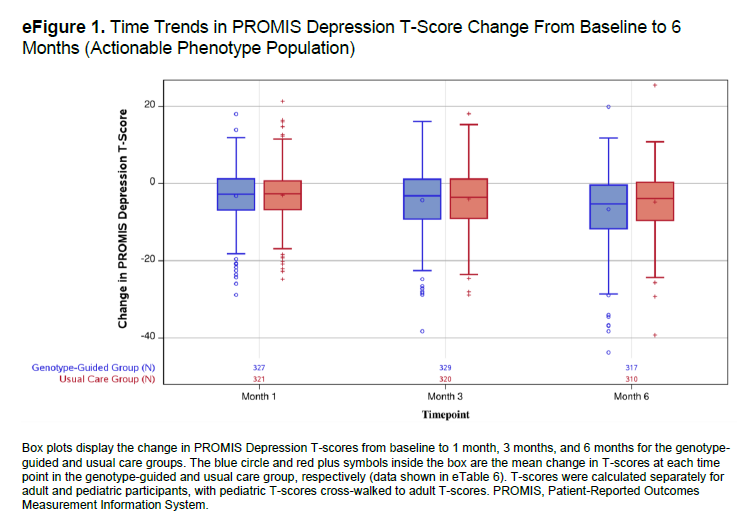
At 6 months, the proportion of patients who experienced remission from depression was significantly higher in the genotype-guided group compared with the usual care group, as measured with both the PROMIS and PHQ-8 surveys (Table 3). Based on PROMIS depression scale scores, 153 of 317 patients (48.3%) in the genotype-guided group achieved symptom remission compared with 122 of 310 (39.4%) in the usual care group, yielding a mean difference of 8.9% (95% CI, 1.2%-16.6%; P = .02). Similarly, remission based on PHQ-8 scores was more frequent in the genotype-guided group than in the usual care group (95 of 318 vs 65 of 309 ), with a mean difference of 8.8% (95% CI, 2.1%-15.6%; P = .01).
This data, if taken at face value, shows that approximately 2% of patients may derive more benefit in the long-term from genotype-guided treatment than from usual care (out of a total 1460 patients, 31 more patients benefited in the genotype-guided treatment group than in the usual care group).
A benefit for 2% of depressed patients is not exactly a striking win for precision psychiatry. Indeed, a quick visual examination of the graph from the paper shows just how similar outcomes were between groups.
However, one could argue that if even a single person benefits, the test is worth it. That is perhaps a question for insurance companies who must pay thousands of dollars for genetic testing, clinicians who will be adding these tests and their interpretation to their workload, and patients who should know that they have a 1 in 50 chance of benefiting from the test and will probably be responsible for some of the costs as well.
(Another commonsense interpretation of the study could be that doctors should avoid the five listed antidepressants, since there’s a long list of antidepressants of varying classes that they could use instead. The researchers don’t mention this possibility.)
Perhaps another part of the problem is that this pattern follows what clinicians already do—when a drug fails to improve depression, they switch to a different one. Thus, there is little actual difference between “usual care” and genotype-guided antidepressant selection.
But I also have to wonder how to interpret this finding in the context of the PRIME Care study (the previous large trial of genotype-guided antidepressant selection) since these findings are contradictory. PRIME Care found early benefit for genotype-guided prescription that disappeared into no benefit in the long term, while ADOPT PGx Depression found no early benefit but a positive long-term result. Which finding should be believed?
A contradictory result like this surely cannot guide clinical decision-making.
There were other issues with the study. The patients and clinicians couldn’t be blinded to group selection, since they either received their genetic results (to guide antidepressant selection) or did not. Unblinding is a pernicious problem in psychiatric research that can lead to overestimation of positive effect. The researchers note that “This is a notable design limitation that remains difficult to overcome. “
The researchers also included a large number of participants (29.9%) who were taking bupropion and a few who were taking other drugs considered CYP2D6 inhibitors; they classed these people as having an actionable CYP2D6 phenotype, but this makes the results messier and less trustworthy as we now have to consider whether outcomes would be the same for those experiencing drug interactions as for those with natural genetic differences.
Also, 221 of the 1460 participants (15.1%) were children; it is unclear whether their results differed.
Ultimately, the genotype-guided approach to antidepressant drugs presupposes that the best way to deal with the lack of efficacy of the drugs is to switch to a different one or to try another biologically focused approach. But this assumption isn’t supported by research. A 2022 study underlines this idea: in a real-world setting, even with aggressive treatment approaches, less than a quarter of depressed patients experienced any improvement. More than half of the patients ended up on multiple drugs, a third were hospitalized, and a third also received psychotherapy. Yet more than 75% of the patients couldn’t even be classified as “responding” to treatment.
What if the problem is that depression is not a biological defect, but a complex psychosocial process? A 2023 study led by prominent neuroscientist Nils R. Winter provides some insight into this.
Winter and his colleagues began with the acknowledgment that studies focusing on individual, specific brain areas and biological markers have failed to identify depression. The problem, they thought, was that depression is too complex—tons of minor neurobiological changes that, on their own, wouldn’t be suitable biomarkers, but if combined could be. So the researchers used machine learning to create a composite of all hypothesized neurobiological causes of depression to see if that would be better able to identify the condition.
To their surprise, the program failed. No group of neurobiological changes—structural, genetic, or chemical—could predict depression. What could? Environmental variables. Winter’s group had included two such variables, social support and childhood maltreatment, and each of these was far more successful at predicting depression than any proposed biomarker.
Another study by Winter and his colleagues came to a similar conclusion: they could find no differences in neurobiology between people with depression diagnoses and healthy controls.
They wrote that “healthy and depressive participants are remarkably similar on the group level and virtually indistinguishable on the single-subject level across a comprehensive set of neuroimaging modalities.”
The researchers concluded that factors such as childhood abuse, trauma, and lack of social support explained up to 48 times more of the variance than neuroimaging and genetics.
What if precision psychiatry, then, is just driving further down a dead-end street? In a 2018 JAMA Psychiatry letter, Ana Gómez-Carrillo, Timothé Langlois-Thérien, and Laurence J. Kirmayer write that the breathless enthusiasm around precision psychiatry as a “paradigm shift” is misplaced. Psychiatry should instead place its focus on understanding and treating the social, environmental, and psychological correlates of mental health concerns, they suggest.
Will psychiatry as a whole ever listen to voices such as these?
–
This post was originally published on Mad In America.