
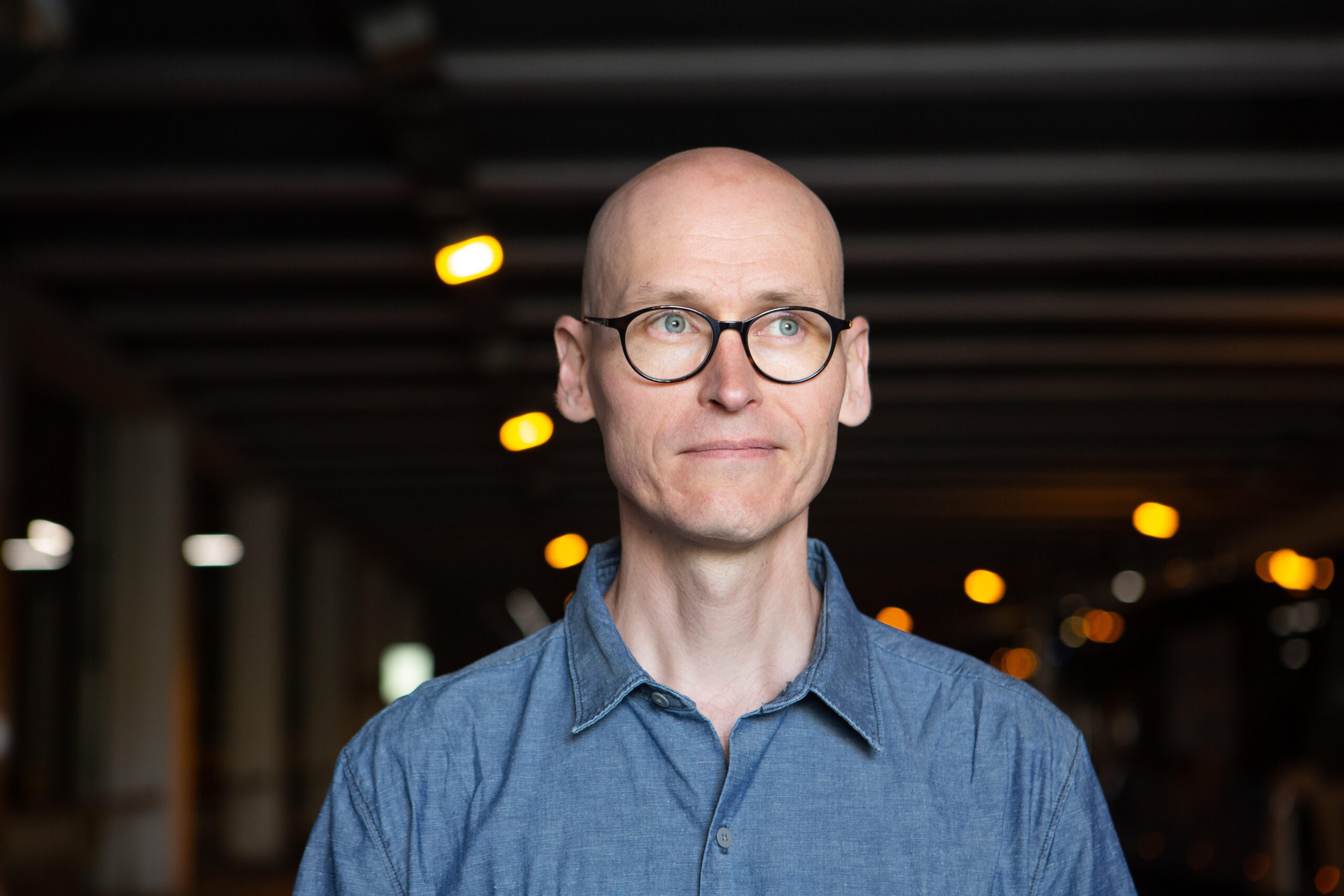
Jussi Valtonen is a neuropsychologist, an adjunct researcher with the Finnish Centre for Evidence-Based Orthopedics (FICEBO), a professor of writing at the University of the Arts Helsinki, and a columnist for the Finnish Medical Journal. He works clinically as a neuropsychologist, and his research and writing sit at the crossroads of mind and brain through the health humanities.
Jussi is an award-winning novelist as well. His novel They Know Not What They Do won Finland’s top literary prize and has been translated into multiple languages. Alongside his scholarly work, he leads the Health, Narrative, and the Arts initiative at Uniarts Helsinki, which offers training in narrative skills for professionals in healthcare and social work and brings literary, artistic, and humanistic ways of thinking into conversation with clinical care.
In this conversation, we turn to Jussi’s recent work helping to build narrative medicine groups in Finland, first with clinicians and now increasingly with neurological patients, as well as to his broader effort to show why the humanities are one of the rare places where clinicians and patients alike can recover forms of attention, listening, interpretation, and moral imagination that dehumanized healthcare systems work to erode.
The transcript below has been edited for length and clarity. Listen to the audio of the interview here.
Jussi Valtonen: Narrative medicine is an approach in which the arts and humanities are used to inform clinical work. There are many different sides to this work, but at its core, I think it reminds us that life is much broader, more complex, and richer than we sometimes remember in clinical work. It is also about reminding us of our shared humanity, among clinicians, between clinicians and patients, and really across all of humanity.
Valtonen: In our case, I had been postdoc-ing in New York, where I was in contact with the narrative medicine team at Columbia University, who have been doing this work for a long time. I was really inspired by their work, pioneered by Rita Charon and her colleagues. I also ended up collaborating with Bradley Lewis, who works at the intersection of arts, humanities, and medicine, and also does work in narrative psychiatry.
When I came back to Finland, I got a job teaching creative writing at the University of the Arts in Helsinki. I mentioned this work to my colleagues and said I had been really inspired by it. I was wondering if we could maybe try something like this at home. My colleagues were really encouraging, and we were lucky enough to get a grant from a Finnish foundation to start piloting some of this work. In the beginning, we organized these groups for clinicians working in the Helsinki City healthcare and social services sector.
At first, we did not really know if anybody would show up, or what Finnish clinicians would think about reading poetry and short stories together and doing creative writing exercises. But people did show up. As it turned out, the responses were really positive. Our feedback was literally at ceiling from the beginning, which to us suggested that there seems to be room for this kind of work in Finnish healthcare.
The basic idea is that we use the literary arts to inform clinical work, to get ourselves out of these little boxes that clinical work so easily puts us in. In those boxes, we tend to forget what life is really about, and what people are really about, in a more open-ended and broader sense than we get through diagnostic criteria or diagnostic categories.
In our case, the groups we have facilitated have typically had around 10 participants. We spend the time practicing close reading of literature together. We learn to pay close attention to what a poem or a short story conveys, not only explicitly, but also implicitly, between the lines. We try to listen to the tone, the nuances, the structures, and all the little and big things that a literary work does.
There is an obvious parallel to clinical work. To be a skillful reader of short stories or poems, you need similar kinds of skills to the ones you need if you want to be a careful, attentive, competent listener to your patients as a clinician. That is only part of the rationale for doing this kind of work, but it is a really important one.
Valtonen: We’ve done this in different ways with different groups. We actually started doing this work during the pandemic, when we had to do all of it online. In that case, people were where they worked, or sometimes at home, but they were on their computers. We were slightly worried about this, but as it turned out, they were great experiences.
The groups tend to be much more intense when they are completely in person, but it turns out you can do it either way. In some cases, we organized these groups at the University of the Arts at the Theatre Academy, which was actually maybe even more powerful for the clinicians because they had to leave their places of work. You are no longer in the hospital setting. You are at an art school, with a completely different crowd.
If the work itself already takes you out of your comfort zone, and you really do not know what to expect or what the right answers are, so to speak, I think this may sharpen that experience a little bit. In the beginning, we typically start by reading a short story or a poem together and asking what feels resonant or relevant to the participants. Then we start focusing more closely on the details in the text that have those effects on readers, and we go from there.
Valtonen: I think it is the personal creative writing part in particular, and then especially sharing that writing with other group members.
In the narrative medicine model that the Columbia team has pioneered, there are typically three steps. In the first, you engage with a work of art, usually a literary work in our case. After that, we ask participants to respond to the text through a writing prompt. It is typically loosely connected to the text we have just read, but it gives participants room to explore their personal experiences, or to go wherever the text takes them.
For example, if we have read the Louise Glück poem “Crossroads,” we might give a writing prompt along the lines of: write about a situation in which you have been at a crossroads in your life. Then everybody is free to interpret that as literally or as metaphorically as they want, and to make it as personal as they want.
Of course, everybody gets to choose whether they want to share it with the group afterward. But after the writing, we do invite participants to share their writing with the other group members. The people who do often describe the experience as much more intense than they anticipated.
I actually think this is part of why these groups are so useful, or can be so useful, for clinicians. When you read a piece of personal writing to your colleagues in a group like this, the feeling of vulnerability can be more intense than you anticipated. You are immediately reminded of how important it is for all of us to be heard as human beings, and how powerful it can be just to have other people witness what has happened to you. Even if it is not the most heartbreaking experience in your life, it is something personal that you chose to write about, so it probably has some meaning to you.
There is the experience of not knowing how the group will respond to what you have written, but then, hopefully, having the experience of being heard, and of how good that feels. I think that can be a useful reminder for clinicians. It starts from realizing: this is probably a little bit similar to how a patient may feel when they are disclosing their personal, difficult experiences to you in your office. Clinicians, obviously, are often the ones doing the listening. It can be surprisingly easy to forget what that feels like in the other room.
Valtonen: Once we discovered, to our relief, that the feedback from these groups was really positive, we realized that we wanted to understand more about why clinicians felt these methods were helpful and relevant to their clinical work.
We hired a postdoctoral researcher, Dr. Elina Renko, who is a social psychologist and has experience and expertise in qualitative research methods. Her work for a long time has centered on healthcare interventions, motivation, and well-being. She was the perfect person for us to invite into this project to investigate what clinicians feel is relevant about reading poetry together and doing creative writing together.
How is that helpful to them, in their own words? What she did, basically, was invite all of our participants from two groups for interviews. She interviewed them and asked them to explain, in their own words, what the experience of participating was like for them.
One of the things we looked at in these responses was how people thought about perspective-taking, which in many ways is presumably at the core of clinical work. You have to try to imagine what life feels like, or looks like, through the eyes of another person in order to help them.
One of the things our participants reported about working with stories in these groups is that perspective-taking can be much more difficult than they had assumed, although this is something many of them believe they had been doing every day in their clinical work, in some cases for a long time.
Valtonen: I think the place where the difficulty shows most clearly in our groups has been the writing exercises, where we guide the participants to switch narrators.
Participants who do not have extensive experience with creative writing will typically use the first person when they are asked to write about their own personal experiences. That is a natural and great choice in many ways, but it is not the only way to write. We guide them to try the third-person narrator, where instead of writing about something that happened to me, you are writing about something that happened to him or her.
Already, in a subtle way, that shifts things in your mind. Your own personal experiences may start to look a little bit different just because of the change in narrator.
Then the third way we guide participants to do this is to try to imagine what a clinical encounter they have actually had felt like to their patient. So we ask them to write using the first person, but from the perspective of the patient.
This is typically the exercise where participants report that it felt really difficult, even starting with the language. It is not clear what language I should use when I try to imagine how my patient would describe the event.
We do not use this writing prompt because we think it is a shortcut into perspective-taking, or that it will make them masters at imagining life through the eyes of their patients. Instead, especially during the discussion, we can explore the ways in which we probably always fail when we try to do this for somebody else, because we do not have access to the other person’s mind.
When this works, at best, what I think it inspires is a new kind of curiosity about what experiences other people have and how they would describe them. Next time I see that patient, maybe I can pay closer attention to the word choices they make when they describe things to me.
It is a subtle way to try to fine-tune the way clinicians listen to their patients. Words and language are important. If you are not paying close attention, you may miss cues that turn out to be really crucial.
I also wanted to add something about the metaphorical language participants use when they describe the experience of participating in these groups. I think one of the things great fiction often does is remind us that life is more interesting, richer, and more complicated than we sometimes remember. When this happens, it is really difficult to put into words.
That experience you have after reading a fantastic short story is far from trivially easy to describe. You feel it. You have just experienced it. Life feels like the colors are brighter suddenly, somehow. There was something really important that I just experienced. But how do you explain it? It can be really difficult.
I think this is a very common experience with great art. But especially with clinicians, some of whom may not be constantly engaged with short stories, this can feel delightful in a surprising way. I think that is part of the reason they use metaphorical language when they try to explain what happened.
Valtonen: Yeah, I think that’s exactly right. One of the really useful things about short stories in this context is that they do not really know what our professional roles are, or how we should react as clinicians to a given problem. Because they are ignorant of all of that, it is impossible for us as participants to approach a short story or a poem as a clinical neuropsychologist. That is not how you engage with a work of art. If you engage with it in any meaningful way, you have to be present as a full human being.
Of course, that is part of the idea in these groups. We deliberately try to take clinicians outside of the clinical roles and boxes that they are used to being in. Judging from the way they describe their experiences, it feels a little dangerous to them, but in the best sense of the word, if that makes sense.
It is not clear what the right answers are in a creative writing exercise, or when reading a poem that does not fully make itself understandable on the first reading. So, not knowing what the right answers are turns out to be a really useful experience sometimes.
Valtonen: I think it is a beautiful finding in the study that this would have been one of the things they experienced after participating.
In our study, many participants linked the experience of mercy to something that comes from having read many texts together in the group, both published literary works and pieces of writing that participants have written during the group. One thing they often find, or that we find together, is that there are many things we respond to in a given text in similar ways. But there are also many things people interpret quite differently, depending on who they are and what their expectations were.
Often, that can take us to a space where you realize, for example, that the way you have interpreted a difficult encounter with your patient may not be the only way to understand it. You may not have been thinking about it actively for a long time, but sometimes people end up writing about a situation that happened two years ago, and they are still partly upset by what happened.
Maybe you feel like you made a mistake. Maybe you feel the patient was being unfair to you. Or maybe it was something else. But sometimes, during the writing and the discussion, you realize that there are other ways to interpret that situation. Maybe the way I have always thought about that situation was not the right way, or at least it was not the only way.
Perhaps there are other reasons why the patient may have behaved the way they did. Maybe what I thought of as a mistake was not a mistake. Maybe what happened was caused by other things. Often, just during the solitary phase of the writing process itself, things may occur to you that you have always known, but that somehow did not feel relevant before now. Suddenly, they may be brought into a new light through the act of writing itself.
Sometimes, it almost feels like you get new information. And sometimes this comes from hearing how other people respond to what they hear in your writing.
Sometimes, you get these new, or potentially new, ways to interpret a given situation. Sometimes, you witness this happening to other people. What this can cause, together, is a broader understanding of how complicated human interactions are, and how sometimes there really may not be a right answer to how you should have done things. Maybe people have many different motives for doing what they did.
If it is not the case that there is a right answer, and that I should have known what it is, then maybe it is okay to feel a little mercy toward myself and toward my colleagues. We do not always know the right answers. Maybe there are no right answers in this particular case.
Valtonen: Of course, none of this is meant to mean that we should disregard scientific evidence, or that we should not pay attention to what the best evidence-based treatments are for a given problem. All of that is important, obviously. But there is also the singular human being, their experience, the meanings they give to their singular situation, and the patient’s values and preferences, which should be driving clinical decisions.
Part of the rationale for doing this work is to remind clinicians how incredibly important the human experience part of all this is for the patient.
Valtonen: I think the fact that I had experience in clinical work was partly why I was immediately convinced by the work that Rita Charon and her colleagues were doing. I did not question it for a second.
In my case, I had never thought that the two sides of my double life would ever meet, so to speak. I am really proud of the scientific training that I have in neuropsychology, and I think there is really valuable knowledge that we have because of the way psychology has tried to find this objective stance from which we can find generalizable facts about human behavior and how the brain works, and so on and so forth.
But at the same time, especially in clinical work, it was always really clear to me that this is just one side of what it means to be a human being.
If you really want to understand life and what it is about, I would always go to Tolstoy instead of the latest neuropsychological findings. That was just always clear to me. That was why I was always drawn to literature and to fiction writing, even though I was training as a neuropsychologist.
But I never thought there would be a way to combine these two worlds, because they felt so completely separate from each other. That was why, I guess, I always felt a little, and sometimes more than a little, uncomfortable doing clinical work, especially in psychiatry.
Because of that background, I think this is what motivated me to try to start doing some of this work in Finland.
Valtonen: It is really constricted. And you do want to do the best job you can, because whatever would benefit the patient most is what you want to do. In most cases, I think, that is not creative writing, because the neuropsychologist’s job is really to assess cognitive functions, or whatever it is that you are asked to do in that particular case.
But I do think it is really helpful, even for a clinician who is not an aspiring novelist, or who does not want to write fiction in that way, to become a little acquainted with the kinds of choices you make with language whenever you write anything. Even if it is just a neuropsychological patient report or your clinical notes.
You do make choices, little and big ones, all the time. And you are actually using power that affects how the patient looks and sounds to another reader. Those are choices that I think we should be making very deliberately and carefully. If you do not pay close attention to language, it is really difficult to be aware of the choices you are making anyway.
Valtonen: I do not think I have a perfect example in mind right away. But I am going back to some of our findings from participants’ experiences in our groups.
One of the things they often report is that they start looking at their own clinical notes in a completely different way, because they are paying more attention to the language, and maybe partly because they have tried to write from the perspective of the patient. They suddenly realize that there is this whole language they have been using. But that language has not been shaped by what is best for the patient. It has been shaped by the system, by other clinicians, and by routine that has become routine.
Valtonen: We have known for a long time that people tend to be intuitive dualists when they think about the mind and the brain. Typically, it intuitively feels to us like there are two kinds of stuff in the world. You have a physical body that feels very physical, takes up space, and so forth. But then you also have thoughts, beliefs, desires, and emotions that do not feel like physical stuff. Intuitively, it feels like there are two kinds of stuff in the world.
At the same time, nowadays, most of us know that the brain is probably not completely irrelevant for that other kind of stuff. Thoughts and emotions probably have something to do with how the brain works.
In our study, we were interested in trying to learn something about how people think the mind and the brain interact. Because if there are two kinds of stuff, and they are not completely irrelevant to each other, there must be some kind of interaction going on. We conducted a series of experiments to try to get at this.
This is actually a really difficult question to ask, because people’s intuitive theories about the mind and the brain can be really fuzzy. If you ask people how they think about this, they will go all over the place. Everybody will have a different language, even, for describing it.
So we ran controlled experiments where we tried to manipulate certain variables to get at some of this. The basic finding from that study was that people seem to think the brain and the mind can both influence each other. But when they do, the brain is much more powerful in influencing the mind than the other way around.
That is why we decided to call it neurodualism. There are two different kinds of stuff. They can affect each other. But one of them is much more powerful in affecting the other than the other way around. That is one way to describe an aspect of how we think about ourselves in terms of our mind and our brain.
Valtonen: Minds and brains do not really come up that much in our groups, and I do not know that working with stories in groups will directly affect our intuitive theories about the mind and the brain.
But what does happen, I think, is that the unique personal experience of the singular patient you are treating becomes foregrounded a little bit, or becomes a little more difficult to forget. Sometimes, in health care, for a number of reasons, quantitative research findings, biomedical variables, and all of that tend to take priority. We sometimes make the mistake of assuming this means the personal experience of the patient is not important.
Of course, it is the most important thing in a clinical encounter. But for a number of reasons, we as clinicians sometimes tend to forget this.
Valtonen: Yeah, for some reason, especially in mental health, we tend to prioritize neuroscience findings and biomedical findings, and it is not clear that we should be doing that.
What you just described sounded like you were describing the book The Blind Spot that I think you recommended to me when we spoke the last time. That is a really interesting book that I would recommend to readers who are interested in philosophy of science. I think that book raises really important questions about why we are making certain metaphysical assumptions in science, assumptions that we clearly tend to be making.
Valtonen: I worked in neurology a couple of years ago for a little while, and during that time, I was asked to organize a group centered around reading fiction and poetry and creative writing for neurological patients. This was because people at that clinic knew I had been doing this work with clinicians, and they wanted to see if we could do it with patients too.
It turns out that you can, and it works out beautifully, at least based on our first experience. We only tried this once with a very small group. But the feedback from the patients was so encouraging that we are now looking to do this more, and also to study participants’ experiences, as we have done with clinicians.
There are many different things that happen in a group like this, but the peer support aspect alone is something I think would benefit almost anybody in any setting. So why not patients in neurology?
Writing, of course, is a great way to process things you have experienced and things that have happened to you, and to explore what they mean to you. If you have experienced something like a neurological illness that can potentially be life-changing, writing can be one way we can suggest to patients: maybe this is something you can try, and maybe it can be helpful.
But also, in a group like this, when different patients share their experiences through writing, it builds trust among the group members. It becomes a very social, close experience of, “We are in this together.” Although our experiences may be slightly different in the details, we are all in the same boat, so to speak.
We are such social animals in such a profound way that I think there is something about this group work that is really helpful and healthy for all of us, almost regardless of the situation we are in.
Valtonen: Yeah, that’s a great question. There obviously are elements of this that come very close to psychotherapy, and to group therapy especially. We always have a facilitator who is a healthcare professional. But we do not think about these groups in that way, perhaps because the point is still the literary arts, and using them to inform us not only about our own experiences, but also about life and the human condition more broadly.
Our group facilitators are people who have experience in close reading and facilitating creative writing. I guess there is a parallel, or a connection, to a basic creative writing workshop, although these groups are very different from that. In a creative writing workshop, people typically try to workshop a story to make it publishable, or better in some way. We do not do any of that. Nobody critiques anybody’s work or anything like that.
But still, in any creative writing group, people will hopefully be writing about things that feel relevant and important to them, and about things they have experienced, or can imagine happening because of something they have seen or experienced themselves.
I wonder if it is possible to write fiction in a way that would feel relevant and important to a reader if it is not therapeutic to you at all in any way. Maybe it is, but it does not seem like it to me. So therapy and art and life are all obviously connected. Where to draw the boundaries is not always that clear to me.
But we do try to draw a line between this and making it a full-on therapy group. That is not what our groups are about. But they do have those elements, clearly.
Valtonen: To be perfectly honest, in a group like this that meets face to face, the whole question of AI feels completely irrelevant. Robots are not in the room. The people who are in the room are actual, real, live human beings.
The human connection among the group members, witnessing what other people have experienced, and getting the experience of, “They listened to what I wrote, and I heard that something was conveyed by what I wrote,” feels like something where there is no way any artificial intelligence will ever have membership in that club in any way. It just does not seem possible. But maybe that is just me. I tend to prioritize human connection.
Even in literature, to me, that is the point. If you write a novel, I am interested in it because I am hoping it will tell me something about what life feels like to you, what you have experienced, how you see life, and what it is that you see from where you are.
I guess a great large language model can model that in some way by averaging the things that many of us have written before. But it is not going to be able to convey what life feels like to another human being.
Valtonen: If you pushed me, I would say that the most important thing for us as clinicians today would be to practice the kinds of things AI will never be able to do. That would be our job: to give patients the things that no robot will ever be able to give another human being. I think we should be prioritizing that.
Valtonen: Hopefully, yes.
**
Photo credit: Laura Malmivaara / Uniarts Helsinki
***
MIA Reports are supported by a grant from Open Excellence and by donations from MIA readers. To donate, visit: https://www.
–
This post was originally published on Mad In America.
Trust this device for 30 days