
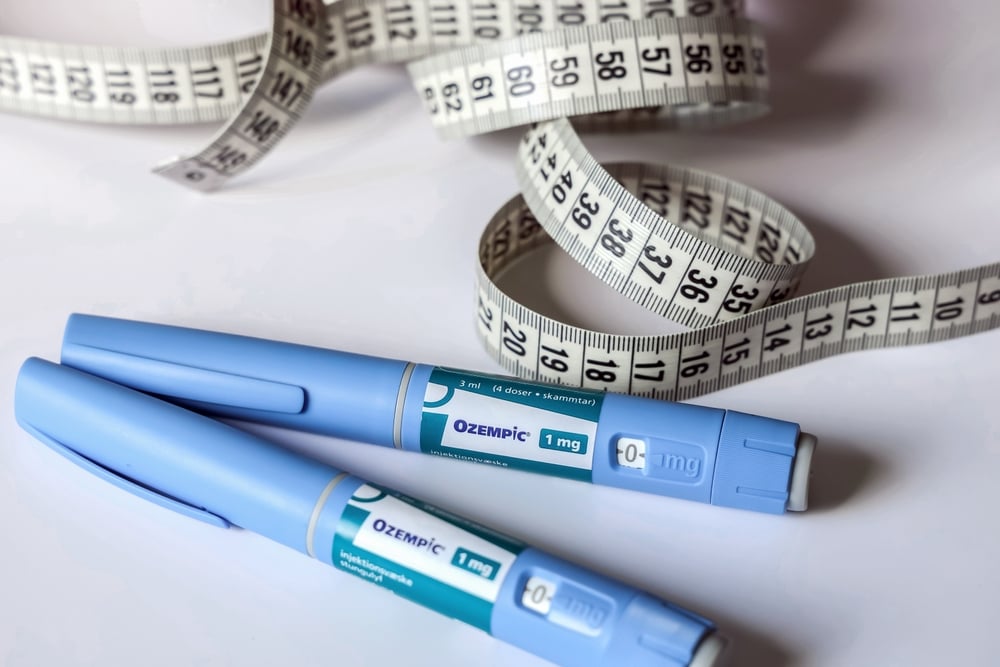
The U.S. Food and Drug Administration is investigating reports of increased suicidal thinking among those using GLP-1 injections for obesity and weight-loss.
According to Bloomberg News, the federal agency began “monitoring international probes into Novo [and] Lilly Obesity Drugs” last month after the UK’s Medicines & Healthcare Products Regulatory Agency received “several reports of suspected adverse drug reactions associated with semaglutide—the active ingredient in Novo’s diabetes and weight-loss drugs Ozempic and Wegovy. The agency, known as MHRA, also received reports linked to liraglutide—the active ingredient in Saxenda.”
The European Medicines Agency is also “investigating suicide-related risks after receiving reports from the Icelandic Medicines Agency related to Saxenda and Ozempic.”
The new generation of drugs—only one of which, Wegovy, cleared approval in 2021 for the treatment of obesity—is meant to mimic the hormone GLP-1 (short for “glucagon-like peptide 1”) by activating GLP-1 receptors in the body and brain. In reducing the amount of glucagon released by the pancreas, the drugs help lower blood sugar levels that ordinarily rise when food is digested, slowing—sometimes drastically—the passage of food through the stomach.
The ability of GLP-1s to lower blood sugar is a key reason drugs such as Rybelsus (semaglutide) received FDA approval in 2019 for diabetes treatment. According to Fiona Rutherford at Bloomberg, clinical trial data in the US do “not support warnings for suicidal thoughts or behavior for the GLP-1s approved for diabetes indications.” “In the US,” she adds, “the labels for Wegovy and Saxenda already include warnings for suicidal behavior and thoughts, and recommend that patients using these drugs are monitored for worsening symptoms.”
In publicity and posts across Instagram, influencers have hyped the drugs as “miracle” solutions to foods cravings, reducing them to levels where they are easier to ignore. When acknowledged, the drugs’ adverse effects and reactions are generally presented as mild and tolerable, though they include a substantially higher risk of nausea, diarrhea, and vomiting, with caveats as well about rare but nonetheless greater risk of pancreatitis and thyroid cancer.
Underlining the mixed messages accompanying publicity about the drugs, Bloomberg itself ran a cover story in its magazine less than a week before news broke about their potential ties to increased suicidality, describing “wonder drugs Wegovy and Ozempic” as “WeightWatchers’ Last Shot.”
After six decades of promoting behavioral change to food, including by encouraging clients to weigh portions and to count calories, WeightWatchers, writes article authors Emma Court and Ellen Huet, earlier this year paid “$132 million to acquire Sequence, a two-year-old telemedicine startup that prescribes a new, much-hyped set of medications called GLP-1s that can basically melt the pounds away. The drugs, which go by Wegovy, Ozempic, and other brand names, have comes to be regarded in the past year as a magic weight-loss solution.”
When told, inaccurately, that “these drugs could eradicate obesity in her lifetime,” WeightWatchers’ new CEO, Sima Sistani, is quoted as responding: “I was just like, ‘Wow, that is a big statement…. We need to catalyze this.”
“Other medications had things that were more nervous-system-related, or agitation or increased heart rate,” the company’s Chief Scientific Advisor, Gary Foster, is quoted as adding. With GLP-1s, he asserts, “you’re not seeing any of that.”
Apparently, Foster spoke too soon. Regarding the scientific advisory board that he oversees at WeightWatchers, Court and Huet report that it is “made up of outside academics and physicians… some [of whom] have taken tens of thousands of dollars from either Novo Nordisk A/S or Eli Lilly & Co., both makers of GLP-1s.” (The company writes in response that it “looks for the best scientific experts and hires them based on their expertise, regardless of affiliations.”)
WeightWatchers’ embrace of injectable GLP-1s as its principal mechanism for supporting weight-loss contrasts sharply with its careful avoidance of similar drug-related controversies in the past. In 1997, as Court and Huet note, rival companies Jenny Craig and Nutrisystem Inc. decided to throw their support behind prescriptions for fen-phen (fenfluramine/phentermine), an amphetamine-based combination that was touted at the time as the best appetite suppressant available. That is, until “fen-phen was linked to heart damage, a discovery that led to recalls and lawsuits.”
In addition to reports in the UK and Europe of heightened suicidal thinking after use and discontinuation of GLP-1s, the FDA is also tracking the drugs’ potential association with gastroparesis, or stomach paralysis, where digestion slows to the point of being harmful.
“They took blockbuster drugs for weight loss and diabetes,” Brenda Goodman reported recently for CNN, of several patients diagnosed with severe gastroparesis and cyclic vomiting syndrome after years’ long use of GLP-1s. “Now their stomachs are paralyzed.”
“I wish I never touched it. I wish I’d never heard of it in my life,” Joanie Knight, 37, of Angie, Louisiana, is quoted in the article as saying. “This medicine made my life hell. So much hell. It has cost me money. It cost me a lot of stress; it cost me days and nights and trips with my family. It’s cost me a lot, and it’s not worth it. The price is too high.”
Goodman also references Emily Wright, 38, a teacher in Toronto, who started taking Ozempic in 2018 and lost 80 pounds in one year, but who “now vomits so frequently that she had to take a leave of absence from her job.”
In addition to severe gastroparesis, which both patients’ doctors tie to their GLP-1 medication, Wright has been “diagnosed with cyclic vomiting syndrome, which causes her to throw up multiple times a day.”
People Magazine and Axios have further contributed to recent reporting on GLP-1s and gastroparesis. In “Ozempic and Wegovy May Cause Stomach Paralysis in Some Patients,” People quotes a warning from the American Society of Anesthesiologists that slower digestion from longtime use of these drugs puts patients at risk of “regurgitation and pulmonary aspiration.” “A big problem,” Dr. Michael Champeau, ASA president and adjunct clinical professor at Stanford University, is quoted as telling Health, “is that because these drugs are still relatively new, “they haven’t done studies on how long it actually takes for the stomach to be empty after taking a GLP-1 agonist, so there are a lot of areas where we might be able to give more precise guidance if we have more science.”
In addition, Axios flags “the potential downsides of new blockbuster obesity drugs,” including depleted muscle mass and that clinical trials involving GLP-1s did not include significant numbers of people 60 and older.
Likely hoping to derail the negative press, Novo Nordisk recently announced the results of its multiyear, randomized and placebo-controlled trial that aims “to demonstrate superiority of semaglutide 2.4 mg (Wegovy) compared to placebo” with respect to cardiovascular events such as non-fatal myocardial infarction and strokes. In a press release, the company claims its drug lowers the risk of “major adverse cardiovascular events by 20% in adults” who are overweight, though it does not report adverse events from the trial, including how many dropped out from side effects or experienced increased suicide ideation.
When the fen-phen controversy blew up in 1997, a WeightWatchers spokeswoman told the Los Angeles Times, “We’re not a medical organization, and never pretended to be. Medical decisions about prescription drugs should be left to people and their personal physicians.”
The article was called “Scales Tip Toward Drug-Free Weight Loss,” and quoted John LaRosa, a diet industry tracker, as saying of the company’s then refusal to support diet and obesity medication, “This could be very positive for someone like [them]… They can honestly say: ‘We’ve taken the safe route all along. We were looking out for your health.’”
In since going all-in on GLP-1 agonists, WeightWatchers now has no choice but to address the negative publicity tied to the drugs’ adverse effects. Those hoping merely for reduced weight via GLP-1s may have to contend instead with a rise in suicidal thinking, as well as severe gastroparesis and cyclic vomiting syndrome that could derail their lives completely.
As in the 1990s, the “miracle cure” of weight-loss medication turns out to be anything but.
Trust this device for 30 days