
“The relevant question in psychiatry shouldn’t be what’s wrong with you, but what happened to you.” — Jacqui Dillon
For over twenty years, I lived in what I now call mental hellness, which isn’t a disorder in the DSM, although I suspect it would fit better than a few things that are.
Like many stories that pass through mental hellness, mine didn’t start with psychiatry. It started with life’s stresses, the kind that build slowly and then quietly take up too much space.
Life was happening, and not in a gentle way. Work, kids, and responsibilities carried the ordinary pressures of adulthood, and I saw what I was experiencing as part of that, not as illness. I didn’t think anything was terribly wrong. I thought I was keeping things moving under stress, as people do, until my body, apparently less committed to denial than I was, made itself known.
I started having heart symptoms serious enough for my family doctor to send me to a cardiologist. Naturally, I assumed there was a physical explanation to be found. Something concrete and nameable. Something that, once identified, would be fixed.
The cardiologist ran the usual tests, listened, observed, and then told me it was supraventricular tachycardia, episodes of a racing heart that can feel terrifying when they hit. I was prescribed a beta blocker to slow things down, and at the time it seemed simple enough: heart problem, heart pill, problem solved.
But the conversation didn’t stay with my heart. She also suggested that what I was experiencing might not be cardiac at all, but psychological. More specifically, she suggested I might be depressed and recommended that I go back to my family doctor to explore that.
It felt like a reasonable next step, though I remember doubting the depression framing. I thought I was stressed, not depressed, but said I would consider seeing my family doctor. What I didn’t grasp then was how much could enter through a step that seemed so ordinary.
Only much later did I circle back to a different question. Beta blockers come with their own effects, including fatigue, emotional flattening, and symptoms that can begin looking suspiciously like what later gets called depression, which left me wondering what exactly was unfolding in my body before psychiatry ever laid a hand on the story.
When I returned to my family doctor, I expected we would spend more time talking about what the cardiologist had found and what supraventricular tachycardia might mean for me. I was curious what had passed between them, doctor to doctor, and whether it pointed to something still worth understanding about the heart symptoms themselves. I thought that was where the conversation would go.
Instead, the conversation moved almost immediately to depression, and the tone shifted. There wasn’t much curiosity about what was happening in my life, and not many questions about context, stress, or environment, despite the fact that this was how I understood what I was dealing with.
I was told that what I was experiencing was depression, and that depression was caused by a ‘chemical imbalance’ in the brain. It was explained in a way meant to be reassuring, simple, easy to accept. Like insulin for diabetes. Like something measurable and manageable. The message was clear: This was a biological issue, not something tied to what was happening in my life, and the solution was psychiatric drugs.
There was comfort in that explanation at the time. What I didn’t understand then was how quickly that framing would narrow everything that came after. Once the word depression entered the room, it began organizing the story.
What followed was over twenty years inside a system that labeled, medicated, and escalated without stepping back to ask what had led me there in the first place. I was heavily drugged, subjected to electroshock, hospitalized repeatedly, and moved through a system that called itself care, even when it often didn’t feel like care.
Much of that time now exists in my memory as fragments. There are stretches I cannot reliably access, events I remember only in pieces, and periods so blurred they almost feel borrowed from someone else’s life.
Nine years ago, I started tapering off psychiatric drugs with the help of my wife, who is a naturopath, and the psychiatrist I was seeing at the time. Seven years ago, I took my last pill and ended my relationship with psychiatry, despite being told I would likely need both for life.
What followed wasn’t the deterioration I had been warned about. It was something else entirely, though not easy or linear. Tapering was brutal at times, physically and mentally demanding in ways I had not been prepared for, and recovery came slowly, through a hard-won return of memory, clarity, and selfhood.
That matters, because recovery can be awkward evidence when the prognosis was lifelong illness.
But recovery did not answer everything. If anything, as memory returned in fragments, it sharpened certain questions. At some point, the question stopped being how I felt and became much more direct:
What had actually happened to me?
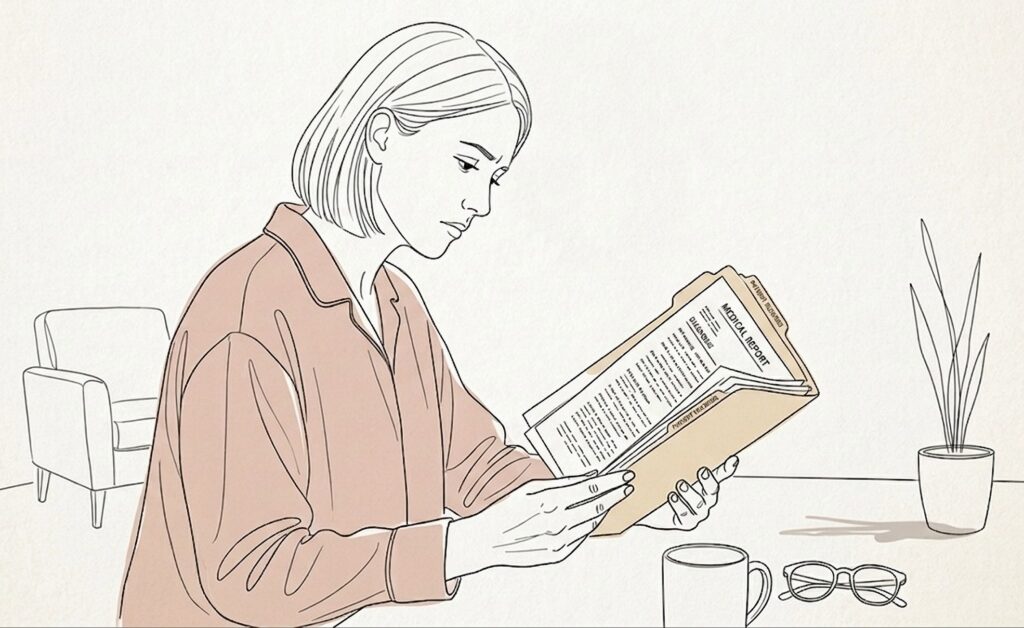
That is what led me to my medical records.
I had thought about requesting them for years, then avoided it for just as long. Then the pandemic arrived, and with it, time enough to stop postponing. I made the calls, filled out the forms, and set the process in motion.
While waiting for the records, I journaled about what I expected to find and what I feared I might uncover. Reading those entries now, what strikes me most is that I still believed the framework I had been handed. I referred without hesitation to “my mental illness.” I described electroshock as treatment. I was writing as someone still inside the story.
What eventually arrived was over two thousand pages of my life written by other people. A version of me translated into clinical language, filtered through diagnoses, observations, and decisions. And it was through those records that the scale of it finally came into focus.
Five psychiatric labels.
Twenty-one psychiatric drugs.
Thirty-nine rounds of electroshock “therapy.”
And, to my shock, documentation showing eight suicide attempts.
I knew there had been attempts, but I had no idea there had been that many until I saw it in my records. I now see those attempts as responses to profound injury, including what heavy drugging and electroshock were doing to me. Seeing it laid out on paper felt like discovering an inventory of damage. It was an astonishing amount of intervention for someone who kept getting worse.
Things began to shift as I started reading more, not only my records but the broader history and claims of psychiatry. What I found didn’t align as neatly as I had expected, especially when I realized there were no tests confirming what I had been diagnosed with. No scan, no marker. Nothing concrete behind the certainty.
Going through those pages, it was hard to separate what I had lived from what they had written about me. The words on the pages were written in such confident language, and the conclusions were clear, but the outcomes didn’t always match.
As I look back at all that happened to me, I’ve come to see my story not simply as personal history, but as a reason to question how the system can turn normal human emotion into disorders of the brain.
How often are people labeled and drugged when what they may be carrying is trauma, stress, grief, or simply the strain of being human? That might be one of psychiatry’s cruelest tricks: convincing people that their humanity was the malfunction.
***
Mad in America hosts blogs by a diverse group of writers. These posts are designed to serve as a public forum for a discussion—broadly speaking—of psychiatry and its treatments. The opinions expressed are the writers’ own.
–
This post was originally published on Mad In America.
Trust this device for 30 days