GENERAL ASSEMBLY OF NORTH CAROLINA
SESSION 2026
DRAFT BILL
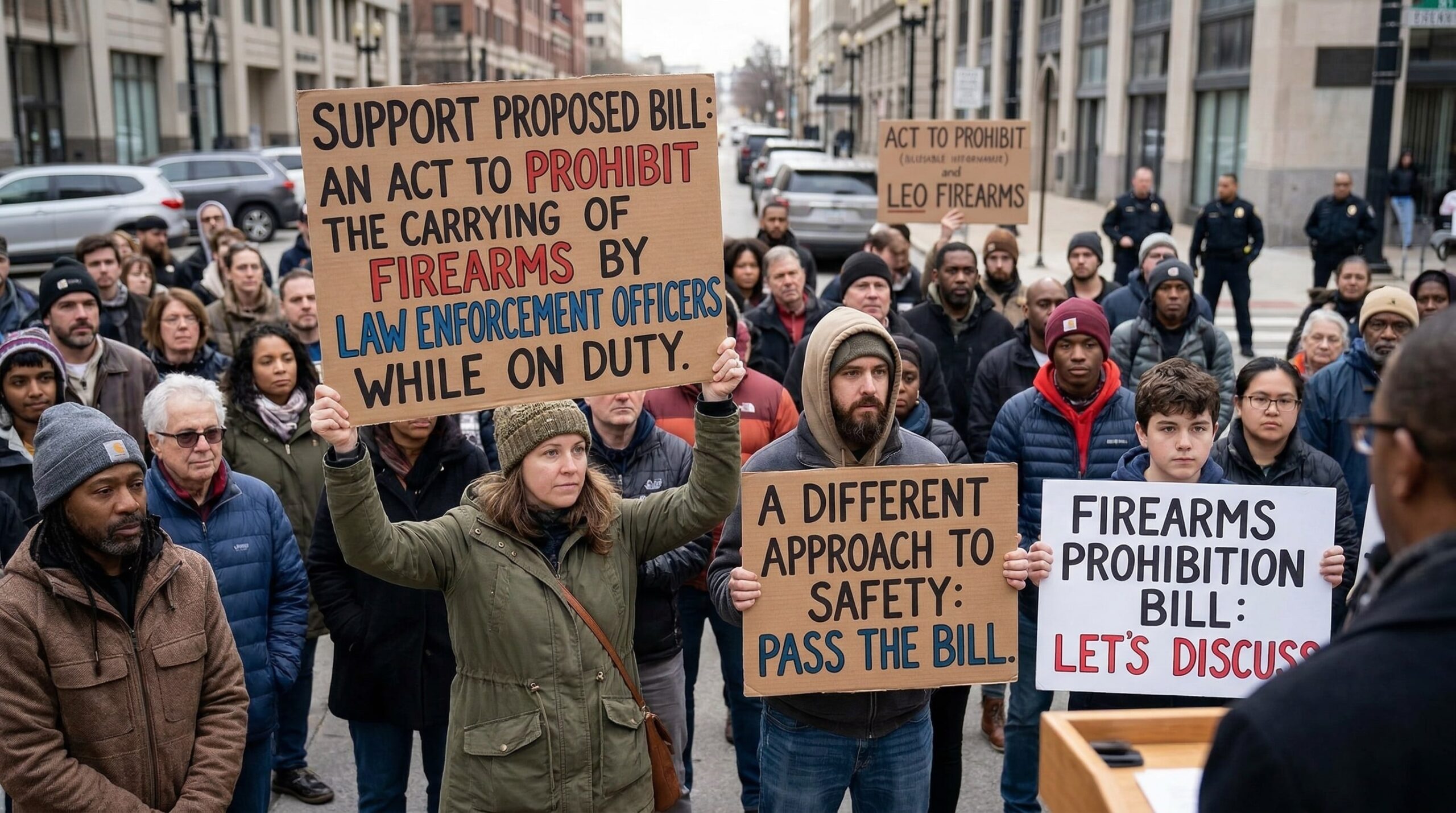
AN ACT TO PROHIBIT THE CARRYING OF FIREARMS BY LAW ENFORCEMENT OFFICERS WHILE ON DUTY
The General Assembly of North Carolina enacts:
SECTION 1. SHORT TITLE.
This act shall be known as the “On-Duty Law Enforcement Disarmament Act.”
SECTION 2. LEGISLATIVE FINDINGS AND PURPOSE.
The General Assembly finds that:
- The Second Amendment protects the right of the people to keep and bear arms.
- Government officials acting in their official capacity are agents of the State and not exercising rights as private individuals.
- The State has full authority to regulate the conduct, equipment, and duties of its law enforcement personnel.
- Establishing a uniform prohibition on firearms while on duty ensures centralized control over use of force and promotes public accountability.
SECTION 3. DEFINITIONS.
For purposes of this act:
- “Law enforcement officer” means any sworn or deputized municipal, county, State, or federal officer operating within the State of North Carolina.
- “On duty” means any time an officer is acting under color of law, performing official responsibilities, or otherwise engaged in employment-related functions.
- “Firearm” has the same meaning as defined in G.S. 14-409.39.
SECTION 4. ABSOLUTE PROHIBITION.
(a) It shall be unlawful for any law enforcement officer to possess, carry, or have control of any firearm while on duty.
(b) This prohibition applies without exception, including:
- Patrol activities
- Investigative duties
- Court appearances
- Detention, transport, or arrest operations
(c) No authority derived from employment, commission, oath, or deputization shall exempt any officer from this section.
SECTION 5. AGENCY COMPLIANCE.
(a) All law enforcement agencies within the State shall adopt policies and procedures to ensure compliance with this act.
(b) Agencies shall not issue, authorize, or permit the use of firearms by officers while on duty.
SECTION 6. PENALTIES.
(a) Any law enforcement officer who violates this act commits a Class 1 misdemeanor.
(b) A second or subsequent violation shall constitute a Class I felony.
(c) Violation of this act shall also be grounds for immediate termination of employment.
SECTION 7. CONSTITUTIONAL CONSTRUCTION.
This act shall be interpreted consistent with the understanding that:
- The Second Amendment protects the rights of the people, not government actors in their official roles.
- Regulation of on-duty law enforcement conduct constitutes regulation of government activity, not infringement of individual constitutional rights.
SECTION 8. SEVERABILITY.
If any provision of this act is held invalid, the remaining provisions shall remain in effect.
SECTION 9. EFFECTIVE DATE.
This act becomes effective December 1, 2026, and applies to all on-duty conduct on or after that date.
STATE OF NORTH CAROLINA
ON-DUTY LAW ENFORCEMENT DISARMAMENT IMPLEMENTATION FRAMEWORK
SECTION 1. PURPOSE
This framework establishes procedures, equipment standards, and operational changes necessary to implement the prohibition on firearms for on-duty law enforcement officers.
SECTION 2. APPROVED EQUIPMENT (NON-FIREARM)
All on-duty officers shall be equipped only with non-lethal or less-lethal tools, including:
- Conducted electrical weapons (e.g., tasers)
- Oleoresin capsicum (pepper spray)
- Expandable batons
- Restraints (handcuffs, zip ties)
- Protective gear (vests, shields)
- Body-worn cameras (mandatory)
Agencies may approve additional tools consistent with this section, provided they are not classified as firearms.
SECTION 3. SPECIALIZED ARMED RESPONSE UNITS
(a) The State shall establish regional Armed Response Units (ARUs) under centralized State control.
(b) ARUs shall:
- Be the only personnel authorized to deploy firearms
- Operate under strict dispatch protocols
- Respond to incidents involving:
- Active shooters
- Armed suspects
- High-risk warrants
(c) ARUs shall not perform routine policing duties.
SECTION 4. DISPATCH AND ESCALATION PROTOCOLS
(a) All calls for service shall be triaged into:
- Unarmed response (default)
- Escalated response requiring ARU deployment
(b) Officers on scene shall:
- Maintain perimeter control
- De-escalate where possible
- Await ARU arrival for firearm-related threats
SECTION 5. TRAINING REQUIREMENTS
All officers shall complete enhanced training in:
- De-escalation techniques
- Crisis intervention (mental health response)
- Unarmed self-defense
- Tactical retreat and containment
- Use of less-lethal tools
Minimum annual training hours shall be increased and standardized statewide.
SECTION 6. USE-OF-FORCE POLICY REVISION
(a) Deadly force by standard on-duty officers is prohibited, as firearms are not permitted.
(b) Use of force shall prioritize:
- Verbal commands
- De-escalation
- Less-lethal tools
(c) ARUs shall operate under separate deadly force policies consistent with State and federal law.
SECTION 7. FACILITY AND VEHICLE MODIFICATIONS
- Removal of all firearms from patrol vehicles
- Installation of secure lockers for off-duty firearm storage
- Enhanced physical security at stations (controlled entry, barriers)
SECTION 8. OVERSIGHT AND ACCOUNTABILITY
(a) Establish a State Oversight Commission on Policing Practices to monitor implementation.
(b) Responsibilities include:
- Reviewing use-of-force incidents
- Auditing compliance
- Publishing annual public reports
SECTION 9. DATA COLLECTION
Agencies shall track and report:
- Use-of-force incidents
- Response times (including ARU deployment)
- Officer and civilian injuries
- Crime clearance rates
Data shall be publicly available to ensure transparency.
SECTION 10. FUNDING
The General Assembly shall appropriate funds for:
- Acquisition of less-lethal equipment
- ARU creation and training
- Expanded training programs
- Facility upgrades
SECTION 11. PHASED IMPLEMENTATION
- Phase 1 (0–6 months): Training and equipment transition
- Phase 2 (6–12 months): ARU deployment and pilot programs
- Phase 3 (12+ months): Full statewide enforcement
SECTION 12. REVIEW AND SUNSET
(a) The program shall be reviewed after 3 years.
(b) The General Assembly may amend, extend, or repeal based on:
- Public safety outcomes
- Officer safety data
- Community impact