Faith in oneself, tempered by adversity, creates an anti-fragile personality.
I am living proof of that concept.
I grew up in Monona, Wisconsin, in an enriched environment of beautiful parks and swimming pools, community theater projects, and gifted and talented programs run by the University of Wisconsin-Madison. In addition to parks and pools, my childhood was defined by my vegan Mormon family. They were weirdly outside the mainstream, part of overlapping countercultural communities.
My mother taught that the Standard American Diet is deadly. White sugar, white flour, meat, and dairy were not allowed in our home. Dad practiced acupressure. Eventually, my mom relaxed the dietary restrictions when she discovered Sunrider, a network marketing company that sold Chinese regenerative whole food formulas. With Sunrider, our family went from “rags to riches” in a few short years.
I’m Moira (that’s “More-Ah,” with a silent i) Cue. At 49, with a solo museum show that almost happened at the incredible age of 17, a record deal that almost happened at the age of 29, and film deals that have been almost happening since my thirties, I could call myself an “almost-has-been.”
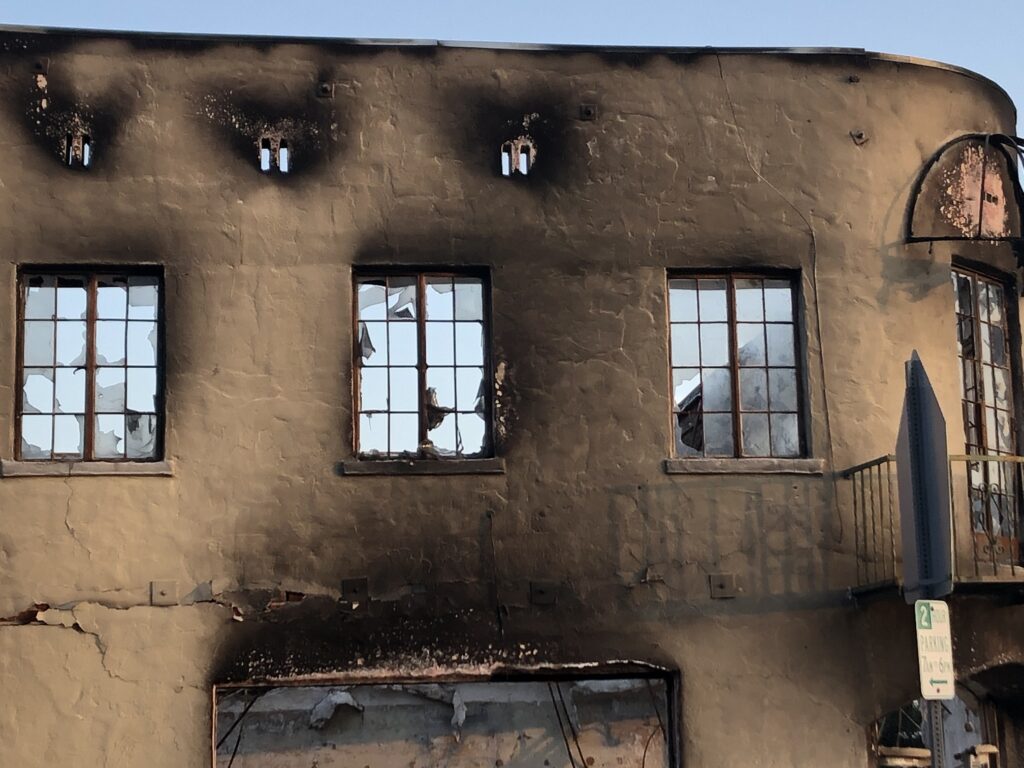
Or I could share my sob story. I’m writing from the sofa of an Airbnb, where I’ve spent the past five weeks displaced. Prior to that it was four weeks in a hotel. Prior to that it was five weeks back in Madison, Wisconsin, sheltering from the Eaton fire that left my beloved Beautiful Altadena looking like the Gaza Strip after Israeli airstrikes.
Prior to that, in the summer and fall of 2024, I spent three months in the throes of nausea, followed by hallucinatory drug withdrawal symptoms, dehydration, and a Near Death Experience after an adverse reaction to an anti-nausea medication (promethazine) for food poisoning in the ER during a meditation retreat.
Prior to that, pandemic unemployment.
Prior to that, from 2019 to 2020, a year on disability leave under the care of a neurologist and pain management doctor.
Prior to that, in 2014, a hospitalization after rare, adverse symptoms from drugs prescribed for insomnia, a withdrawal effect from going off marijuana cold turkey. These symptoms were treated as evidence of mental instability rather than known side effects of lorazepam, and resolved upon cessation of medication.
Prior to that, in 2005, I dropped out of the MFA program at the School of the Art Institute of Chicago due to sexual harassment.
Prior to that, in 2004, I narrowly avoided paralysis from the waist down in an automobile accident where I fractured my pelvis, hip, and L4 and L5 vertebrae.
On Good Friday of 2002, the suicide of a lover.
In 2001, assault by a gang, one month after leaving the same alcoholic boyfriend the night he strangled me to unconsciousness and one week after 9/11.
From 2001 to 2003, life in a series of homeless, then domestic violence, then transitional shelters, a brief period of shared and then lost housing, and a period of living illegally within various overnight workstations while obtaining my BFA from the School of the Art Institute of Chicago.
In 2000, the destruction of my marriage as a direct result of my experimentation with polyamory.
In 1999, a hospitalization caused by cold turkey withdrawal from an antidepressant I could not afford out-of-pocket when I ran out of insurance. I’d been placed on the antidepressant after reading alarming allegations about Transcendental Meditation online and stopping my practice while already overwhelmed. I told the psychiatrist I couldn’t stand the sound of El trains and that the weight of the world’s history—its oppression, its genocide—was unbearable. She put me on Paxil.
I fell for it. The psychiatrist, unlike me, seemed so sure of herself. My faith in herbs and meditation, which I knew worked for me, was shakable. If my meditation community and family were right about herbs and meditation, why were we the minority—freaks and outsiders? All the cool famous artists were mentally ill and/or drug addicts.
Prior to my first drug-withdrawal-induced psychosis, in 1992, I was kicked out of the family home, shortly after my 17th birthday. As members of the Church of Jesus Christ of Latter-Day Saints, my parents disapproved of me engaging in premarital sex with the 21-year-old man I would later marry (at 21) and eventually divorce (at 27, years after our separation).
“Kicked out,” at least, was my subjective experience—what my mother remembers is a daughter who was publicly well-behaved but privately challenged everything she held sacred and whose rage terrified her.
As an adult, my mother has self-diagnosed as autistic, and I am in the process of seeking a formal diagnosis. The spark of genius runs through both sides of my family. My father scored 138 on military IQ tests after deliberately failing the clerical section to avoid a desk job. My mother was published in the Atlantic Monthly at the age of 21. While my mother and father had the good sense to avoid doctors after their own singularly bad experiences in young adulthood, I couldn’t trust my parents enough to process the cognitive dissonance between what my family practiced and society pushed.
Consciously or unconsciously, I chose to test assumptions. Perhaps being sick and “special” was preferable to the weight of exceptionalism and the obligation, if the disease model was as faulty as my parents said it was, to go against the grain.
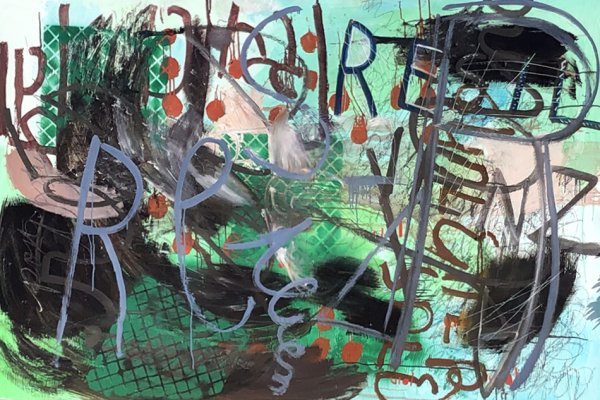
Prior to my exodus from the LDS church (a part of my identity I have since made peace with and integrated, on my own terms), in 1990, at the age of 15, I underwent therapy with a woman who had been influenced by Bennett Braun. Braun, prior to his death in 2024, had his license revoked for the iatrogenic creation of multiple personalities among his patient population.
During therapy, my therapist pathologized my status as a child prodigy and my drive to paint. I was assumed to be bipolar because I “made so many paintings,” “only cared about painting” and “screamed at” my mother. Treatment with lithium lasted two weeks. It made my skin burn; I slept 12 hours a night and still screamed at my mother.
Therapy with “C” lasted ten years, from 1990 to 2000. In the absence of my own mother and father, which she encouraged, I grew dependent on her. It’s still unclear to me what, if any, memories “uncovered” during treatment were based on events that occurred outside of my imagination. However, those events, so far as my nervous system is concerned, were real.
To be completely honest, there was an admitted child molester in our family—Uncle ‘Bob.’ I met him once, around 1978, and then refused to speak for three days afterward. When I finally did talk, I told my dad I didn’t like him telling stories to another little girl—my cousin, who often says she wishes my dad had been her father instead.
Prior to therapy, in 1988, at age 13, I developed a life-threatening eating disorder—a condition I believed necessary to look the part of a Hollywood actress, a dream fueled by thousands of hours of rehearsal and performance.
My parents stuck me in therapy because of that eating disorder.
They did not expect we would be estranged for many years, or that the estrangement would lead to real abuse scenarios. They just wanted to save my life.
In 1986, at 11, I’d read about bulimia and decided that if I ever weighed “too much,” I would try it. In my hyper-focused mind, vomiting’s perceived risks outweighed its inadvertently advertised benefits.
The moment I decided to sacrifice my health for my ambition is an “inciting incident,” in screenwriting terms. But there’s an earlier timestamp where the “fire in the crucible” began.
I was somewhere around three years old. Sitting on the toilet. I’d learned about scale, that a block was bigger than a house, a city was bigger than a block, a state was bigger than a city and so on up to the solar system. I was plagued by pinworms. As I thoughtlessly crushed one between my fingers, it dawned on me that as I was to the pinworm, God was to me. In other words, God was a lie.
I decided to leave a mark on the world. It was a reaction to an inverted cosmos, wherein man was nothing more than a parasite upon the earth. People lied to themselves, and, therefore, children.
My decision to leave a mark on the world was reactive rather than proactive. Based in fear of my own insignificant nonexistence, rather than love of humanity. I was doomed to fail.
Until I learned.
By having my ass kicked. Over. And over. And over again.
Through poverty—the days I drank half cream-and-sugar coffee just to get some calories. I went on first dates for the meal. Years later, after ten years in corporate America ended when I informed my employer I’d been ordered back to pain management in 2019, I found myself financially constrained, once again.
Through rejection—the William Morris Endeavor agents who said, “She’s obviously very talented but we don’t know what we’d do with her,” the grants and fellowships that went to other artists, the record label that kept passing my demo on to another person until finally the final decision maker said thanks but no thanks, the audition where I was asked to wear a bikini and push a vacuum cleaner in high heels, the people I thought were my friends who were not.
Through adversity—Covid, six times. The physical pain of a 3000-pound-plus Chevy Impala going 35 mph slamming into my body and tossing me 15 feet into the intersection.
Through deception—hospitalizations that would not have happened with competent, rather than negligent or over-confident care. People who presented themselves as experts whose care caused only harm.
Through these trials I learned: Our Universe is a place of infinite beauty and abundance wherein an omnipotent, omniscient power of goodness is the strongest force.
I can look back on each of these pain points and see a message from Source. In contrast to the absolute horror of these experiences.
August 2001, when I lived at a homeless shelter on the impoverished Near West Side of Chicago, the only income I had was $25 that had been given to me by my first husband’s girlfriend, who was living in what had been my home, even wearing clothes I’d left behind when I’d run off to first San Francisco and then Chicago with my alcoholic boyfriend who would be dead within a year.
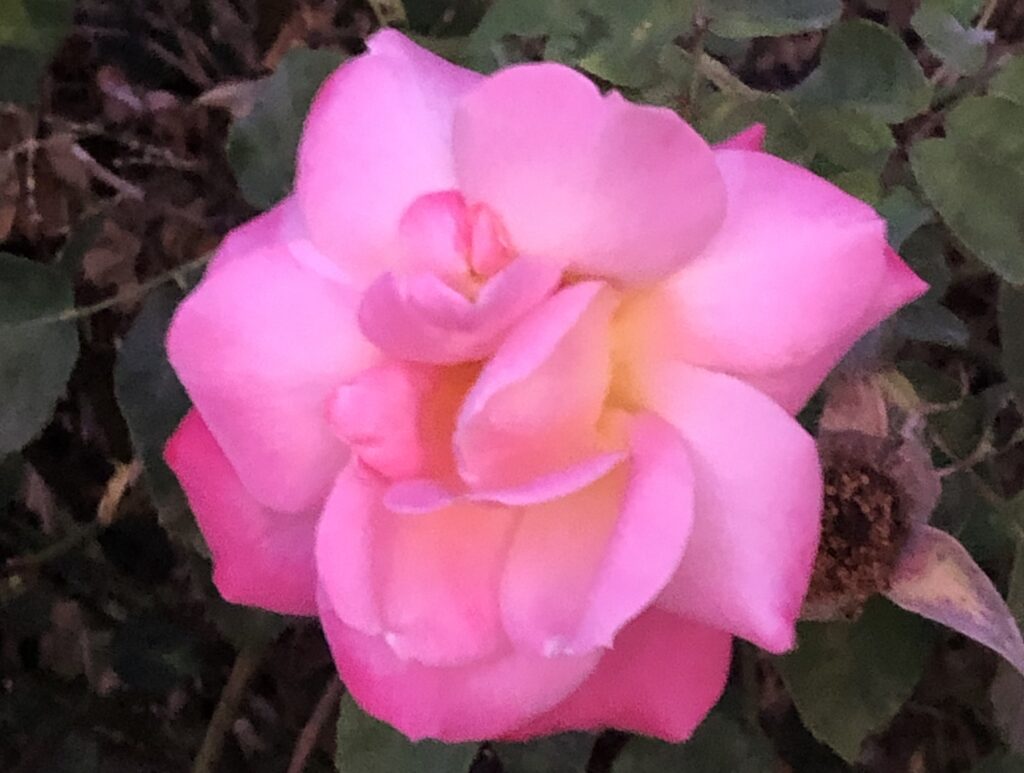
After spending the $25 on art supplies, I had no lunch money. One day during lunch hour, I went walking through Grant Park’s rose garden, smelling the various varieties of roses. I remember the gardener who cut a long-stemmed deep red blossom and handed it to me. I was so hungry that I went to the commissary, got a cup of hot water, and brewed rose petal tea. Looking at that rose, I remember being overwhelmed with its beauty and the poignancy of the moment. Beauty is always there, even in the deepest sorrow.
We all have a reticular activating system, the part of the brain that finds more of whatever we focus on. We all have cognitive frames. The dominant medical model says that certain “defective” bodies are born with deficiencies of chemicals only Big Pharma can ameliorate. The ever-increasing cost of an ever-growing percentage of Americans on one or more daily medications is seen through a moral lens of patient entitlement, conceding to corporations who demand profit margins that consume an ever-increasing portion of the GDP.
This is the Big Lie.
That I am my history. My trauma. That with a trauma history like mine, I can never be okay. That to pass as an employable member of society, I should carry the weight of not speaking my lived experience.
That to tell the truth is to erase my credibility.
But holding it in hurts more than what I might lose by letting it out.
When I sacrificed my sovereignty—giving the power to heal, as well as the power to harm, to someone or something other than myself—I got hurt. Our “care” industry creates perpetual patients to ensure perpetual profits. The world too often sees a holistic worldview and altruistic creative genius in neurodivergent women as a threat.
Now that I understand the depravity of the care system, my truth may cause others discomfort, even anger. It may not stop them from othering me. But I can’t look to society for external validation. Instead of placing my faith in those who cannot accept me as I am, I’ve finally found, in midlife, through a decade-plus of regular meditation, my own kind of faith in God. And by God, I also mean Providence, god, goodness, Nature, a power greater than myself, the Absolute, my inner goddess, the intelligent field of life itself—however you comprehend that sacred, high-functioning, knowing within all of us.
I believe Nature designed me well. My discomfort is a healthy response to a world in crisis—a world that urgently needs my voice, my belief in the possibility of beauty and abundance.
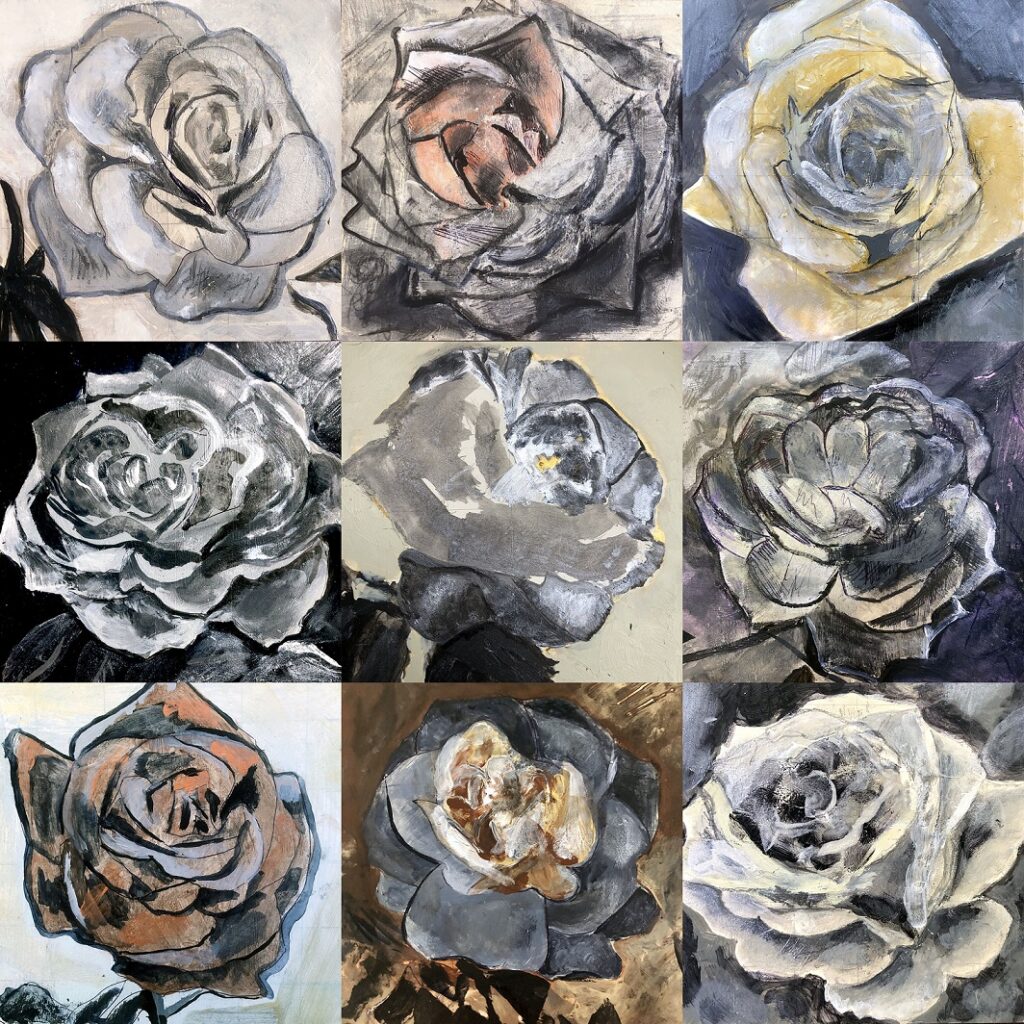
Writing this article’s first draft in April of 2025, in the rubble of Altadena, I marveled at homes whose rose bushes miraculously survived. I took photos of roses, both before and after the fires, and began a new series of paintings in the fall.
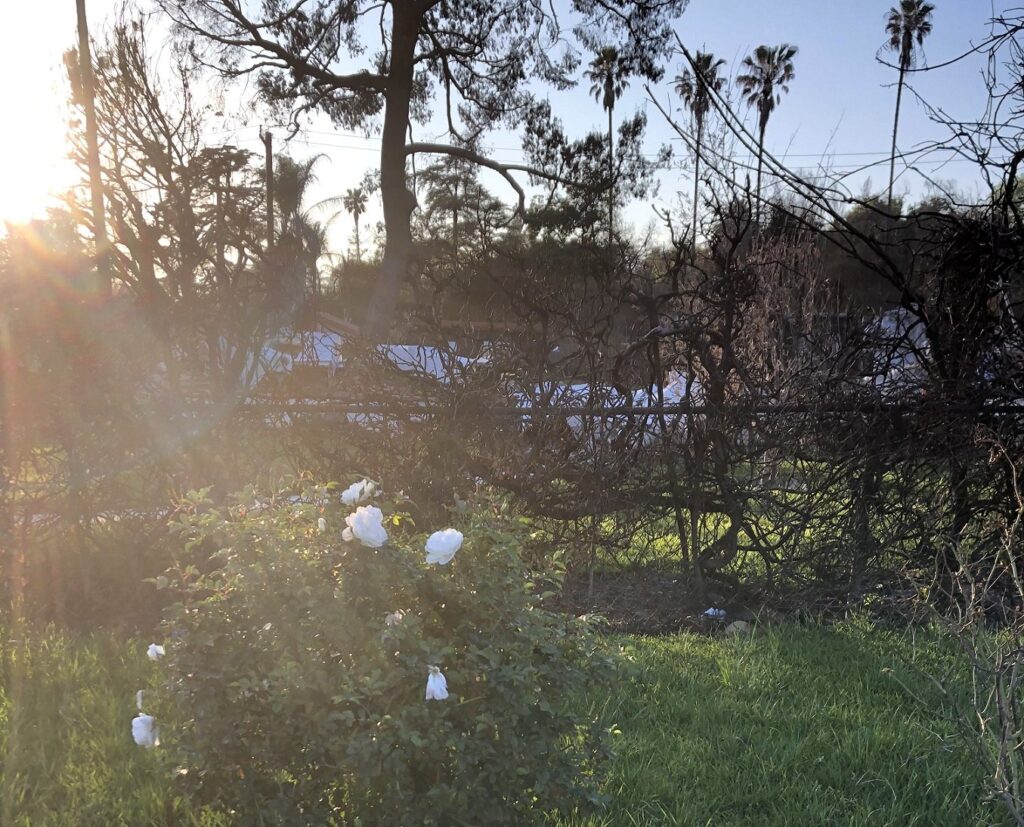
Between the writing of this article and its final preparation for publication, months passed. During that time, I underwent another descent into psychic hell, triggered by layers of systemic failure, catastrophic loss, sensory overwhelm, and daily evidence of predatory exploitation in the aftermath of the Eaton fire.
It started in late April or early May, while crossing a busy street, like walking into a dark, sticky energy field. It came with an inverted thought: Our world is a place of incomprehensible suffering. Two particular memories I’d been coaxed, during Freudian analysis, to label as “false,” came back to life re-energized, as visceral flashbacks.
Like serial pestilence in a Biblical plague, meltdowns, triggered by fluorescent streetlights, followed the flashbacks. Then in mid-August came the last twelve weeks (and counting) of neuropathic pain characterized by a burning sensation across my skin, radiating discomfort along the lumbar nerves at the base of my spine, and intermittent, sudden electrical ‘jolts,’ symptoms that flared after extended post-evacuation travels.
This is what “anti-fragile” looks like. While I know there is great evil in this world, degradation and beauty, grief and hope, still co-exist. Post-traumatic growth, nearing the one-year anniversary of the fires, doesn’t look like Superwoman. It’s simply the strength to endure.
To sit with discomfort.
In April of 2025 I wrote, “The anti-fragile personality embraces and embodies post-traumatic growth. It is not merely resilient, it is stronger than before.” In November, after tossing a houseful of toxic, soot-contaminated belongings, losing most everything we owned, and trying to clean more than 200 soot-coated paintings by hand, these words sound merely aspirational.
Back home in Altadena, I see the scarred landscape where piles of burnt and twisted debris have been cleared—and I try to remember the roses.